Augusta University's MSN Clinical Nurse Leader: from first clinical to the 420-hour immersion
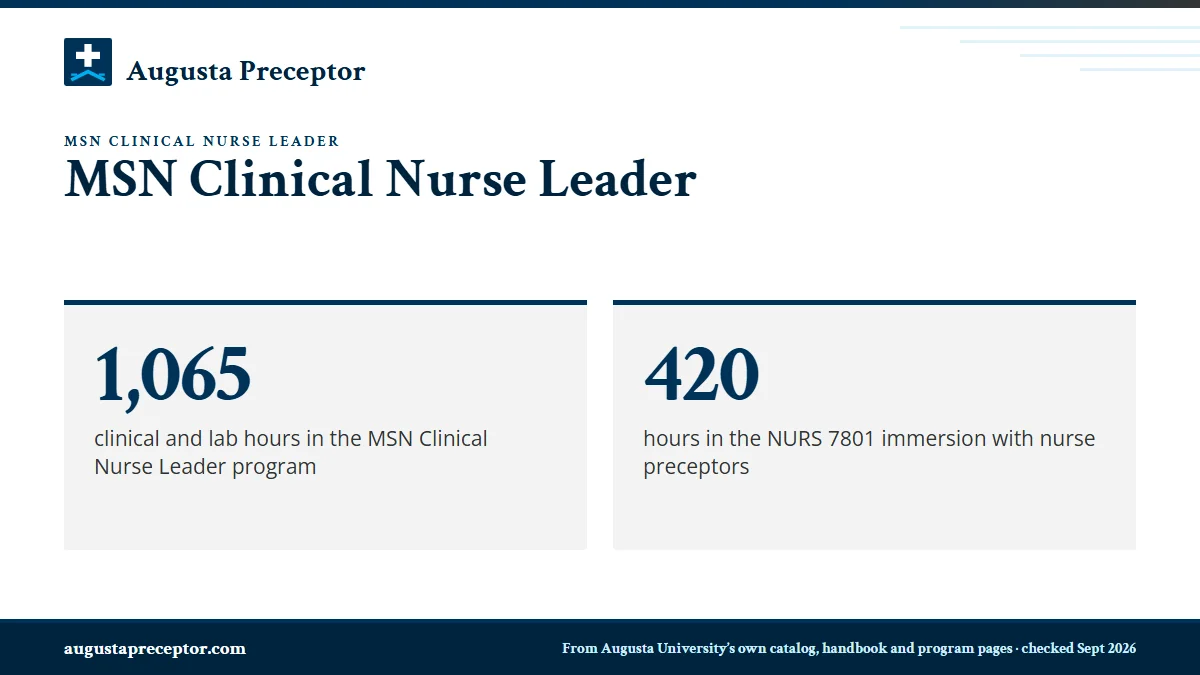
Augusta University's MSN Clinical Nurse Leader program takes people who hold a bachelor's or higher in another field and prepares them to enter nursing in 16 months. It runs on the Augusta and Athens campuses, carries 60 credits and 1,065 clinical and lab hours, and ends with a 420-hour immersion, NURS 7801, in which students work with nurse preceptors. Its clinical experiences are faculty-led.
Questions about CNL clinicals or what comes next
Tell us your campus and semester. Your placement advisor replies with planning help for the immersion and for any later advanced practice study.
Who the CNL is built for
The CNL is Augusta University's only MSN, and it is a prelicensure program. The catalog describes an accelerated course of study that blends classroom and clinical teaching for people whose bachelor's or graduate work was in a field other than nursing. It is not a nurse practitioner track; Augusta University prepares nurse practitioners only through its DNP concentrations.
The program runs 16 months over four semesters and starts in fall, with applications for Fall 2027 opening August 6. It is taught on both the Augusta and Athens campuses. The Georgia Board of Nursing approves the CNL, which matters because the Board regulates prelicensure programs and their clinical teaching, while it does not regulate post-licensure programs such as the DNP.
The catalog notes that the CNL program has partnered with several health care institutions to support its teaching, without naming them. CCNE accredits Augusta University's master's program in nursing, with its current term running through December 31, 2034.
1,065 hours, semester by semester
The CNL schema prints 60 credits and 1,065 clinical and lab hours, with semester totals of 150, 225, 225 and 465. Its footnote gives the credit notation in an order that does not reproduce those totals; read the other way round, the numbers add up, which puts the program at about 840 clinical and 225 lab hours. That split is our reading, not a figure Augusta University prints.
| Semester | Courses with clinical or lab hours | Hours printed for the semester |
|---|---|---|
| First fall | NURS 6700 Nursing Therapeutics and Professional Nursing | 150 |
| Spring | NURS 7001 Clinical Reasoning I; NURS 7300 Mental Health | 225 |
| Summer | NURS 7100 Population Health; NURS 7215 Clinical Reasoning II; NURS 7400 Women, Children and Family Health | 225 |
| Final fall | NURS 7600 Complex Health Alterations Across the Lifespan; NURS 7801 Synthesis of CNL Role in Practice | 465 |
The schema adds that the Integrated Health Care series, meaning the mental health, population health and women, children and family courses, may be offered in different semesters. For NURS 7100, the catalog says community clinical meetings and presentations are in person, with dates and times set by the clinical site or organization. The clinical hours planner compares these totals with every other Augusta University program.
The 420-hour immersion in NURS 7801
NURS 7801, Synthesis of Clinical Nurse Leader Role in Practice, is the program's capstone clinical course: nine credits and 420 clinical hours in the final fall, taken alongside NURS 7600. Entry requires a C or better in NURS 7215 and NURS 7500. The catalog describes concentrated clinical experience in which students are immersed in the clinical setting and collaborate with nurse preceptors.
By our arithmetic, 420 hours across a 15-week fall term comes to 28 hours a week, before classes and the lab time in NURS 7600. The final semester's printed total of 465 hours is more than double any earlier semester, so plan work, family and travel around it well ahead.
For many CNL students this is the first long stretch working beside one nurse, and it is useful practice for the precepted clinical courses that come with any later advanced practice study. Watching how a strong preceptor teaches, gives feedback and hands over responsibility is part of what the immersion offers.
Faculty-led clinicals and how nurse preceptors are chosen
CNL clinicals are faculty-led: the catalog language says the student will be provided with the concentrated clinical experience, and the College's faculty lead it. Augusta University does not publish its own rule for choosing CNL preceptors, but the Georgia Board of Nursing's rule for Board-approved prelicensure programs fills that gap.
Under Georgia rule 410-8-.06, the preceptor is chosen jointly by the designated faculty member and the registered nurse responsible for nursing care in the practice setting. The preceptor must hold a current RN license, plus advanced practice authorization where that applies, and may work with no more than two students at a time. The same rule says the practice setting does not pay the student during the precepted experience.
The Georgia Board of Nursing rules guide explains the rest of that chapter and why it reaches the CNL and the BSN but not the nurse practitioner tracks.
Compliance and costs for CNL students
CNL students follow the College of Nursing's prelicensure compliance cycle, which differs from the DNP cycle in a few places. These are the items that come up most, and clinical sites can add their own requirements on top, at the student's expense under policy CON16. Keep copies of every record, since a site may ask for proof at short notice.
- A criminal background check and drug screen every May, each year of the program (CON12).
- HESI resources, which BSN and CNL students pay for (CON14).
- In-person American Heart Association BLS; courses from other providers are not accepted (CON16).
- The College's clinical immunization form, shared with the graduate clinical programs, including annual influenza vaccine and TB testing.
- Transportation to clinical agencies, and any overnight lodging, at your own cost (CON14).
The compliance requirements guide covers the deadlines, including where two Augusta University sources give different lead times for the immunization form.
After the CNL: certification and advanced practice
The MSN page describes certification in two ways on the same page: once as the CNL exam offered by the American Association of Colleges of Nursing, and once as Clinical Nurse Leader certification through ANCC. Ask the program which body it prepares you for before you register for an exam.
Some CNL graduates later look at advanced practice. Augusta University's DNP nurse practitioner concentrations admit post-baccalaureate and post-master's students, recommend a year of professional nursing experience before clinical courses, require a Georgia or multistate RN license before enrollment, and ask NP students to live in Georgia or South Carolina. The DNP-FNP guide shows how those clinical courses are built.
That is where a preceptor becomes central, and where our placement desk does most of its work: finding a well-matched nurse practitioner preceptor near home who meets Augusta University's rules, whatever role the program plays in placement. When that time comes, the placement request form is the place to start.
Questions Augusta University students ask
Can I work while in Augusta University's CNL program?
The MSN FAQ says students are in class, lab, simulation or clinical four to five days every week, with weekend and evening clinical possible. Policy CON20 also bars work in the eight hours before any clinical. Plan for limited outside work, especially in the final fall, when the schema prints 465 hours.
Is the CNL offered in Athens?
Yes. The MSN page says the CNL is taught on the Augusta and Athens campuses; the Athens regional campus dates to 1974, when MCG opened it. The catalog does not list the clinical sites for either campus. Our Athens and northeast Georgia guide describes the region's health systems.
What grades do CNL clinical courses require?
Clinical grades across the College of Nursing are pass or fail, and one unsatisfactory rating on the final clinical evaluation fails the clinical, whatever the classroom grade. Later CNL courses list prerequisites at C or better, so NURS 7801 needs a C or better in NURS 7215 and NURS 7500.
How does the CNL differ from Augusta University's BSN?
Both are prelicensure, faculty-led, taught in Augusta and Athens and approved by the Georgia Board of Nursing. The BSN is a 2+2 program for students who complete their first two years elsewhere, with 765 lab, simulation and clinical hours. The CNL is a 16-month master's for people who already hold a bachelor's or higher in another field. See the BSN clinicals guide.
Does Augusta University report NCLEX results for the CNL?
The College of Nursing's About page says its prelicensure BSN and MSN programs have excellent NCLEX pass rates and high employability, without giving a number. It also says those two programs together produce nearly 400 graduates a year. Ask the program for recent CNL pass rates if they matter to your decision.
Related pages
Last checked 2026-09-27
We check these pages against Augusta University's own catalog, program plans, DNP handbook and program pages, and Georgia and South Carolina rules. Your course faculty and the College of Nursing have the final word.
Whatever your program arranges, we find the preceptor who fits.
Tell us your Augusta University track, where in Georgia or South Carolina you live and when your next clinical course starts. We find preceptors near you who fit the course and Augusta University's rules, and hand you everything your faculty and the site need, well before the semester.
- Adult, pediatric and older-adult preceptors for
NURS 8312toNURS 8318, acute care forNURS 8332toNURS 8338 - Pediatric primary care for the PNP courses and psychiatric preceptors for
NURS 8342toNURS 8348 - Across Georgia and South Carolina, from the CSRA to Savannah, Atlanta and Columbia
Start your placement plan
Program, city and start date is all we need to begin.