Augusta University's AGACNP post-graduate certificate and its acute care clinicals
Augusta University's post-graduate certificate in adult-gerontology acute care is a 20-credit, part-time program that begins in spring. Its three practice courses carry 540 clinical hours plus 90 lab hours, and an individual gap analysis can push the clinical total as high as 750. The first practice course opens in your first semester, so the acute care setting and the preceptor for it matter from day one.
Plan your AGACNP certificate clinicals
Tell us your start term and where you live in Georgia or South Carolina. Your placement advisor replies with a plan for each practice course.
What the AGACNP certificate involves
The certificate is a one-year, 20-credit program in adult-gerontology acute care, taught mostly online. It starts in spring: the College of Nursing set September 15, 2026 as the application deadline for Spring 2027. Because the specialty courses build on one another, the certificates page says these options are usually taken part time, at fewer than nine credit hours a semester.
CCNE accredits Augusta University's post-graduate APRN certificate program, most recently on March 13, 2024, for a term that runs through December 31, 2034. College of Nursing policy CON01C gives certificate students three consecutive years from first enrollment to finish, and a C in a clinical course brings academic probation and a repeat of that course.
One admissions detail does not line up. The certificates page describes applicants as holding a doctorate, the DNP overview page says a master's or a doctorate, and the catalog calls the program a post-master's certificate. If your highest nursing credential is a master's, confirm your eligibility with the College of Nursing before you apply.
Three practice courses, 540 clinical hours
The curriculum schema puts one practice course in each of three terms in a row, starting with your first spring. The first two mix lab and clinical time; the third is all clinical. Each course opens only after the one before it ends with a satisfactory grade.
| Course | Term | Clinical hours | Lab hours | What unlocks it |
|---|---|---|---|---|
NURS 8333 Adult Gerontology ACNP Practice I | Spring, year 1 | 120 | 45 | Taken with NURS 8331 |
NURS 8370 Acute Care ACNP Practice II | Summer, year 1 | 180 | 45 | NURS 8331 at B or better and NURS 8333 satisfactory; taken with NURS 8334 |
NURS 8371 Acute Care Practice III | Fall, year 2 | 240 | 0 | NURS 8334 at B or better and NURS 8370 satisfactory; taken with NURS 8337 |
| Total | Three terms | 540 | 90 | Catalog: 630 clinical and lab hours |
The schema also lists NURS 7425, NURS 7430, NURS 7470, NURS 7450 and NURS 9193, the certificate's APRN practicum, for anyone who has not completed them before the certificate starts. NURS 9193 is a three-credit terminal practicum done with a preceptor, and its clock hours are not published. The schema carries approval dates from 2016, so check your own plan of study with your advisor.
The AGACNP practice courses guide covers the DNP versions of this sequence, and the clinical hours planner lines up every Augusta University program side by side.
Why 540 hours can become 750
The catalog treats 540 clinical hours as the floor and allows up to 750, based on an individualized gap analysis it ties to the National Taskforce Standards for NP education. The analysis weighs what your earlier NP education covered against what the acute care role requires. The catalog does not say how extra hours are scheduled or which course carries them, so ask the certificates program to explain your result before your first practice course.
By our arithmetic, the space between floor and ceiling is 210 clinical hours, close to a full NURS 8371 term. That affects preceptor planning directly: a preceptor who agreed to a set number of hours may need to be asked for more, or a second site may be needed to finish.
Summer is the other pressure point. NURS 8370 carries 180 clinical hours in the summer term, and Augusta University's Summer 2027 calendar runs full-term sessions of 10 or 11 weeks, while the plans compute hours on 15-week terms. Our arithmetic puts that at roughly 16 to 18 clinical hours a week, against 12 on a 15-week term. The summer terms guide shows how to plan those weeks.
Georgia or South Carolina, and the license you hold
Certificate students fall under Augusta University's residence requirement. The DNP overview page lists the post-graduate certificates with the four NP concentrations and explains why: instructors need to visit the student, the preceptor and the clinical site. The concentration pages repeat the rule without naming certificates, and the Graduate School's certificate page places clinical experiences in Georgia or South Carolina. An archived 2017 version of that page also named Tennessee; current pages do not.
Your RN license must be valid wherever your clinical hours take place, and the certificate admissions page tells students to add a license in any other state where that applies. Both states belong to the Nurse Licensure Compact. Georgia's Board of Nursing adds that preceptors working in Georgia need a Georgia or multistate license, and that clinical instruction in APRN programs must come from a nurse holding Georgia APRN authorization. The Georgia and South Carolina rule guide covers what happens if you move.
The Graduate School's certificate page speaks of clinical experiences at a variety of ambulatory practices, yet this certificate prepares acute care nurse practitioners, and the DNP version of the sequence describes adults with complex, urgent and emergent needs. Ask your course faculty which settings count for each practice course before anyone commits to a site.
Acute care preceptors in the two states
Augusta University does not publish preceptor qualifications for the certificate or a list of approved acute care sites; your course faculty are the source for both. What hospital systems publish about NP students fills in the rest, and much of it is about timing.
Wellstar Health System, parent of Augusta University's academic health system, Wellstar MCG Health, takes NP student applications through ACEMAPP, with deadlines of November 15 for spring, March 30 for summer and June 30 for fall, according to its ACEMAPP pages. Those pages also require an active affiliation agreement between the school and Wellstar, and they do not say whether the Augusta hospital uses the same process. Northside Hospital's ACEMAPP page asks for peer precepting, NP to NP, one student per preceptor, with a form signed by a physician. Emory Healthcare runs every precepted placement through one central request and says placements arranged outside it are not honored.
Put the dates together and the squeeze is clear. The certificate's Spring 2027 application deadline was September 15, 2026, and NURS 8333 opens that same spring, while Wellstar's spring cutoff is November 15. By our count, that leaves about two months between applying and the first system deadline that could touch your first clinical course. The clinical agreements guide explains why affiliation lead times matter.
How we support AGACNP certificate students
However your program arranges its clinical experiences, a willing acute care preceptor near home, matched to the course in front of you, makes the certificate year far calmer. That is the work our placement desk does, built around Augusta University's own sequence and rules.
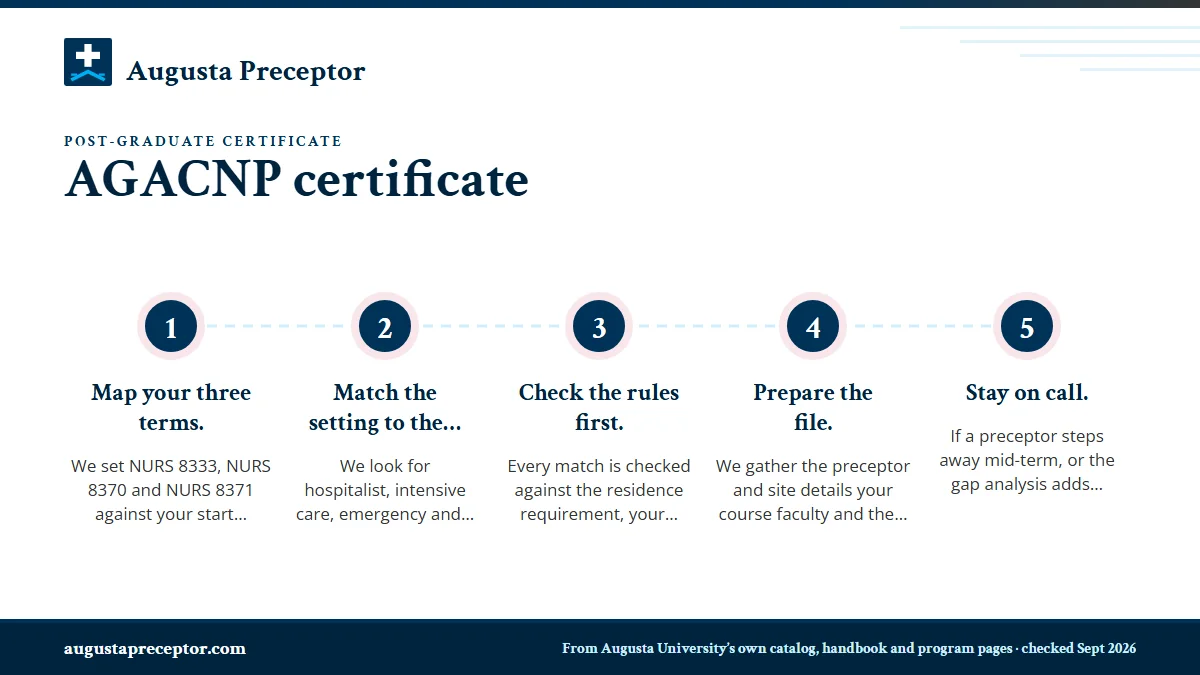
- Map your three terms. We set
NURS 8333,NURS 8370andNURS 8371against your start term, your gap analysis result and the hospital deadlines that apply where you live. - Match the setting to the course. We look for hospitalist, intensive care, emergency and inpatient specialty preceptors in Georgia or South Carolina whose patients fit each course.
- Check the rules first. Every match is checked against the residence requirement, your license, the preceptor's license and Georgia APRN authorization before it reaches your faculty.
- Prepare the file. We gather the preceptor and site details your course faculty and the clinical site need, so the faculty visit starts from a complete, well-matched placement.
- Stay on call. If a preceptor steps away mid-term, or the gap analysis adds hours, we line up the next option quickly and keep your hours log in order.
Send your details through the placement request form and your placement advisor will map the year with you.
Questions Augusta University students ask
Can I take the Augusta University AGACNP certificate while living outside Georgia or South Carolina?
The DNP overview page includes the post-graduate certificates in its requirement to live in Georgia or South Carolina, because instructors visit you, your preceptor and your clinical site, and the certificate page places clinical experiences in those two states. Plan to live in one of them for the whole certificate, and talk to the College of Nursing early if a move is coming.
Is NURS 9192 part of the AGACNP certificate?
No. NURS 9192 is the final practicum in the DNP nurse practitioner tracks. The certificate schema lists NURS 9193 instead, a three-credit terminal practicum done with a preceptor, for students who have not completed it before starting. Augusta University does not publish its clock hours, so ask your advisor how it fits your plan of study.
Which certification exam follows the AGACNP certificate?
Augusta University's own sources differ. The certificates page names the American Academy of Nurse Practitioners or the American Nurses Credentialing Center, while the catalog names the American Association of Critical Care Nurses and ANCC. Check each board's current eligibility rules; the certification exams guide compares the options.
Can the AGACNP certificate be completed full time?
The certificates page says the specialty courses are progressive, so these options are typically treated as part-time study, under nine credit hours a semester. The practice courses run spring, summer and fall in order, and each needs a satisfactory result in the one before, so the clinical pace follows that sequence whatever your course load.
What board pass rate does Augusta University report for this certificate?
Augusta University reports on its certificates page that certificate students have had a 100 percent board pass rate for the last five years. It does not publish the yearly numbers behind that statement. The accreditation guide covers CCNE status and the other outcomes the College of Nursing reports.
Related pages
Last checked 2026-09-27
We check these pages against Augusta University's own catalog, program plans, DNP handbook and program pages, and Georgia and South Carolina rules. Your course faculty and the College of Nursing have the final word.
- Augusta University Graduate School: Post-Master's Nursing Certificates
- Augusta University College of Nursing: Post-Graduate Certificates
- Augusta University: AGACNP post-graduate certificate curriculum schema
- Augusta University College of Nursing: Doctor of Nursing Practice
- Georgia Board of Nursing: Nursing education
Whatever your program arranges, we find the preceptor who fits.
Tell us your Augusta University track, where in Georgia or South Carolina you live and when your next clinical course starts. We find preceptors near you who fit the course and Augusta University's rules, and hand you everything your faculty and the site need, well before the semester.
- Adult, pediatric and older-adult preceptors for
NURS 8312toNURS 8318, acute care forNURS 8332toNURS 8338 - Pediatric primary care for the PNP courses and psychiatric preceptors for
NURS 8342toNURS 8348 - Across Georgia and South Carolina, from the CSRA to Savannah, Atlanta and Columbia
Start your placement plan
Program, city and start date is all we need to begin.