Faculty site visits in Augusta University NP clinicals
Augusta University says its instructors must be able to visit three parties (you, your preceptor and the site where you train), and it cites that need as the reason NP students have to reside in Georgia or South Carolina. How often visits happen, how long they last and whether any are virtual is not published, so those details come from your course faculty. The preparation is the same either way, and it starts with your preceptor.
Get a visit-ready placement
Tell us your course and term, and your placement advisor will look for preceptors in Georgia or South Carolina who have room for faculty involvement.
What Augusta University publishes about visits
One sentence carries the public record. On the DNP program pages, faculty travel to the student, the preceptor and the clinical site is the stated reason for the two-state residence rule. Visits are therefore built into how the clinical courses run, not an optional extra.
Other published pieces show what faculty own. In its residency section, the DNP handbook says faculty assess each student's learning needs, write learning objectives for practice experiences together with the student, brief the preceptor or mentor, and answer for the evaluation of what the student learns. Policy CON31 requires a pass rating on every clinical objective, documented on each course's evaluation tools, which you can annotate and must sign.
The stakes are real. NP clinical courses are graded Satisfactory or Unsatisfactory, and under policy CON27 one unsatisfactory rating on the closing summative evaluation is enough to fail the clinical; the grades guide explains the knock-on rules.
What is not published
Beyond that sentence and those policies, the specifics of a visit are left to each course. None of these appear on Augusta University's public pages as of September 2026:
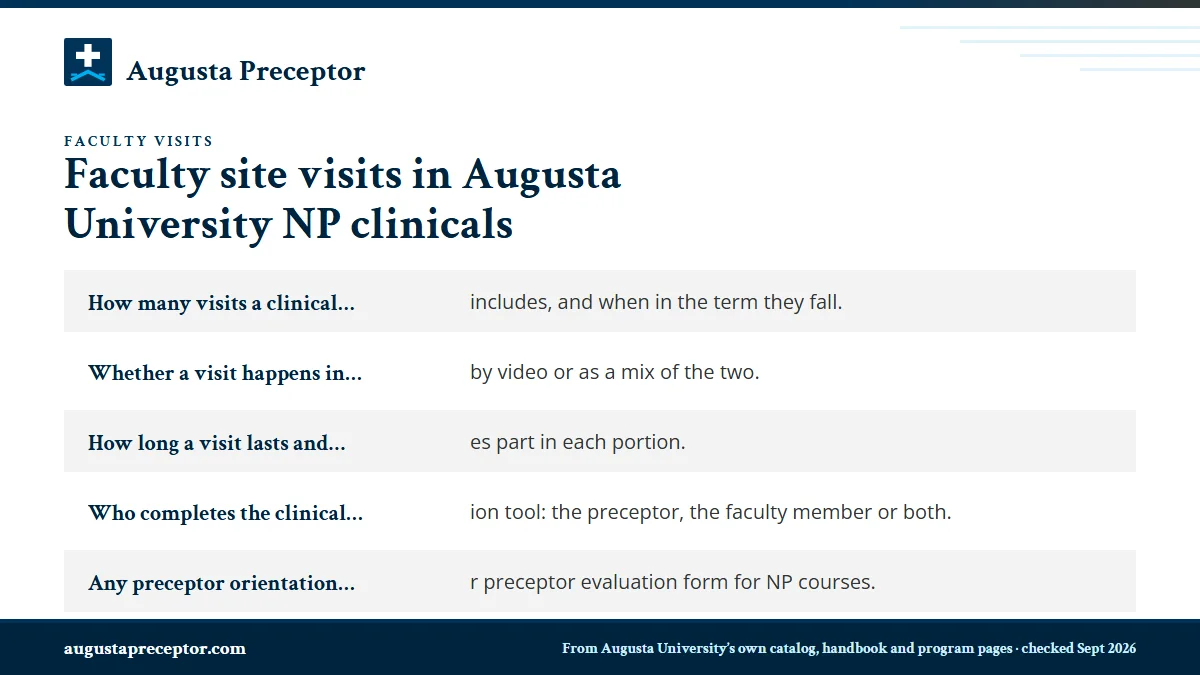
- How many visits a clinical course includes, and when in the term they fall.
- Whether a visit happens in person, by video or as a mix of the two.
- How long a visit lasts and who takes part in each portion.
- Who completes the clinical evaluation tool: the preceptor, the faculty member or both.
- Any preceptor orientation packet or preceptor evaluation form for NP courses.
Ask your course faculty about each point in the first week of the course, then pass the answers to your preceptor in writing. A preceptor who knows the plan ahead of time can protect the slot in a busy clinic.
Why distance and the two-state rule are linked
A visit that has to reach you, your preceptor and the site only works if the site is within reach of faculty. That is the logic behind limiting NP and certificate students to Georgia and South Carolina, and it is why the two-state rule matters the moment you start looking at sites.
Georgia adds a licensing layer. Its Board of Nursing says any faculty member or preceptor teaching in Georgia, whether physically present or teaching by electronic means, needs a Georgia or multistate license, and that only a nurse authorized as an APRN in Georgia may give clinical instruction in an APRN program. South Carolina's Board states in an archived FAQ that post-licensure programs fall outside its regulation.
Distance lands on you as well. Under policy CON14, getting to and from clinical agencies, plus any overnight stay, is at the student's cost. A site near home keeps your expenses down and makes a faculty trip easier to schedule.
Preparing your preceptor
Your preceptor agreed to teach you, which is not the same as agreeing to host a visitor in the middle of a full clinic day. A few steps make the visit easy on them.
- Tell them at the start of the course that a faculty visit is part of it, and share the date or window as soon as faculty confirm.
- Share the course objectives and the clinical evaluation tool you receive, so they know what faculty will ask about.
- Agree on a slot at a quieter point in the schedule and ask them to hold it on their calendar.
- Brief them the week before on your patient mix, the procedures you have done and the objectives you have met.
- Confirm how faculty should reach them if the plan changes, using the channel your course faculty prefers.
Preparing the site
- Tell the office manager or site contact the date, so the front desk expects a visitor and nobody is surprised.
- Check the site's visitor, badge and parking rules; health systems often keep their own.
- Confirm your site documents are signed. Policy CON16 requires Augusta University and clinical affiliate documents, such as confidentiality agreements and a Student Applied Learning Experience Agreement, before rotations begin.
- Find a private room for any conversation about your performance, away from patients and staff.
- Know the site's designated clinical contact. Policy CON23 asks you to notify that person, along with your clinical instructor, before any absence.
What students most often get wrong: assuming everyone at the site already knows about the visit. Front desks, schedulers and even preceptors change from week to week, so confirm the time, the room and the agenda with each of them a few days ahead.
Preparing yourself
Your own record is the backbone of a good visit. Keep your hour logs current in the College of Nursing's paid tracking system, covered in the tracking system guide, and bring a one-page summary of the patients you have seen by age group and problem type, plus the objectives you still need to meet.
Think about questions too. A visit is a chance to ask faculty how your progress reads to them and what they want to see by the final evaluation. Arrive early: under CON23, a student who arrives 15 minutes or more after the start time may be asked to leave, and CON20 bars working in the eight hours before a clinical.
Visit-ready placements from our desk
However your program approaches placement, we find preceptors in Georgia or South Carolina who welcome faculty involvement and have room for it in their schedule. Your placement advisor confirms at the outset that the preceptor is willing to host a visit, notes the site's visitor rules and the documents it needs, and keeps both sides current through the term. If a site's rules would make a visit awkward, such as tight limits on visitors, your advisor raises it before you commit, not halfway through the course.
Preceptors weighing your request can read what precepting involves, a page written for them. See how it works for the full process, or use the form below to start.
Questions Augusta University students ask
Will faculty evaluate my preceptor during the visit?
Augusta University does not publish whether a visit includes any review of the preceptor or the site. In its residency section, the handbook makes faculty responsible for preceptor and mentor orientation and for judging student learning. Ask your course faculty what they will cover, and share the answer with your preceptor so the visit holds no surprises.
What if my preceptor cannot be there on the visit day?
Tell your course faculty as soon as you know, since they set the plan and may prefer a new date to a visit without the preceptor. Offer two or three alternative slots your preceptor has already agreed to. Augusta University publishes no rule on rescheduling, so the faculty member's answer is the one that counts.
Do faculty visit post-master's DNP students at their project site?
The residence rule covers the NP tracks and certificates and leaves out the Traditional and Nurse Executive tracks. For those students, the handbook sets up a DNP Project team made up of the student, a faculty advisor and a site partner, with bi-weekly team meetings, but it does not describe site visits. Your project faculty advisor can say what to expect.
What happens if a visit shows I am behind?
No published policy ties a grade to a single visit. Policy CON31 says clinical remediation may be required, meaning extra laboratory or clinical experiences aimed at improving performance. The grade that counts is the final summative evaluation, where one unsatisfactory rating fails the clinical, so a mid-course warning is time to act.
Related pages
Last checked 2026-09-27
We check these pages against Augusta University's own catalog, program plans, DNP handbook and program pages, and Georgia and South Carolina rules. Your course faculty and the College of Nursing have the final word.
Whatever your program arranges, we find the preceptor who fits.
Tell us your Augusta University track, where in Georgia or South Carolina you live and when your next clinical course starts. We find preceptors near you who fit the course and Augusta University's rules, and hand you everything your faculty and the site need, well before the semester.
- Adult, pediatric and older-adult preceptors for
NURS 8312toNURS 8318, acute care forNURS 8332toNURS 8338 - Pediatric primary care for the PNP courses and psychiatric preceptors for
NURS 8342toNURS 8348 - Across Georgia and South Carolina, from the CSRA to Savannah, Atlanta and Columbia
Start your placement plan
Program, city and start date is all we need to begin.