Augusta University's DNP-AGACNP and its acute care clinicals
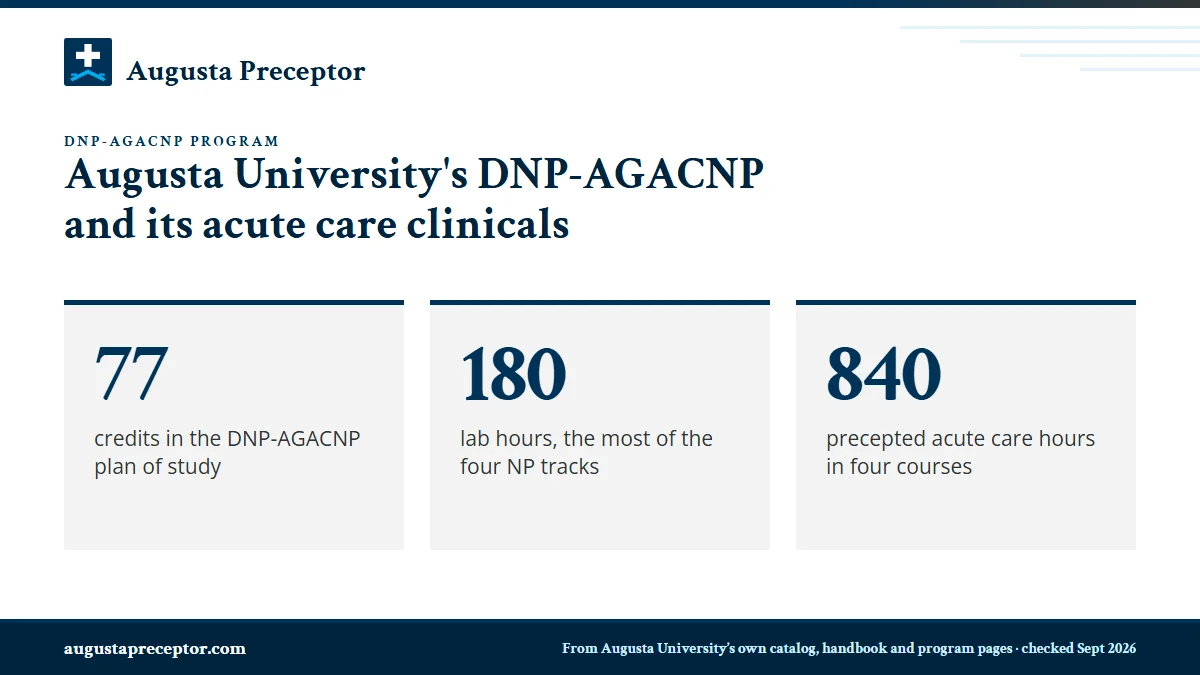
Augusta University's Adult-Gerontology Acute Care Nurse Practitioner concentration is a 77-credit DNP, finished in three full-time years or four part-time ones, always starting in the fall. It asks for 840 precepted hours with adults and older adults whose conditions are complex, urgent or changing fast, plus 360 residency hours and the most lab time of any Augusta University NP track.
Plan your acute care rotations
Share your county, your unit and your first clinical term, and we will build your search around each hospital's calendar.
What sets the acute care track apart
Three things separate the DNP-AGACNP from Augusta University's other nurse practitioner concentrations. It prepares you for the acute and complex care of adults and older adults rather than primary care. It carries 180 lab hours instead of 135, because its first two practice courses each include a lab block. And at 77 credits it is the leanest of the four plans, one credit under family and pediatrics and three under psychiatric mental health.
Everything else follows the shared DNP design. More than half of the work is delivered online, the cohort is based at the Augusta campus, and the precepted courses run from the spring of your second year to the spring of your third on the full-time plan. The four-year part-time plan carries the same 77 credits and the same hour totals.
Admission, from NursingCAS to orientation
The application path matches the other DNP tracks: NursingCAS first, then Augusta University's applicant portal once NursingCAS has verified you. The fall 2027 cycle opens in early August 2026 (the program page says August 7, the Graduate School says August 6) and closes on May 15, 2027, with documents due May 29.
An unencumbered RN license, Georgia or multistate, must be in hand before you enroll. A year of professional nursing experience before the clinical courses is recommended but optional. The College of Nursing publishes no critical care minimum for this track, unlike its nurse anesthesia program, which asks for a year of full-time critical care nursing within the past three years.
The DNP Handbook notes that the NP concentrations admit post-master's applicants as well as post-baccalaureate ones. Whichever door you come through, you attend a face-to-face orientation at the start and a face-to-face defense near the end.
The acute care clinical sequence
Each AGACNP practice course is worth 4 credits and runs with a didactic partner (NURS 8331, NURS 8334 and NURS 8337), while NURS 9192 runs with NURS 9191. The catalog describes the later courses by how sick the patients are: urgent and emergent needs in Practice II, rapidly changing conditions in Practice III.
| Course | Credits | Clinical hours | Lab hours | Term |
|---|---|---|---|---|
NURS 8332 Adult Gerontology ACNP Practice I | 4 | 180 | 45 | Spring, year 2 |
NURS 8335 Adult Gerontology ACNP Practice II | 4 | 180 | 45 | Summer, year 2 |
NURS 8338 Adult Gerontology ACNP Practice III | 4 | 240 | 0 | Fall, year 3 |
NURS 9192 final practicum | 4 | 240 | 0 | Spring, year 3 |
The AGACNP practice courses page looks at each course and the kind of preceptor it calls for, and the guide to the shared capstone covers the last 240 hours.
Hospitals run on credentialing calendars
Acute care rotations often sit inside hospitals, and hospitals admit students through their own onboarding. Every Georgia or South Carolina health system whose student page states a rule requires an affiliation agreement with the school before any student rotates, and most Georgia systems process students through ACEMAPP.
Deadlines come early. Wellstar's ACEMAPP page, which lists AGACNP among the NP tracks it accepts, sets its application deadlines at November 15 (spring rotations), March 30 (summer) and June 30 (fall), and asks students not to call before decisions post. Northside's student page wants you compliant 30 days before a rotation, 60 for January starts, expects peer precepting, and allows one student per preceptor per rotation. Emory's page sends every precepted request through its central Office of APP and says arrangements made outside that process cannot be honored.
Hospitals add their own conditions as well. College of Nursing policy lists mask fit testing where a clinical site requires it, warns that agencies may require COVID-19 vaccination, and leaves any agency credentialing fee to the student. The clinical agreements guide explains why lead time decides so much.
By our reading of the two calendars, Wellstar's November 15 spring deadline arrives before Augusta University's fall classes even end in late November. A hospital preceptor for NURS 8332 needs to be confirmed well before that date, not over the winter break.
Labs and MEGAI: the hands-on side
Four 45-hour lab blocks make up the track's 180 lab hours: health assessment (NURS 7470, first summer), diagnostic and clinical reasoning (NURS 7460, second fall), and the lab portions of NURS 8332 and NURS 8335. Each practice course also carries a nursing skills lab fee in the catalog.
AGACNP students also attend MEGAI, the multi-day campus intensive the College of Nursing holds for its FNP, AGACNP and PNP DNP students. Augusta University describes in-person teaching of skills like suturing, joint injections, ultrasound and casting for students who otherwise study mostly online. Dates and length are not published; the MEGAI page collects what is known.
Residency hours and the 1,200 total
On top of the 840 clinical hours, AGACNP students log 360 residency hours across the project sequence that begins with NURS 7150. The catalog adds the two for a 1,200-hour total, while the DNP Handbook's floor for every DNP student is 1,000 supervised post-baccalaureate hours, with residency time counted as practice rather than clinical hours.
Residency work is overseen by a project team made up of you, your faculty advisor and a sponsor at the project site, and that sponsor does not grade coursework. Both kinds of hours land in the same paid tracking subscription the College of Nursing requires, still unnamed on Augusta University's public pages. The 840-hour page shows how the four tracks compare.
Rules that follow you to the bedside
The residence rule applies here as in every NP track. Enrollment depends on living in Georgia or South Carolina, a condition Augusta University ties to faculty visits with each student, preceptor and site. The College of Nursing does not publish how often those visits happen or what form they take. The residence rule page goes deeper.
Georgia's Board of Nursing expects students and preceptors doing clinical work in the state to hold a Georgia or multistate license, and it reserves APRN clinical instruction for nurses with Georgia APRN authorization. Your preceptor's own practice rests on paperwork with a physician: a delegation protocol in Georgia, a practice agreement in South Carolina. Georgia and South Carolina are both Nurse Licensure Compact members.
Grading in the practice courses is Satisfactory or Unsatisfactory, and under CON27 one poor final evaluation is enough to fail the clinical. A preceptor who knows what the course asks of an acute care student is the best protection for that grade.
How we set up AGACNP rotations
With hospital rotations, the calendar matters as much as the preceptor. We start from each hospital's deadlines and work backward, so the preceptor and the paperwork meet the system's window as well as your course start. How the College of Nursing arranges AGACNP clinicals is not published; whatever role your program takes, a preceptor confirmed before the credentialing window closes makes the second spring calmer.
What AGACNP students get from us
- A search for acute care nurse practitioners at hospitals you can reach from home, matched to Practice I, II, III and
NURS 9192in turn. - Checks on licensure and, for Georgia sites, APRN authorization before you are introduced.
- A timeline built on each system's deadlines, ACEMAPP steps and extras such as fit testing.
- A complete file for your course faculty and the site, ready well before the term begins.
- Backup all semester long: if your preceptor cannot continue, we look for the next one.
Use the request form to tell us your county, your current unit and your first clinical term.
Questions Augusta University students ask
Can I do AGACNP clinical hours on the unit where I work?
There is no published Augusta University rule on precepted hours at your own employer, so raise it with your course faculty first. Hospitals set their own terms: Wellstar, for one, holds employees who rotate as students to the full student onboarding and denies them employee access. Policy CON20 adds that you may not work at all in the eight hours leading up to a clinical.
Is Augusta University's AGACNP an acute care or primary care program?
Acute care. The catalog builds Practice II around urgent and emergent problems in adults and older adults, and Practice III around conditions that change quickly. Augusta University's primary care concentrations are the DNP-FNP and the pediatric primary care DNP-PNP, each a separate plan with its own clinical courses.
Which certification exam do Augusta University AGACNP graduates take?
Two certifying bodies appear in the catalog for this track: the American Association of Critical Care Nurses and the American Nurses Credentialing Center. Augusta University reports that its AGACNP graduates had a 100% board pass rate in four of the last five years. State steps come after the exam: APRN authorization in Georgia, or a nurse practitioner license and practice agreement in South Carolina.
Does Augusta University offer an AGACNP post-graduate certificate?
Yes. Nurse practitioners who already hold a master's or doctorate can take the post-graduate AGACNP certificate, which starts in spring and requires at least 540 clinical hours plus lab, with up to 750 set by an individual gap analysis. The AGACNP certificate guide covers it.
Could a physician serve as my AGACNP preceptor?
No preceptor qualifications for NP courses appear in Augusta University's public documents, which leaves the decision with your course faculty. Georgia's Board of Nursing points toward APRNs, since it wants an APRN-authorized nurse leading clinical teaching in APRN programs, and some hospitals, Northside among them, add their own peer-precepting rules. Our acute care searches start with nurse practitioners.
Related pages
Last checked 2026-09-27
We check these pages against Augusta University's own catalog, program plans, DNP handbook and program pages, and Georgia and South Carolina rules. Your course faculty and the College of Nursing have the final word.
- Augusta University: DNP Adult Gerontology Acute Care Nurse Practitioner
- Augusta University: DNP-AGACNP full-time plan of study (Fall 2026)
- Augusta University: Doctor of Nursing Practice
- Wellstar Health System: ACEMAPP page for NP, PA and midwifery students
- Northside Hospital: ACEMAPP advanced practice student page
Whatever your program arranges, we find the preceptor who fits.
Tell us your Augusta University track, where in Georgia or South Carolina you live and when your next clinical course starts. We find preceptors near you who fit the course and Augusta University's rules, and hand you everything your faculty and the site need, well before the semester.
- Adult, pediatric and older-adult preceptors for
NURS 8312toNURS 8318, acute care forNURS 8332toNURS 8338 - Pediatric primary care for the PNP courses and psychiatric preceptors for
NURS 8342toNURS 8348 - Across Georgia and South Carolina, from the CSRA to Savannah, Atlanta and Columbia
Start your placement plan
Program, city and start date is all we need to begin.