Clinical agency agreements for Augusta University students
Before a health system lets a student onto a unit, it almost always wants a signed contract with the school, and Augusta University's policies refer to that clinical agency contract directly. Nearly every Georgia and South Carolina system that publishes student rules requires one, a few are not signing new ones, and each adds its own lead time. The sooner a site is known, the more room there is to clear all of it.
Get your placement plan
Tell us your Augusta University program and where you live. A placement advisor replies with preceptor and site options in your community that fit your Augusta University course.
What Augusta University's policies say about clinical agencies
The College of Nursing's student policies treat the clinical agency and its contract as a fixed part of every clinical course. The fees and expenses policy (CON14) says you must meet the credentialing competencies spelled out in the clinical agency contract, and that the credentialing process carries a fee. The compliance policy (CON16) says you sign the required Augusta University and clinical affiliate documents before a rotation begins, inside the time frame you are given before clinicals start.
Documents CON16 lists as possible
- Confidentiality agreements
- Policy acknowledgment agreements
- Authorization for release of records and information
- A Student Applied Learning Experience Agreement
CON16 also lets a clinical site add requirements of its own at your expense, and it lists mask fit testing among the items that clinical settings call for. CON14 adds that clinical agencies may require COVID-19 vaccination even though the College does not, so an unvaccinated student may face a longer drive.
Background checks: each agency makes its own call
Under the College's background check and drug screen policy (CON12), a clinical agency reviews your results independently, applies its own criteria, and decides whether you may take part in clinical activities there. A result one agency accepts may not satisfy the next, because each judges for itself.
DNP and Nurse Anesthesia students complete the check and screen several times during the program, each at their own cost, because those programs run through multiple clinical agencies. Some agencies also want a fingerprint background check, again at the student's cost. Several Georgia systems name their own screening route on their ACEMAPP pages: Wellstar, Piedmont, Northside and Atrium Health Floyd use Advantage Students, and Piedmont repeats its screens every 18 months.
The College's own deadlines for the check, the screen and immunizations disagree from one document to the next; the compliance guide lays out each version side by side.
Systems that require a school agreement first
Every system in our research that states a rule wants a school-level agreement before a student arrives. The table draws on each system's own student page, read in September 2026 unless marked archived.
| System | What its page says | Timing it states |
|---|---|---|
| Wellstar Health System (includes Wellstar MCG Health) | An active student affiliation agreement with the school before any student may rotate | NP applications due March 30 (summer), June 30 (fall), November 15 (spring) |
| Emory Healthcare | An agreement before any rotation; a new one can take several months and may not be approved | Requests go to its Office of APP first, then into ACEMAPP |
| Grady Health System | An agreement with the school of nursing must exist before any clinical experience | Requests handled in the order received |
| Piedmont Healthcare (includes Piedmont Augusta) | Requests come through a school partnership in ACEMAPP; archived 2021 guidelines add an affiliation agreement and insurance certificate | Request windows in August (spring), February (summer), April (fall); fully compliant 10 days before start |
| Northside Hospital | The school needs a partnership with the specific Northside campus | Compliant 30 days before start (60 suggested for January) |
| Atrium Health Floyd (Rome) | An active agreement is required, and no new ones are being signed | Apply at least three months ahead, in set windows |
| Prisma Health (archived copy) | A Prisma-affiliated school; no new agreements without a specific workforce need | At least two weeks for clearance; no start in the week of the request |
| Spartanburg Regional (archived copy) | Establishing an affiliation agreement is the first step for any rotation | Not stated |
Only Atrium Health Floyd's agreement list, below, names Augusta University. Separately, the Augusta VA's spinal cord injury center page says it is affiliated with Augusta University's training programs, the College of Nursing included, and the VA's trainee page asks for onboarding to begin 90 to 120 days ahead.
Atrium Health Floyd: an agreement that names Augusta University
Atrium Health Floyd in Rome shows why an existing agreement matters. Its advanced practice student page on ACEMAPP says an active Clinical Education Affiliation Agreement must be on file between Atrium Health Floyd or Harbin Clinic and your school, and that there is currently a moratorium on new ones.
The active agreement list posted on that page includes the row "Augusta University | Atrium Health Floyd (AHF) | PA, NP", starting January 1, 2024, with automatic renewal. Harbin Clinic's Augusta University entry covers physician assistant students only. That is the list's own wording; a rotation still depends on the application window and on a preceptor being available.
The rules around it: apply at least three months ahead, within windows (July 1 to October 1 for January to April rotations, November 1 to February 1 for May to August, March 1 to May 31 for September to December). Each application carries one preceptor, and the page asks students not to phone its physicians, APPs or facilities about an application. Its own teammates enrolled in approved programs are offered priority. The northwest Georgia guide covers the rest of that region.
Systems closed, or nearly closed, to new schools
Some large systems have narrowed who they accept, which matters more than their size on a map. According to an archived copy of Prisma Health's graduate nursing page (August 2025), Prisma considers only its own team members with at least a year of employment and graduate nursing students from Clemson University or the University of South Carolina, requires a Prisma-affiliated school, and sets aside new affiliation agreements unless a specific workforce need exists.
An archived copy of AnMed's NP placement page (April 2026) limits placements in Anderson to AnMed employees and students from Anderson University and Clemson University, and asks students not to approach its offices or providers directly. Atrium Health's central advanced practice page, in a February 2026 archived copy, also reports a moratorium on new agreements; whether that page governs Atrium Health Navicent in Macon is not stated.
For an Augusta University student, the lesson is to settle the agreement question before chasing a preceptor at any large system. The Upstate guide covers the other systems in that part of South Carolina.
Why lead time decides the semester
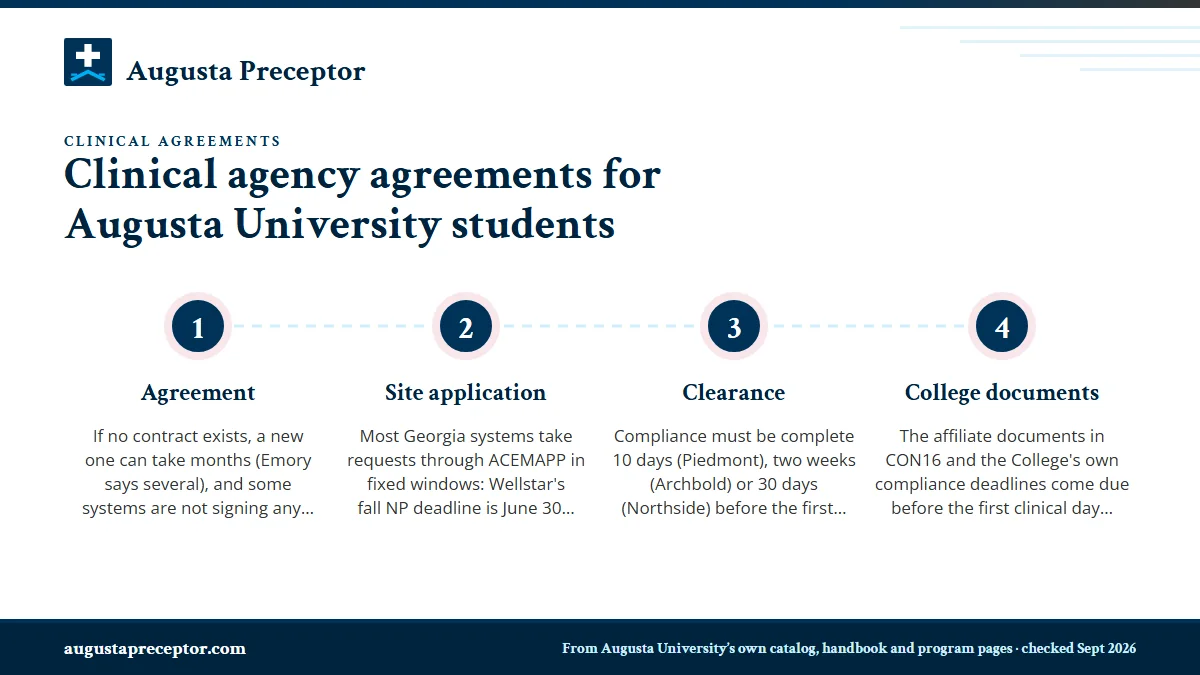
Each step below has its own clock, and they run one after another rather than side by side.
- AgreementIf no contract exists, a new one can take months (Emory says several), and some systems are not signing any. This is the step nobody can hurry.
- Site applicationMost Georgia systems take requests through ACEMAPP in fixed windows: Wellstar's fall NP deadline is June 30, and Piedmont's fall window is April.
- ClearanceCompliance must be complete 10 days (Piedmont), two weeks (Archbold) or 30 days (Northside) before the first day.
- College documentsThe affiliate documents in CON16 and the College's own compliance deadlines come due before the first clinical day as well.
Our arithmetic, not an Augusta University figure: fall 2026 classes began August 18, so Wellstar's June 30 deadline fell seven weeks earlier, and its March 30 summer deadline lands about six weeks before the 11-week summer 2027 term opens on May 10.
What to ask, and how we help
Three questions for your course faculty cover most of this: whether the College already has an agreement with the site you have in mind, what happens if it does not, and which College documents and deadlines apply to that site. Ask early in the term before your clinical course, not the week it starts.
However your clinical course comes to have its site, the placement desk checks the agreement question before anything else. We look for preceptors at sites whose rules an Augusta University student can meet, say plainly when a system is closed to new schools, and hand you and your faculty the site's requirements and dates early, so the contract step has room to happen. See the placement process or send your course details.
Questions Augusta University students ask
Does Augusta University have a clinical agreement with Wellstar MCG Health?
Wellstar MCG Health is Augusta University's academic health system, and Wellstar requires an active school agreement for every student rotation. Wellstar's public student pages do not list which schools or programs hold one, so ask your course faculty whether an agreement covers an NP rotation at the facility you want before you apply.
What is a Student Applied Learning Experience Agreement?
It is one of the documents Augusta University's compliance policy (CON16) names as something you may sign before a rotation, alongside confidentiality and policy acknowledgment agreements and a release of records. The form itself is not posted publicly; the required documents and their due dates reach you before clinicals begin.
What if my clinic has no agreement with Augusta University?
Augusta University does not publish how a new agency agreement is started or how long it takes. Raise it with your course faculty as early as you can, since systems that describe the process, such as Emory, say a new agreement can take several months, and some systems are not signing new ones at all.
Can Augusta University students rotate at Prisma Health?
According to an archived copy of Prisma Health's graduate placement page, it considers only its own staff with at least a year of employment and graduate nursing students from Clemson University or the University of South Carolina. Even staff must attend a Prisma-affiliated school, and new school agreements need a workforce need, so confirm with faculty before planning around Prisma.
Who pays for clinical credentialing?
You do, per CON14: the credentialing that clinical agency contracts call for carries a fee, and background checks, drug screens, fingerprint checks and any extra site requirements are at your expense. Augusta University does not publish the amounts; the compliance guide lists what each item involves.
Related pages
Last checked 2026-09-27
We check these pages against Augusta University's own catalog, program plans, DNP handbook and program pages, and Georgia and South Carolina rules. Your course faculty and the College of Nursing have the final word.
- Augusta University College of Nursing: CON16 clinical compliance policy
- Augusta University College of Nursing: CON14 fees and expenses policy
- Augusta University College of Nursing: CON12 background check and drug screen policy
- Atrium Health Floyd: advanced practice students (ACEMAPP)
- Wellstar Health System: NP, PA and midwifery students (ACEMAPP)
Whatever your program arranges, we find the preceptor who fits.
Tell us your Augusta University track, where in Georgia or South Carolina you live and when your next clinical course starts. We find preceptors near you who fit the course and Augusta University's rules, and hand you everything your faculty and the site need, well before the semester.
- Adult, pediatric and older-adult preceptors for
NURS 8312toNURS 8318, acute care forNURS 8332toNURS 8338 - Pediatric primary care for the PNP courses and psychiatric preceptors for
NURS 8342toNURS 8348 - Across Georgia and South Carolina, from the CSRA to Savannah, Atlanta and Columbia
Start your placement plan
Program, city and start date is all we need to begin.