Augusta University's DNP-FNP, from application to the final practicum
The Family Nurse Practitioner concentration of Augusta University's Doctor of Nursing Practice is a 78-credit program that takes three years full time or four part time, with a fall start. Its clinical core is four precepted courses, 840 direct hours covering adults, children and older adults, plus 360 DNP residency hours, and every clinical hour happens in Georgia or South Carolina.
Start your FNP preceptor search
Tell us your county and your first clinical term, and your placement advisor will map all four FNP courses.
The family track at a glance
Augusta University trains family nurse practitioners at the doctoral level only, entering after a BSN. The catalog describes the concentration as approved for web-based delivery with more than half of it taught online and its cohort based on the Augusta campus, and the DNP Handbook calls the model hybrid: online courses, campus sessions, simulation and clinicals.
| Item | DNP-FNP |
|---|---|
| Credits | 78 |
| Length | 3 years full time or 4 years part time |
| Start term | Fall only |
| Direct clinical hours | 840, across four courses |
| DNP residency hours | 360, inside the project courses |
| Lab hours | 135 |
| Hour total in the catalog | 1,200 |
| Required campus time | Orientation, MEGAI, the defense |
The part-time plan keeps the same credits and hour totals and spreads them over a fourth year.
Getting admitted
You apply through NursingCAS first. Once NursingCAS verifies the application, Augusta University's Graduate Admissions Office picks it up and the remaining steps run through the university's applicant portal. For a fall 2027 start, the FNP page gives August 7, 2026 as the opening date while the Graduate School shows August 6, 2026; both point to a May 15, 2027 deadline, with supporting documents due by May 29, 2027.
Before enrollment you need an RN license in good standing with no encumbrances, issued either by Georgia or as a multistate compact license. Augusta University recommends, without requiring, a year of professional nursing experience before your clinical courses begin. Accepted students attend orientation on campus in person and come back later for an in-person defense, and admission essays may not be generated wholesale by AI.
The background check and drug screen come next, and the two published deadlines differ: the Graduate School wants results at least four weeks before your first semester, while policy CON12 says three months before matriculation. Work to the earlier one, and expect to repeat both during the program at your own expense.
Courses that surround the clinicals
Two lab courses prepare every Augusta University NP student for precepted work: NURS 7470 Advanced Health Assessment in the first summer and NURS 7460 Diagnostic and Clinical Reasoning for Advanced Practice Nurses in the second fall, each carrying 45 lab hours. The FNP's third lab block, another 45 hours, sits inside NURS 8312, which is how the plan reaches 135.
Each practice course runs beside a didactic partner, NURS 8311, NURS 8314 and NURS 8317 in turn, and the last practicum pairs with NURS 9191 APRN Practice Synthesis. Across all three years runs a separate thread of six DNP Project courses, opening with NURS 7150 and closing with NURS 9062, where residency hours are earned.
Four clinical courses and who each one needs
The catalog gives each FNP practice course a different patient group, so the best preceptor for one semester is often the wrong one for the next. On the full-time plan the precepted run begins in the spring of the second year and finishes in the spring of the third; by our count, a student who starts in fall 2027 reaches NURS 8312 in spring 2029.
The order matters for planning. Pediatrics lands in summer, when terms run shorter than the plan assumes, and the two 240-hour courses come last, when the DNP Project is also asking for time.
| Course | Catalog focus | Clinical hours | Term |
|---|---|---|---|
NURS 8312 FNP Practice I | Adults in primary health care settings | 180, plus 45 lab | Spring, year 2 |
NURS 8315 FNP Practice II | Infants, children and adolescents in primary care | 180 | Summer, year 2 |
NURS 8318 FNP Practice III | Older adults and their families | 240 | Fall, year 3 |
NURS 9192 practicum | Full advanced practice scope with a preceptor | 240 | Spring, year 3 |
The FNP practice courses guide goes course by course, and the capstone shared by all four tracks has its own final practicum page.
840 plus 360, and the 1,000-hour floor
Augusta University's documents count FNP hours three ways. The catalog prints a 1,200-hour clinical total. The Fall 2026 plan of study divides that into 840 direct clinical hours and 360 DNP residency hours, listing the 135 lab hours apart. The DNP Handbook sets a minimum of 1,000 post-baccalaureate supervised hours for every DNP student and calls residency time practice hours, not clinical hours.
The totals agree once you see what each one measures, but the difference shows up when you log. Practice courses produce clinical hours with a preceptor; the project courses produce residency hours, which the handbook expects to include indirect work in health care settings as well as patient care. The 840-hour breakdown and the residency hours guide explain each count.
Every hour, clinical or residency, is logged in a tracking platform the College of Nursing has approved. Students hold and pay for their own subscription, and the platform's name is not on Augusta University's public pages.
The plans compute every semester's clinical hours on 15 weeks, summer included, yet the summer 2027 calendar runs 10- and 11-week terms. By our arithmetic, the 180 hours of NURS 8315 average about 12 weekly across a full 15 weeks, yet climb to roughly 16 to 18 when squeezed into 11 or 10. The pediatric summer course is the one to line up first.
MEGAI and the two-state residence rule
FNP students are one of three tracks named for MEGAI, the College of Nursing's multi-day campus intensive, where mostly online students practice skills such as suturing, joint injections, ultrasound and casting with faculty in person. Its dates, length and semester are not published; the MEGAI page gathers what is.
The residence rule shapes every clinical choice. FNP students have to be residents of Georgia or South Carolina, since faculty travel to see each student, the preceptor and the practice, though the number of visits is not published. For clinicals in Georgia, the Board of Nursing adds two conditions: students and preceptors carry a Georgia or multistate license, and the nurse teaching an APRN student holds Georgia APRN authorization. The residence rule guide covers what a move would mean.
Certification, accreditation and what it costs
FNP graduates take a national certification exam; the catalog names the American Nurses Credentialing Center and the American Academy of Nurse Practitioners. Augusta University posts board pass rates for its acute care, pediatric and psychiatric tracks but none for FNP. CCNE accredits the DNP program, most recently on March 13, 2024, with the term running through December 31, 2034. After you pass, Georgia practice rests on APRN authorization plus a signed nurse protocol with a physician who delegates medical acts, while South Carolina asks for a written practice agreement with a physician.
Tuition and fees for the DNP appear on Augusta University's tuition page. Beyond tuition, budget for a per-semester immunization tracking fee, a nursing liability insurance fee, a skills lab fee on the practice courses, the tracking system subscription, repeat background checks and drug screens, any clinical agency credentialing fee, and your own travel to sites.
Why FNP students choose us
Three patient populations in four semesters means three different preceptor searches, and we treat each one as its own match. Augusta University leaves unpublished how FNP preceptors are arranged. Either way, a willing preceptor near home who fits the exact course makes each semester steadier, and your course faculty keep the final say on every site.
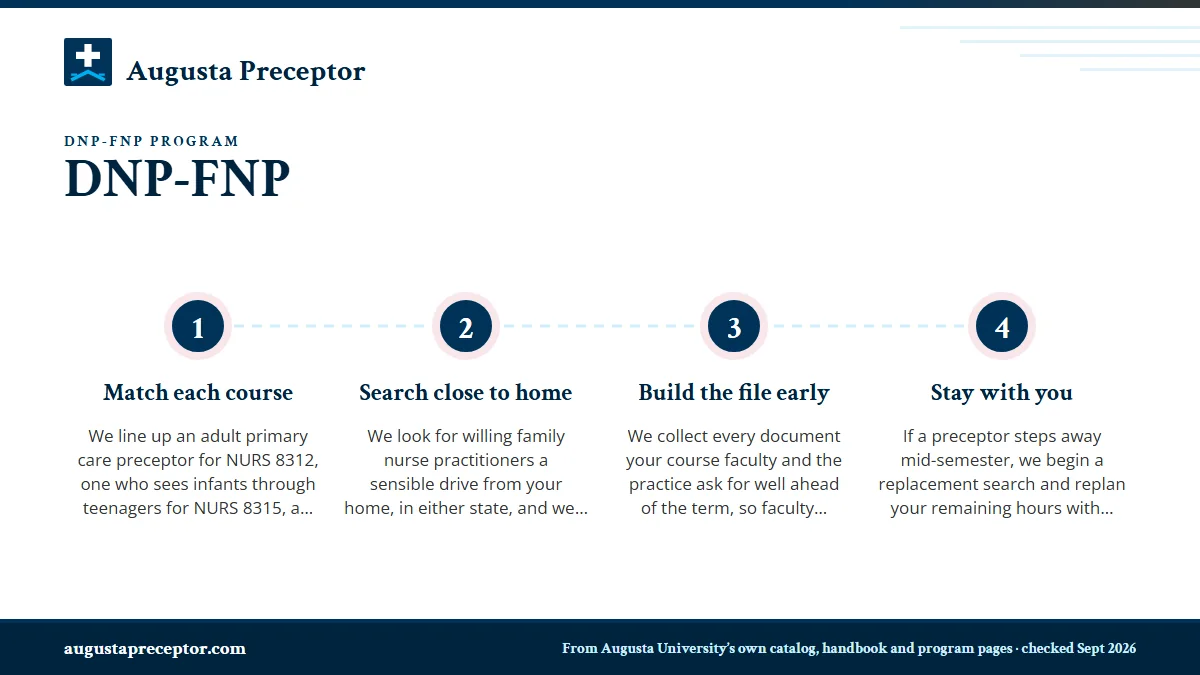
- Match each courseWe line up an adult primary care preceptor for
NURS 8312, one who sees infants through teenagers forNURS 8315, a practice rich in older adults and families forNURS 8318, and a broad family practice for the last 240 hours. - Search close to homeWe look for willing family nurse practitioners a sensible drive from your home, in either state, and we confirm licensure and, in Georgia, APRN authorization before any introduction.
- Build the file earlyWe collect every document your course faculty and the practice ask for well ahead of the term, so faculty visits and tracking system entries start clean.
- Stay with youIf a preceptor steps away mid-semester, we begin a replacement search and replan your remaining hours with you, course by course, through
NURS 9192.
Send us your county and the term your first practicum begins using the request form; we start with whichever course is nearest.
Questions Augusta University students ask
Can I live outside Georgia or South Carolina and still do the Augusta University FNP?
Not under the published rule. The FNP page limits the track to residents of the two states and ties that limit to faculty visits with students, preceptors and sites. If a move is coming, settle it before you enroll; if one might happen mid-program, talk with the College of Nursing first, since every clinical site would still need to be in Georgia or South Carolina.
Is Augusta University's DNP-FNP fully online?
Mostly online, not entirely. Over half of the coursework is delivered online, yet you will be on campus in person for orientation, for the MEGAI skills intensive and for your defense. Clinical hours take place at practices near you in Georgia or South Carolina, and faculty visit those sites during the course.
Does Augusta University have a post-graduate FNP certificate?
Not at the moment. Only two post-graduate certificates are listed today, AGACNP and PMHNP. Older FNP certificate practicum courses remain in the catalog, and the College of Nursing's About page still counts FNP among its accredited certificates, yet neither the Graduate School nor the certificates page offers one.
What happens if I get an Unsatisfactory in an FNP clinical course?
Practice courses and NURS 9192 are graded Satisfactory or Unsatisfactory. Policy CON27 is strict: a single Unsatisfactory on the end-of-course clinical evaluation means failing the clinical, and that sinks the course no matter how the didactic side went. CON01D then treats one U in a DNP course as cause for dismissal from the College of Nursing, which is why the fit between preceptor and course matters so much.
Can I start the Augusta University FNP in spring?
No. The DNP-FNP plans of study begin in the fall, and applications are taken for a fall start only. Spring starts at the College of Nursing belong to the post-graduate certificates, which cover adult-gerontology acute care and psychiatric mental health rather than family practice.
Related pages
Last checked 2026-09-27
We check these pages against Augusta University's own catalog, program plans, DNP handbook and program pages, and Georgia and South Carolina rules. Your course faculty and the College of Nursing have the final word.
Whatever your program arranges, we find the preceptor who fits.
Tell us your Augusta University track, where in Georgia or South Carolina you live and when your next clinical course starts. We find preceptors near you who fit the course and Augusta University's rules, and hand you everything your faculty and the site need, well before the semester.
- Adult, pediatric and older-adult preceptors for
NURS 8312toNURS 8318, acute care forNURS 8332toNURS 8338 - Pediatric primary care for the PNP courses and psychiatric preceptors for
NURS 8342toNURS 8348 - Across Georgia and South Carolina, from the CSRA to Savannah, Atlanta and Columbia
Start your placement plan
Program, city and start date is all we need to begin.