Augusta University FNP Practice I to III, course by course
Augusta University's DNP-FNP track moves through three patient populations before the final practicum: adults in NURS 8312, infants, children and adolescents in NURS 8315, and older adults with their families in NURS 8318. Each course calls for a different kind of preceptor, and the pediatric one is the hardest to line up. Whether or not your program helps with placement, we find a preceptor for each course near your home in Georgia or South Carolina who sees the patients that course is built around.
Plan your next FNP practice course
Tell us which course and term are coming up, and where you live in Georgia or South Carolina.
Three courses, three patient populations
The Fall 2026 FNP plan of study runs the practice courses in three back-to-back terms, beginning in the spring of year two for full-time students. The catalog frames each one around a single population, and the plan sets each beside a didactic course in the same semester. None of the three shows a formal prerequisite in its catalog entry.
| Course | Population in the catalog | Hours | Plan credits | Full-time term | Paired course |
|---|---|---|---|---|---|
NURS 8312 FNP Practice I | Adults in primary health care settings | 180 clinical + 45 lab | 4 (0-1-3-4) | Spring, year 2 | NURS 8311 |
NURS 8315 FNP Practice II | Infants, children and adolescents in primary health care settings | 180 clinical | 3 (0-0-3-3) | Summer, year 2 | NURS 8314 |
NURS 8318 FNP Practice III | The elderly client and their family | 240 clinical | 4 (0-0-4-4) | Fall, year 3 | NURS 8317 |
The plan turns credits into clock hours at four to one over 15 weeks for clinical work, so each clinical credit is 60 hours, and at three to one for lab, so each lab credit is 45. The four-year part-time plan reaches the same totals on a longer grid, so check its terms if you study part time. How these 600 hours (our sum) join the final practicum and the residency is laid out in the 840-hour breakdown.
NURS 8312 in spring: adults in primary care
Practice I is your first term with a preceptor and the only FNP practice course that also carries lab time: three clinical credits and one lab credit in the plan's notation. The catalog places it in primary health care with adult patients and lists a nursing skills lab fee on the course. You take it alongside NURS 8311.
Our suggestion for the preceptor: a family medicine or internal medicine clinician whose days are mostly adult office visits, in a practice busy enough to fill 180 hours without long gaps. Rural and shortage-area practices are worth a look; HRSA counted 245 primary care shortage designations in Georgia and 114 in South Carolina as of June 30, 2026. Augusta University does not publish a list of approved settings for this course, so confirm the setting with your course faculty first; we prepare the practice details they will want.
In Georgia, a preceptor needs a Georgia or multistate license, and the Board of Nursing expects APRN clinical instruction to come from a nurse with Georgia APRN authorization. Preceptor requirements covers South Carolina and the gaps Augusta University leaves to faculty.
NURS 8315 in summer: the pediatric course
FNP Practice II keeps 180 clinical hours but turns to infants, children and adolescents, still in primary care, and it lands in the summer of year two with NURS 8314. The plan counts those hours across a 15-week term, while the Summer 2027 calendar offers 10- and 11-week terms, so the weekly load climbs. The summer terms guide works through that math.
Pediatric preceptors are the scarcest match in this track. When we surveyed health systems in both states, pediatrics stood out as a thin specialty: we found no public NP student page for Children's Healthcare of Atlanta, and in Augusta, Wellstar Children's Hospital of Georgia runs through Wellstar's ACEMAPP process. DNP-PNP students need pediatric preceptors in that same summer for their own Practice II, so by our reading demand bunches up in one term. That is why we open pediatric searches first.
Our suggestion for the preceptor: a general pediatric practice, or a family practice that can show a steady daily count of children and teenagers on its schedule.
Where FNP students slip: picking a family practice for NURS 8315 because it accepts children, then finding the schedule is mostly adults. Before you commit, ask how many pediatric visits the practice sees in a typical week. A short summer term leaves little room to make up hours.
NURS 8318 in fall: older adults and their families
Practice III is the largest of the three at 240 clinical hours, four clinical credits with no lab, taken in the fall of year three with NURS 8317. The catalog centers it on the elderly client and their family, so a setting where relatives join visits and decisions fits well. Over a 15-week fall term, that is about 16 hours a week by our count.
Our suggestion for the preceptor: a geriatric or internal medicine practice with an older panel, a home-based primary care program, or a practice that follows patients into assisted living and skilled nursing. The Charlie Norwood VA Medical Center is another option to raise with faculty: the VA's spinal cord injury center page in Augusta says it is affiliated with Augusta University's health care training programs, including the College of Nursing. VA onboarding starts early; its trainee page, written for residents and fellows, asks for the first part 90 to 120 days before the start date.
Practice III leads straight into the spring practicum every track shares, so plan the two together using the final practicum guide. Augusta University does not publish whether a fall preceptor may continue into spring; raise it with your course faculty early.
One practice for all three, or three preceptors?
A busy family practice sees adults, children and older adults, so it can look as though one placement might carry the whole sequence. Augusta University does not say whether a single preceptor or site may host more than one FNP practice course. Treat it as a question for your course faculty, not an assumption.
Our suggestion: plan three distinct matches and keep reuse as an option. Different preceptors widen what you see before board certification, and a separate pediatric match protects NURS 8315 if a family practice's child volume turns out thin. Augusta University asks NP students to live in Georgia or South Carolina because instructors visit the student, the preceptor and the clinical site, so each practice should be one you can reach without strain; the Georgia and South Carolina rule explains the requirement.
How we match each FNP course
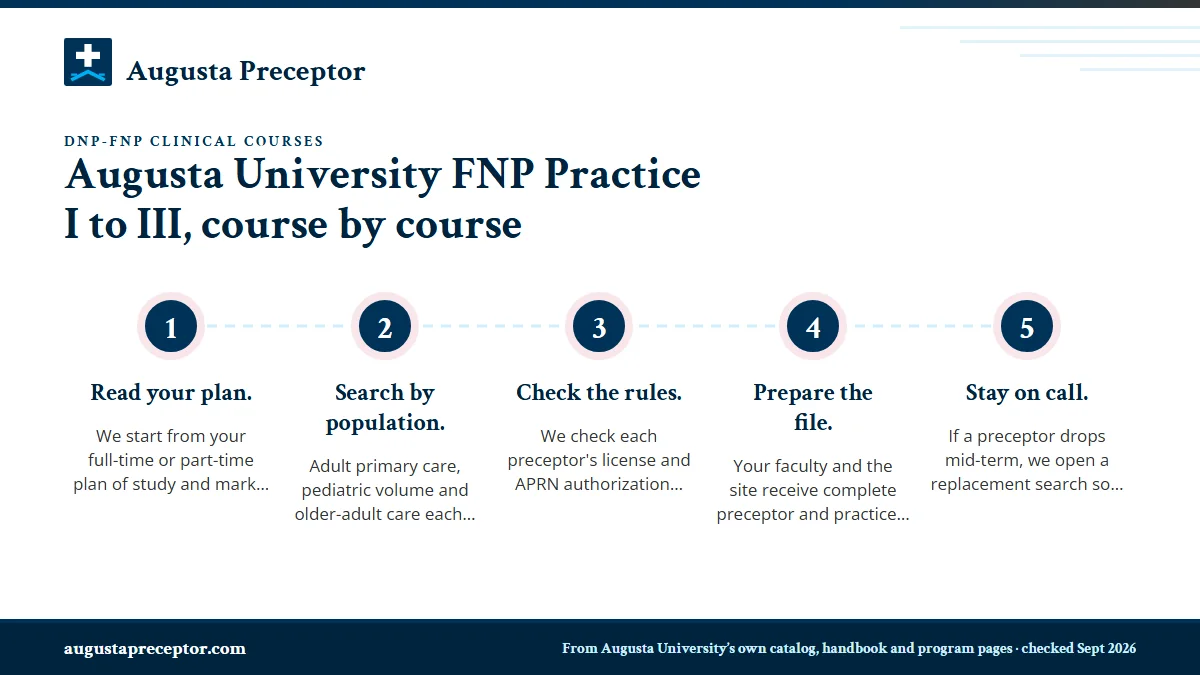
Our placement desk treats each FNP term as its own search, with its own preceptor and paperwork ready before the term opens, whatever part your program plays in placement.
- Read your plan.We start from your full-time or part-time plan of study and mark the terms for
NURS 8312,NURS 8315andNURS 8318. - Search by population.Adult primary care, pediatric volume and older-adult care each get a search near your home, with pediatrics started first.
- Check the rules.We check each preceptor's license and APRN authorization against Georgia or South Carolina rules and the site's own student requirements.
- Prepare the file.Your faculty and the site receive complete preceptor and practice details early, and your logged hours in the College of Nursing tracking system match the course.
- Stay on call.If a preceptor drops mid-term, we open a replacement search so your hours keep moving.
Send your track, term and county through the placement form to start the next search.
Questions Augusta University students ask
Can FNP Practice II be done at a family practice instead of a pediatric office?
The catalog defines NURS 8315 by its patients, infants, children and adolescents in primary care, not by practice type, and Augusta University publishes no list of approved settings. A family practice can work if it sees enough young patients to fill 180 hours in a short summer term. Ask your course faculty before you commit, and bring the practice's weekly pediatric visit count.
Do FNP Practice II and III include lab hours?
No. The Fall 2026 plan writes NURS 8315 as 0-0-3-3 and NURS 8318 as 0-0-4-4, clinical credits only. The track's 135 lab hours sit in three courses at 45 each: NURS 7470 Advanced Health Assessment in summer of year one, NURS 7460 Diagnostic and Clinical Reasoning in fall of year two, and NURS 8312.
Is there an FNP post-graduate certificate at Augusta University?
Not at present. The Graduate School and certificate pages list only AGACNP and PMHNP certificates. The catalog still carries older FNP certificate practice courses (NURS 8313, NURS 8353, NURS 8354), and the College's accreditation line still names an FNP certificate, but the current program pages offer no FNP certificate to new applicants.
How are the FNP practice courses graded?
Satisfactory or Unsatisfactory, according to the catalog. College of Nursing policy says one unsatisfactory rating on the final summative clinical evaluation fails the clinical course, and the DNP progression policy lists a single U in any DNP course among the grades that lead to dismissal. The grades guide explains both rules.
Do FNP students attend a campus intensive?
Yes. Augusta University names FNP students, along with AGACNP and PNP students, for MEGAI, a multi-day on-campus event focused on clinical skills such as suturing and casting. Dates and length are not published; our MEGAI guide covers planning your clinical terms around it.
Related pages
Last checked 2026-09-27
We check these pages against Augusta University's own catalog, program plans, DNP handbook and program pages, and Georgia and South Carolina rules. Your course faculty and the College of Nursing have the final word.
Whatever your program arranges, we find the preceptor who fits.
Tell us your Augusta University track, where in Georgia or South Carolina you live and when your next clinical course starts. We find preceptors near you who fit the course and Augusta University's rules, and hand you everything your faculty and the site need, well before the semester.
- Adult, pediatric and older-adult preceptors for
NURS 8312toNURS 8318, acute care forNURS 8332toNURS 8338 - Pediatric primary care for the PNP courses and psychiatric preceptors for
NURS 8342toNURS 8348 - Across Georgia and South Carolina, from the CSRA to Savannah, Atlanta and Columbia
Start your placement plan
Program, city and start date is all we need to begin.