The Augusta University NP clinical process, step by step
Augusta University publishes the outline of its nurse practitioner clinicals: where you must live, the compliance you complete and pay for, the tracking system you log hours in, the order of the clinical courses, faculty visits to you, your preceptor and your site, and Satisfactory/Unsatisfactory grading. Several practical details are not public, including who finds preceptors, preceptor qualifications, forms and deadlines, and your course faculty is the place to ask about those.
Plan your next clinical course with us
Tell us your track, your course number and your term, and your placement advisor will map preceptors that fit it in Georgia or South Carolina.
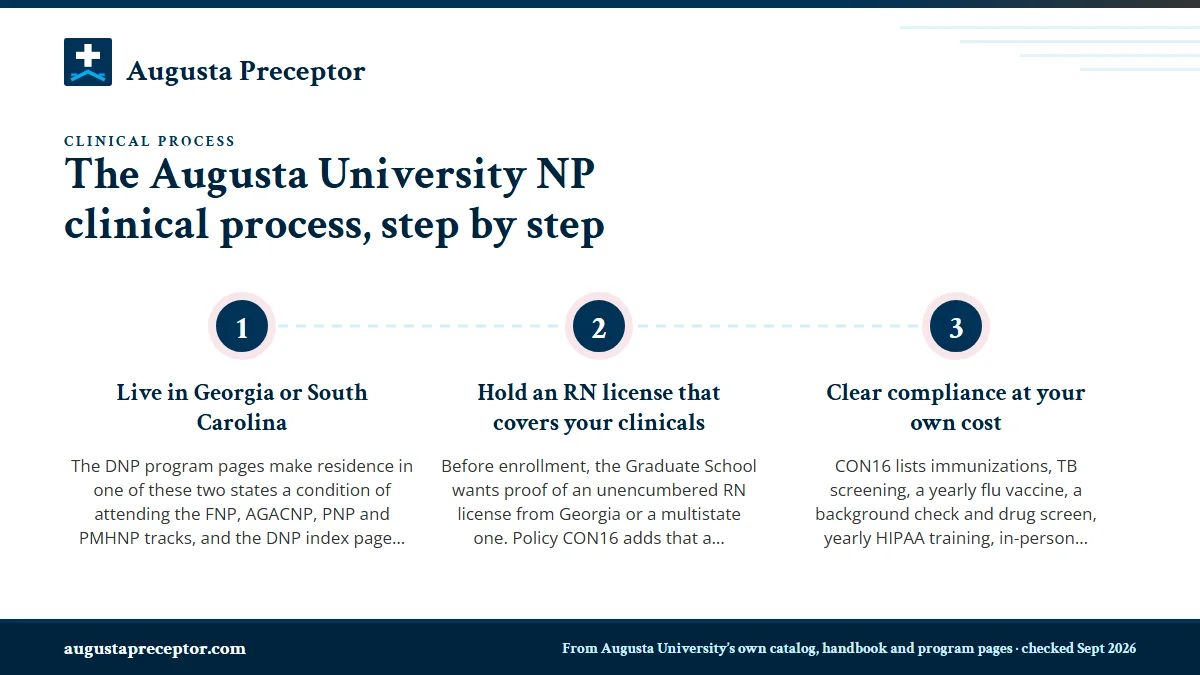
Steps one to three: before your first clinical course
Augusta University's nurse practitioner tracks are DNP programs taught mostly online, with clinical work done near home. Three published conditions come before any clinical hour counts.
- Live in Georgia or South CarolinaThe DNP program pages make residence in one of these two states a condition of attending the FNP, AGACNP, PNP and PMHNP tracks, and the DNP index page adds the post-graduate certificates. The stated reason is that instructors need to come and see the student, the preceptor and the site where training happens. The two-state rule guide quotes the wording and its conflicts.
- Hold an RN license that covers your clinicalsBefore enrollment, the Graduate School wants proof of an unencumbered RN license from Georgia or a multistate one. Policy CON16 adds that a multistate compact license may be needed for graduate rotations or agency requirements, and certificate students must add an RN license for each state that hosts their clinicals.
- Clear compliance at your own costCON16 lists immunizations, TB screening, a yearly flu vaccine, a background check and drug screen, yearly HIPAA training, in-person American Heart Association BLS, professional liability coverage, personal health insurance and mask fit testing. Policy CON12 says DNP students repeat the background check and drug screen several times because they rotate through several clinical agencies.
Published deadlines disagree. CON14 sets six weeks before the semester for the clinical immunization form; the Student Health form itself says two. CON12 wants the background check three months before matriculation, the Graduate School four weeks. Work to the earlier date; the compliance guide has the full list.
Step four: subscribe to the clinical tracking system
The DNP handbook, revised for fall 2026, tells every DNP student to buy a subscription to the College of Nursing's approved clinical education data tracking system. Residency hours are logged there, and the handbook notes that nurse practitioner students document their clinical hours on the same platform.
Augusta University does not name the system on its public nursing pages, and its price is not published. For residency entries, DNP Project faculty review each log and can return an entry that lacks detail or lists an activity that does not qualify; only entries marked accepted add to your total. The tracking system guide covers logging in more depth.
Step five: site documents and the agency's own review
Policy CON16 has you sign both university and clinical affiliate paperwork ahead of each rotation, by the deadline you receive. Its examples are confidentiality agreements, policy acknowledgments, an authorization to release records and information, and a Student Applied Learning Experience Agreement. The documents and their deadline reach students before clinical rotations start.
The clinical site also has a say of its own. Under CON12, each clinical agency reviews your background check and drug screen by its own standards and makes the final call on your participation. CON16 lets a site add requirements at your expense, and under CON14 the credentialing competencies in the agency's contract are yours to meet, for a fee.
Health systems add their own onboarding, usually ACEMAPP in Georgia and myClinicalExchange in South Carolina.
Step six: the clinical courses, in order
Each BSN to DNP nurse practitioner track has four clinical courses on the fall 2026 plans of study: three practice courses named for the track, then a final practicum every track shares. On the full-time plan they run from the spring of year two to the spring of year three.
- Practice I, spring of year two180 clinical hours plus 45 lab hours in
NURS 8312(FNP),NURS 8332(AGACNP),NURS 8322(PNP) orNURS 8342(PMHNP). - Practice II, summer of year two180 clinical hours in
NURS 8315,NURS 8335,NURS 8325orNURS 8345. The plans assume 15-week terms, yet summer 2027 lasts 10 or 11 weeks, so each week carries more; see summer clinical terms. - Practice III, fall of year three240 clinical hours in
NURS 8318,NURS 8338,NURS 8328orNURS 8348. - Final practicum, spring of year three240 hours in
NURS 9192, taken alongsideNURS 9191, where the catalog expects you to take on the whole scope of the advanced practice role with a preceptor beside you.
Those four courses total 840 direct clinical hours. The 360 DNP residency hours sit in the project courses instead, which is how the catalog reaches 1,200; the handbook separately sets a 1,000-hour floor for all DNP students, and the 840-hour guide lines the three figures up. Post-graduate certificate students start in spring and follow three certificate practice courses of their own.
Steps seven and eight: faculty visits and grading
Faculty visits are the stated reason for the residence rule, and they reach three parties: you, the preceptor and the site. Augusta University does not say how many visits a course includes or how they are run; faculty site visits covers what is known and how to get ready.
The catalog grades every NP practice course and NURS 9192 as Satisfactory or Unsatisfactory. Policy CON31 requires a pass on every clinical objective, recorded on evaluation tools written for each course; you can add comments and must sign the final one. Policy CON27 says one unsatisfactory mark on the last summative evaluation means a failed clinical, and a failed clinical sinks the whole course no matter the didactic grade. Under CON01D, one U grade in any DNP course means dismissal.
Attendance rules sit beside the grade. CON23 asks you to alert your clinical instructor, and the contact person the site designates, ahead of any missed shift; a third absence can end in dismissal, and a student arriving 15 minutes or more late can be turned away. CON20 forbids a work shift in the eight hours leading up to a clinical.
What Augusta University does not publish
The public record stops short of the day-to-day details. The DNP handbook openly excludes the clinical requirements of each program. Nor is there a public NP clinical handbook, preceptor handbook or clinical syllabus. These items were not found on any official page in September 2026:
- Who finds nurse practitioner preceptors and sites, for any DNP track or certificate.
- Preceptor qualifications, a preceptor agreement, a site approval form or a preceptor evaluation form.
- Placement deadlines, request windows or approval steps.
- How often faculty visit and whether a visit is in person or virtual.
- The name and price of the tracking system, and the background check vendor.
- Whether you may complete clinical hours at your own workplace.
For each of these, ask your course faculty, ideally in the term before the clinical course begins, and keep the answers in writing. An answer from your own course outranks anything a classmate heard last year.
How we work alongside the published process
Whichever way your course handles placement, we locate a preceptor and site close to you in Georgia or South Carolina, matched to the patients and setting your Augusta University course names. Your placement advisor tests every match against the rules Augusta University publishes and the licensing law of the state before you commit.
We then assemble the items your course faculty and the site request, keep your compliance items and hour logs on schedule, and stay on call through the term. If a preceptor steps away mid-course, we start the search for a replacement that fits the same course. How it works lays out our stages; to begin, fill in the form below.
Questions Augusta University students ask
Does Augusta University give NP students a list of clinical sites?
No list of affiliated sites or partner health systems for NP students appears on Augusta University's public pages. A few health systems publish their own lists of schools with active agreements; Atrium Health Floyd's list, for example, names Augusta University with the entry "PA, NP". Ask your course faculty which agencies have a current agreement before you settle on a site.
When should I start preparing for my first clinical course?
Augusta University does not publish a timeline, so this is our advice: begin the term before Practice I. Compliance items can take weeks, and health systems set long lead times of their own, from 30 days for Northside's compliance to several months for a new agreement at Emory. Starting early leaves room for a second choice if the first site says no.
Is the clinical tracking system the same as the immunization portal?
They are described separately. Student Health collects immunization records through its Medicat Connect portal, while the handbook's clinical tracking system for hours is unnamed on public pages. Treat them as two accounts unless your course faculty tells you otherwise, and keep copies of every document you upload to either one.
Do post-master's DNP students follow the same process?
Only in part. The Traditional and Nurse Executive tracks have no patient-care practice courses; their hours are DNP residency hours, a minimum of 540 completed at Augusta University within the project courses and logged in the same tracking system. A practice partner from the project site joins the project team. The post-master's guide has the detail.
Who fills in the clinical evaluation at the end of a course?
Policy CON31 says your performance is recorded on course-specific clinical evaluation tools, that you may add comments, and that you must sign the final tool. It is silent on who completes it: your preceptor, your faculty member or the two together. Ask your course faculty in the first week, and share the tool with your preceptor early.
Related pages
Last checked 2026-09-27
We check these pages against Augusta University's own catalog, program plans, DNP handbook and program pages, and Georgia and South Carolina rules. Your course faculty and the College of Nursing have the final word.
Whatever your program arranges, we find the preceptor who fits.
Tell us your Augusta University track, where in Georgia or South Carolina you live and when your next clinical course starts. We find preceptors near you who fit the course and Augusta University's rules, and hand you everything your faculty and the site need, well before the semester.
- Adult, pediatric and older-adult preceptors for
NURS 8312toNURS 8318, acute care forNURS 8332toNURS 8338 - Pediatric primary care for the PNP courses and psychiatric preceptors for
NURS 8342toNURS 8348 - Across Georgia and South Carolina, from the CSRA to Savannah, Atlanta and Columbia
Start your placement plan
Program, city and start date is all we need to begin.