The Augusta University clinical tracking system
Augusta University's DNP handbook requires every DNP student to record residency experiences and hours in an approved College of Nursing clinical education data tracking system, and nurse practitioner students record their clinical hours there too. Students subscribe and pay for access themselves. The College does not name the platform or its price on public pages, so your course materials are where you will first meet both.
Get your placement plan
Tell us your Augusta University program and where you live. A placement advisor replies with preceptor and site options in your community that fit your Augusta University course.
What the DNP handbook says
The only public description sits in the DNP handbook, revised for fall 2026, under the heading on residency logs and documentation. It says students must use the approved College of Nursing clinical education data tracking system to document DNP residency experiences and hours, that all students must subscribe and pay for access, and, in a parenthetical, that nurse practitioner students use the same platform for their clinical hours.
Three things follow from that paragraph. The platform is the College's approved choice, not one you select. The subscription cost falls on you. And a single record holds two kinds of time: clinical hours from your practice courses and practice hours from the DNP residency, which the handbook names differently.
What is not public
Several details students look for are not on any public Augusta University page, so they reach you through your courses and faculty once you are enrolled.
- The platform's name and vendor.
- What it costs, and whether you pay once, yearly or each term.
- When you must subscribe relative to your first clinical course.
- Whether preceptors confirm your hours in it, and how clinical course hours are reviewed.
No College of Nursing page in our research names Typhon, Exxat or CastleBranch, and ACEMAPP appears on Augusta University's website only for the Medical College of Georgia. Health systems run their own onboarding platforms (ACEMAPP at most Georgia systems that publish a process, myClinicalExchange at Prisma Health and Spartanburg Regional), but those are the hospital's clearance tools, not the College's hour record. Treat any platform name you hear secondhand as unconfirmed until your course materials use it.
Two other published items are easy to confuse with it. The DNP tuition page lists a per-semester immunization tracking fee among its special fees, and nothing public ties that fee to the clinical tracking system. Immunization records themselves go to Student Health through its Medicat Connect portal, a separate channel covered in the compliance guide.
Two kinds of hours in one record
For a BSN-to-DNP nurse practitioner student, the fall 2026 program plans put these hours into the record over the program.
| Hours | Courses | Amount |
|---|---|---|
| Direct clinical hours | Four practice courses per track, for example FNP NURS 8312, NURS 8315, NURS 8318 and NURS 9192 | 180 + 180 + 240 + 240 = 840 |
| DNP residency (practice) hours | NURS 7150, NURS 8550, NURS 9060, NURS 9061, NURS 9062 | 60 + 60 + 60 + 120 + 60 = 360 |
| Post-master's residency hours | The same five courses, with NURS 9062 taken at 5 credits | 540 minimum, set by gap analysis |
The catalog lists "Clinical Hours Total: 1200 Hours" for each NP track, while the handbook sets 1,000 post-baccalaureate hours as the DNP floor and calls residency time practice hours. Keep the two categories apart in every entry so the totals reconcile with whichever figure a reviewer checks. The 840-hour guide explains the split by track.
How the DNP residency log works
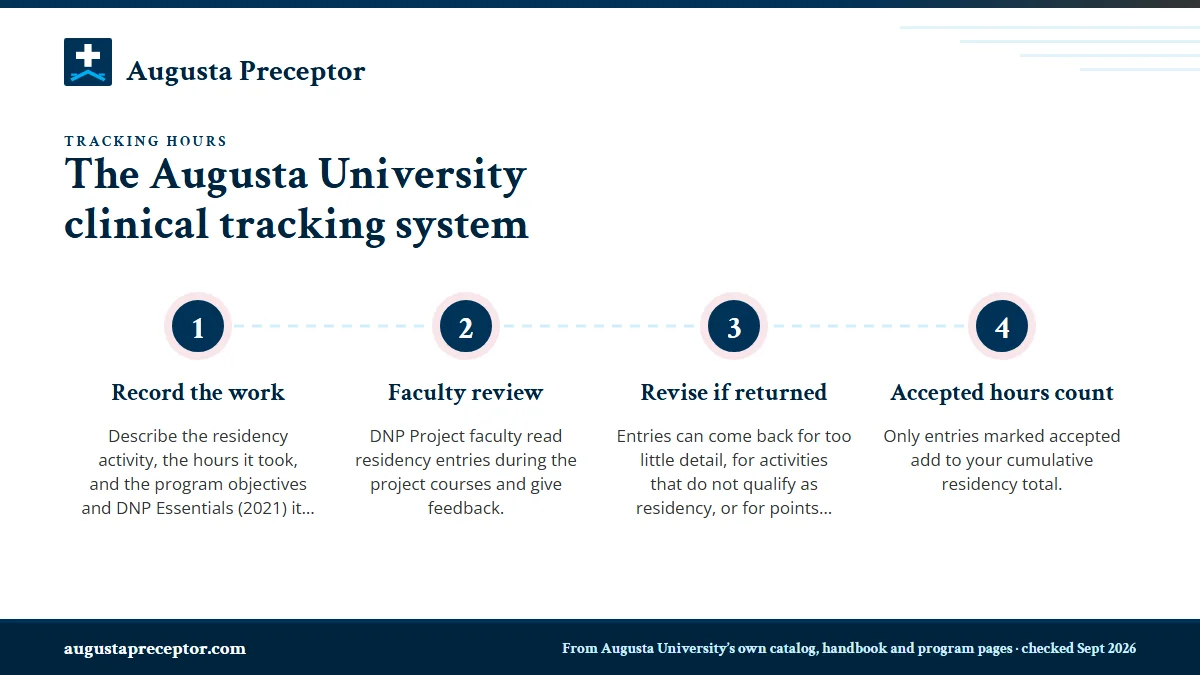
The handbook describes the residency log more fully than any other part of the system. Each entry moves through the same cycle.
- Record the workDescribe the residency activity, the hours it took, and the program objectives and DNP Essentials (2021) it meets.
- Faculty reviewDNP Project faculty read residency entries during the project courses and give feedback.
- Revise if returnedEntries can come back for too little detail, for activities that do not qualify as residency, or for points needing clarification.
- Accepted hours countOnly entries marked accepted add to your cumulative residency total.
Residency hours are not limited to direct patient care. The handbook's examples include carrying out the DNP Project, presentations or work groups tied to it, pre-approved workshops or conferences within practicum limits, collecting and analyzing data, reviewing policy at a practice site, and meetings with project stakeholders. The residency hours guide covers the totals and the post-master's gap analysis.
What to keep in your own files
The College's system is the official record, and a personal copy costs little to keep. Access is a paid subscription, and nothing public says how long your entries stay available after you finish. Certification boards, employers and later programs can all ask for proof of hours.
- A dated weekly summary of clinical hours for each course, with site and preceptor, matching what you entered.
- Copies of residency entries and the faculty feedback on any that came back.
- Your signed final clinical evaluation tool from each course; CON31 has you sign it.
- The College and site documents you signed before rotations, such as confidentiality and policy acknowledgment agreements.
- Each preceptor's name, credentials and license details.
- For post-master's students, the prior-hours verification used in your gap analysis.
Keeping the log clean in heavy terms
Enter hours the same day or at least the same week, while the details are fresh; errors tend to creep in when a month of shifts is typed up at once. Label every entry with its category (clinical or residency) and its course, so nothing lands in the wrong total.
Summer needs extra care. The program plans compute clinical hours on 15-week terms, but the summer 2027 terms run 10 or 11 weeks. By our arithmetic, not an Augusta University figure, the 180 hours in NURS 8315 come to about 12 a week over 15 weeks and 18 a week over 10. The summer terms guide shows how to plan those weeks.
How we keep your hours on track
Whatever route brings you to a preceptor, a clean record starts with a well-planned placement. The placement desk sets each one up so the numbers work: a preceptor who knows the course's hour target, a clinical schedule that reaches it inside the term, and a site contact who understands what may need confirming.
We compare your projected hours against each course as the term goes, flag a shortfall while there is still time to fix it, and line up extra clinical days or a second site when needed. If you are already behind, start here, or send us your course and hours.
Questions Augusta University students ask
What is the name of Augusta University's clinical tracking system?
Augusta University does not name it on public pages. The DNP handbook calls it the approved College of Nursing clinical education data tracking system; the platform name and subscription steps reach enrolled students through their courses. Treat names you hear from students at other schools as unconfirmed until your own course materials use them.
How much does the Augusta University tracking system cost?
The price is not published. The handbook says only that all students must subscribe and pay for access. The DNP tuition page separately lists a per-semester immunization tracking fee, and nothing public says whether the two are related, so budget for the subscription on its own until your course materials say otherwise.
Do DNP residency hours count toward the 1,000-hour requirement?
Yes. The handbook explains that BSN-to-DNP students earn most of their 1,000 post-baccalaureate hours in clinical courses and the rest in the residency, where the time is called practice hours. Only residency entries that faculty mark as accepted count toward the cumulative total, so returned entries need prompt revision.
Does my preceptor approve my hours in the system?
No public Augusta University document says. The handbook describes faculty reviewing residency entries, while the process for clinical course hours is left to course materials. Ask your course faculty at the start of each term how hours are confirmed, and keep your own dated record either way.
Where do DNP Project site hours get logged?
Residency hours tied to the DNP Project go in the same College system, documented with the work done, the hours, and the objectives and DNP Essentials met. The handbook says the project site partner has no role in reviewing or grading project assignments, so faculty review is what moves an entry to accepted.
Related pages
Last checked 2026-09-27
We check these pages against Augusta University's own catalog, program plans, DNP handbook and program pages, and Georgia and South Carolina rules. Your course faculty and the College of Nursing have the final word.
Whatever your program arranges, we find the preceptor who fits.
Tell us your Augusta University track, where in Georgia or South Carolina you live and when your next clinical course starts. We find preceptors near you who fit the course and Augusta University's rules, and hand you everything your faculty and the site need, well before the semester.
- Adult, pediatric and older-adult preceptors for
NURS 8312toNURS 8318, acute care forNURS 8332toNURS 8338 - Pediatric primary care for the PNP courses and psychiatric preceptors for
NURS 8342toNURS 8348 - Across Georgia and South Carolina, from the CSRA to Savannah, Atlanta and Columbia
Start your placement plan
Program, city and start date is all we need to begin.