Behind on hours in an Augusta University clinical course
Act while the term still has weeks left: measure the exact shortfall, take a written plan to your course faculty, and line up more preceptor time, often with a second preceptor. Augusta University grades clinical courses Satisfactory or Unsatisfactory, so the aim is to finish the hours and pass every clinical objective, with no averaging to lean on.
Need a second preceptor fast?
Tell us your course, the hours logged and the weeks left.
Why a shortfall matters in a pass/fail course
The catalog gives every NP practice course and NURS 9192 the Satisfactory/Unsatisfactory grade mode. Policy CON27 adds three rules: final clinical grades are pass/fail, even one unsatisfactory rating on the end-of-term summative evaluation tool means failing the clinical, and failing the clinical means failing the course, however good the didactic grade. CON31 asks for a pass on every clinical objective.
The consequences are steep. Under the DNP progression policy, CON01D, one U in any DNP course leads to dismissal, and under CON01C certificate students who earn a C in a clinical course go on probation and repeat it. Neither policy says how a shortfall in hours is rated on its own, so ask your faculty how your course treats it. The grades and time limits guide covers the full rules.
Measure the gap in hours per week
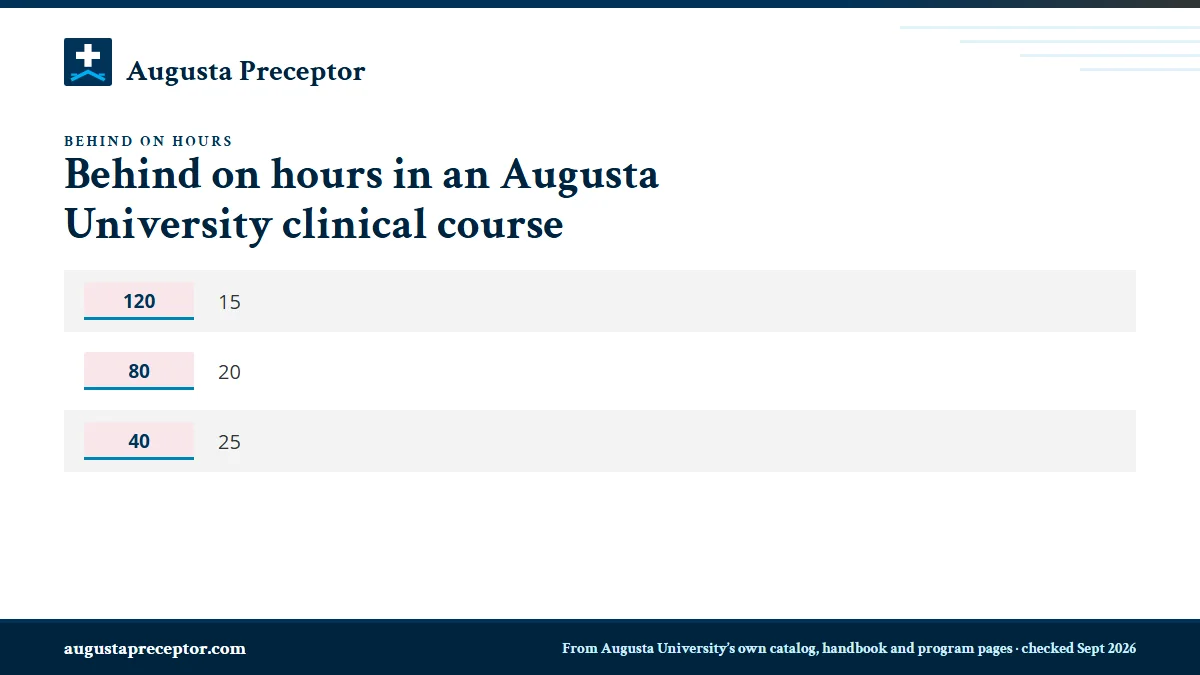
Open your log in the College of Nursing's tracking system and check it against your own notes. Then divide the hours still owed by the clinic weeks left. The table shows how quickly the weekly load climbs in a 240-hour course such as NURS 8318 or NURS 9192; the figures are our arithmetic, not Augusta University's.
| Hours logged so far | 8 weeks left | 6 weeks left | 4 weeks left |
|---|---|---|---|
| 120 | 15 | 20 | 30 |
| 80 | 20 | About 26.7 | 40 |
| 40 | 25 | About 33.3 | 50 |
Once the weekly figure passes what your preceptor's schedule can hold, the realistic options are extra days with the same preceptor, a second preceptor, or both. Policy CON20 rules out one shortcut: no work shift in the eight hours before any clinical, so a night shift before a clinic day is off the table.
Take a written plan to your course faculty
Go to faculty with numbers, not only worry. They oversee the course, visit you and your preceptor, and are the people who can tell you how your course handles a shortfall. A short written plan makes that conversation faster and shows you have thought it through.
What the plan should cover
- Hours logged and accepted so far, and hours still owed
- Weeks left in the term and the days your preceptor can offer
- The cause: cancelled clinic days, a late start, illness or a preceptor's leave
- Your fix: added days, a second preceptor, or both, with names if you have them
- Your questions: whether remediation applies, whether an Incomplete is possible, and how a second preceptor is recorded
CON31 notes that clinical remediation, meaning extra lab or clinical experiences, may be required when performance falls short, so ask whether it applies to you. If your own absences caused the gap, CON23 says a missed clinical may need a full clinical day of make-up, and a third absence in one course may lead to dismissal.
What the catalog says about an Incomplete
The catalog describes the Incomplete (I) grade as covering course requirements left unfinished at the end of a term because of circumstances beyond the student's control. You then have one more semester to finish the work. If it is still unfinished by that deadline, the I becomes an F automatically at the end of the term, though the course instructor may file an extension in POUNCE when warranted.
Two cautions for clinical courses. The catalog text does not treat Satisfactory/Unsatisfactory courses separately, so ask your faculty how an I would work in yours. And the courses chain together: the catalog makes an S in the prior practicum a prerequisite for PMHNP Practice II and III and for the later certificate practica, so an unfinished course can delay the next term. The six-year DNP clock keeps running throughout, and a leave of absence does not pause it.
Adding a second preceptor
A second preceptor adds clinic days without asking more of the first. The newcomer has to fit the same course: the same patient focus, a Georgia or multistate license and Georgia APRN authorization for clinical teaching in Georgia, or a physician practice agreement in South Carolina, plus room for your faculty to visit.
How fast it happens depends on the site. An independent practice can often begin once paperwork and your compliance items are in order, while hospital systems add their own onboarding: Piedmont wants students fully compliant 10 days before a rotation, Archbold two weeks and Northside 30 days, each after a school agreement is in place. Tell faculty before you start with anyone new, and ask how your course records hours from two preceptors.
Silence is the costliest choice. A gap raised in week six leaves faculty real options; the same gap raised in the last week leaves very few.
Protect the next course in the sequence
Hours debt tends to travel. The heaviest courses come last, 240 hours each in Practice III and NURS 9192, so a late finish in one term can squeeze the preparation for the next. Line up the next course's preceptor now, while you are catching up in this one. Give your placement advisor the next term's dates as soon as the catch-up plan is set, so both searches run in step.
If summer caused the gap, the reason is structural: the plans count 15 weeks while the 2027 summer terms run 10 or 11, so the same 180 hours arrive faster. The summer clinical terms guide shows the weekly figures, and the 840-hour guide shows where each track's hours fall.
How we help you catch up
We find the extra preceptor. Your placement advisor searches Georgia or South Carolina near you for someone whose patients fit the same course, confirms license, practice agreement and available days, and hands you the details your faculty will want, so you can walk into that conversation with a named option. Each name carries the same checks as a first placement, so a fast answer still fits the course.
If your first preceptor has left altogether, we run a full replacement search for the course and the hours still owed. How it works explains each stage; to start, send your course, hours logged and weeks left through the request form.
Questions Augusta University students ask
Can I count hours from my regular job toward a clinical course?
Only time with the preceptor and site your course recognizes belongs in the clinical log, and Augusta University publishes no rule on clinicals at your own workplace. Ask your course faculty before counting any workplace time. Remember CON20 as well: no work in the eight hours before a clinical, which matters if you hoped to stack shifts.
Do lab hours count toward the 180 or 240 clinical hours?
No. The plans of study list them separately. Practice I in each track carries 45 lab hours on top of its 180 clinical hours, and lab time sits outside the 840 direct clinical total. Extra lab time will not fill a clinic shortfall, and extra clinic time will not replace a missed lab.
My preceptor cancelled a week. What should I do first?
Log what actually happened, not what was scheduled, and tell your course faculty that week. Ask the preceptor whether other days are open later in the term, and start looking for a second preceptor at once instead of hoping the calendar recovers. Keep the preceptor's cancellation messages with your own records.
Can DNP residency hours make up a practice-course shortfall?
Expect them to stay separate. The handbook calls residency hours practice hours, earned in the DNP Project courses, while the 840 clinical hours belong to the four practice courses, and the plans of study count the two in different columns. If a residency activity and a clinic day compete for the same week, raise it with faculty.
Is being short on hours the same as failing the clinical?
Not automatically, and Augusta University's policies do not spell out how a shortfall is graded. CON27 ties the clinical grade to the final summative evaluation, and CON31 requires a pass on every clinical objective. Ask your faculty how your course treats unfinished hours well before the final evaluation is written.
Related pages
Last checked 2026-09-27
We check these pages against Augusta University's own catalog, program plans, DNP handbook and program pages, and Georgia and South Carolina rules. Your course faculty and the College of Nursing have the final word.
- Augusta University College of Nursing policy CON27: grading
- Augusta University College of Nursing policy CON31: clinical evaluation
- Augusta University College of Nursing policy CON01D: DNP progression
- Augusta University Catalog 2026-2027: academic regulations
- Augusta University College of Nursing policy CON20
Whatever your program arranges, we find the preceptor who fits.
Tell us your Augusta University track, where in Georgia or South Carolina you live and when your next clinical course starts. We find preceptors near you who fit the course and Augusta University's rules, and hand you everything your faculty and the site need, well before the semester.
- Adult, pediatric and older-adult preceptors for
NURS 8312toNURS 8318, acute care forNURS 8332toNURS 8338 - Pediatric primary care for the PNP courses and psychiatric preceptors for
NURS 8342toNURS 8348 - Across Georgia and South Carolina, from the CSRA to Savannah, Atlanta and Columbia
Start your placement plan
Program, city and start date is all we need to begin.