Grades, progression and time limits in Augusta University nursing programs
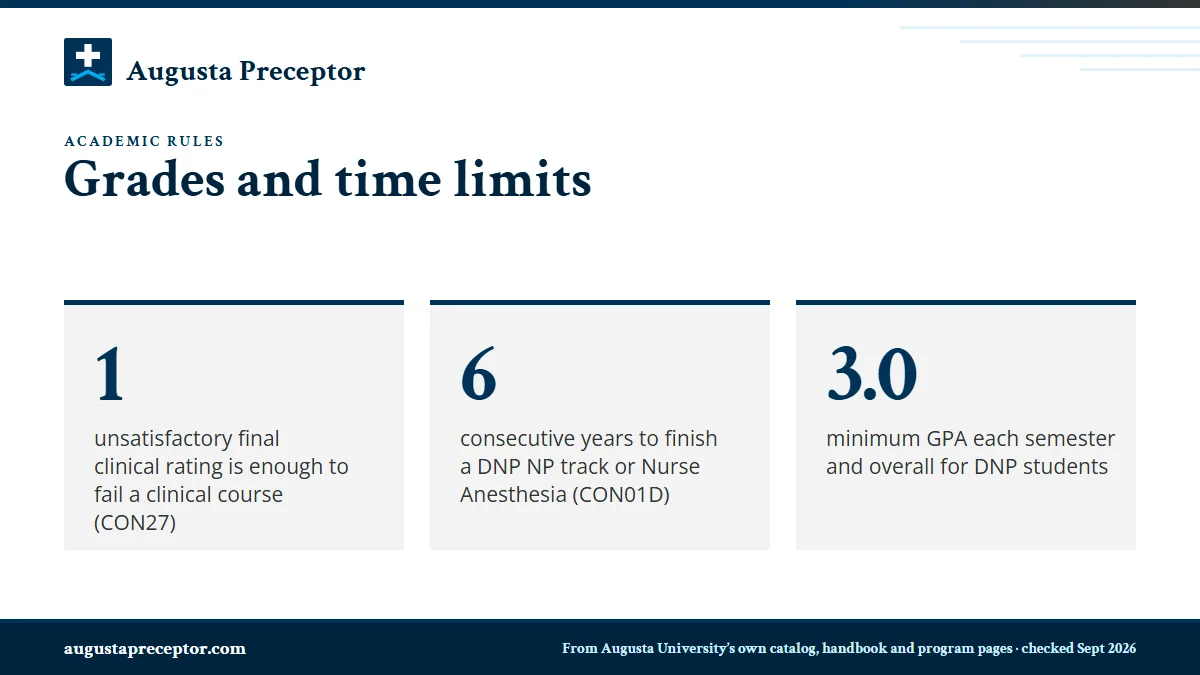
Augusta University grades every NP clinical course Satisfactory or Unsatisfactory, and a single unsatisfactory mark on the end-of-course clinical evaluation is enough to fail it. In a DNP program a single U means dismissal, whatever your GPA. DNP nurse practitioner and anesthesia students have six consecutive years to finish, post-master's DNP students five, and certificate students three.
Protect your clinical semester
Tell us your Augusta University track and next clinical course. A placement advisor finds a preceptor who fits the course objectives.
How clinical courses are graded
The catalog gives every DNP nurse practitioner practice course and NURS 9192 the grade mode Satisfactory/Unsatisfactory. College of Nursing policy CON27 adds the rules behind that grade: final clinical grades are pass or fail, the clinical is failed if even one item on the final summative evaluation tool is marked unsatisfactory, and a student who fails the clinical portion fails the whole course, however strong the didactic grade.
CON31 describes the evaluation itself. You need a pass rating on every clinical objective, your performance is recorded on the course's own clinical evaluation tool, and you may comment on the final tool and must sign it. When performance falls short, faculty can require remediation in the form of extra lab or clinical time. The policies do not say whether your preceptor or your faculty fills in the tool; ask at the start of each course.
Nurse Anesthesia is the exception. Its practicums carry normal letter grades, and each practicum after the first needs a B or higher in its predecessor, per the catalog.
An S depends on every objective, not an average. Strong exams cannot rescue a failed clinical, so a preceptor whose patients match the objectives your course names matters as much as the hours themselves.
Progression and dismissal in the DNP
CON01D sets the DNP progression rules, and they are strict. Keep a GPA of at least 3.0 every semester and overall. A C in any nursing course puts you on academic probation and you repeat the course. Two Cs, or a single U, D or F in any DNP course, leads to dismissal from the College of Nursing regardless of GPA. Because the NP practicums are graded S/U, one U in a clinical course ends the program.
The Graduate School's handbook sets a lower floor, a cumulative GPA of 2.8, and notes that programs may hold students to more; the College of Nursing's 3.0 is the number that applies to you. It also allows a program to recommend dismissal for a D, F or U in a required graduate course.
Conduct can end a program faster than grades. CON27 warns that behavior endangering patient safety or confidentiality, or acting directly against clinical faculty direction, may bring immediate dismissal. Attendance counts too: under CON23 missing a third clinical day in one course can end the program, arriving 15 minutes or more late can get you asked to leave, and any absence must be reported to both your clinical instructor and the facility's designated contact before the shift begins.
Certificate and post-master's students
Post-graduate certificate students follow CON01C. A C in a clinical course brings probation and a required repeat, and the certificate practicums build on each other: for example, the catalog lists NURS 8370 as needing an S in NURS 8333, and NURS 8351 as needing an S in NURS 8350. A slip in the first spring therefore delays the whole sequence.
Post-master's DNP students in the Traditional and Nurse Executive programs have no patient-care practicums, but their residency hours go into the same paid tracking system, and the DNP handbook counts only logs marked accepted toward the total. The residency hours guide explains the 540-hour minimum and the 1,000-hour rule.
The AGACNP certificate and PMHNP certificate guides lay out each sequence term by term.
Time limits by program
The clock starts at your first enrollment and keeps running. CON01D says a leave of absence or withdrawal does not change the deadline, so a paused semester still counts against it.
| Program | Limit | Source |
|---|---|---|
| DNP-FNP, DNP-AGACNP, DNP-PNP, DNP-PMHNP | 6 consecutive years | CON01D; the Graduate Student Handbook agrees |
| DNP Nurse Anesthesia | 6 consecutive years | CON01D |
| DNP Traditional and DNP Nurse Executive (post-master's) | 5 consecutive years | CON01D |
| Post-graduate certificates, AGACNP and PMHNP | 3 consecutive years | CON01C |
By our arithmetic, a full-time NP plan of three years leaves three spare years inside the six, and a four-year part-time plan leaves two. A stalled clinical course, a repeat or an Incomplete eats into that margin quickly.
Incompletes have their own deadline. The catalog allows an I grade only when circumstances beyond your control stop you from finishing, gives one more semester to complete the work, and turns the I into an F automatically if that semester ends first. An instructor can extend the period through POUNCE when warranted.
Transfer credit and prior hours
Policy CON08 limits transfer credit in three ways: the course must be from the previous five years, you must have earned at least a B or its equivalent, and no more than 25% of any program's hours may transfer. Course substitution requests go to a JagTrax contact, and the finished transfer evaluation appears in JagTrax, as the student tools guide explains.
Prior clinical hours are handled differently. Post-master's DNP students have earlier graduate hours verified, and a gap analysis sets what remains; certificate students may owe up to 750 clinical hours after their own gap analysis. Clinical course credit for NP practicums taken elsewhere is not described in the public policies, so raise it with the College of Nursing before you count on it.
Academic integrity and honest logs
The catalog calls academic honesty essential to the university's academic function and points to section five of the Student Manual for the standards and the process for violations. The Graduate School follows the same Academic Honesty and Student Conduct Policies, and the DNP handbook expects students to know the rules on integrity, professional conduct and clinical responsibilities. Even at admission, the DNP essays may not be written wholly by AI.
The DNP Project has its own version of the rule. The handbook allows group projects only with early faculty approval, grades every member individually on every element, and rules out shared components and shared grades; for posters and papers it follows the ICMJE authorship criteria.
Clinical logs fall under the same standard. Record hours only as you work them, with the preceptor and site your faculty approved, and keep your own dated notes in case a log is questioned.
How we help you keep your standing
Most threats to a clinical grade start before the first shift: a preceptor whose patients miss the course objectives, a site that drops you mid-term, or a late start that leaves too few weeks for the hours. We work on all three. However placement works in your program, we locate a Georgia or South Carolina preceptor whose patients suit each course from NURS 8312 to NURS 9192, test the match against Augusta University's published rules, and have your faculty's details ready well before the term.
If a preceptor steps away, your placement advisor starts on a replacement right away, so a lost preceptor costs you as little time as possible. See how it works, or if you are already short on hours, read behind on clinical hours.
Questions Augusta University students ask
What happens if I get a U in an Augusta University DNP clinical course?
Under CON01D, one U in any DNP course leads to dismissal from the College of Nursing regardless of GPA, and the Graduate School also lets a program recommend dismissal for a U. If you believe the grade is wrong, CON06 starts the appeal clock when the grade posts on D2L, with five business days to act.
Does a leave of absence stop the six-year DNP clock?
No. CON01D says a leave of absence or a withdrawal does not modify a student's obligation to finish within six consecutive years of first enrollment. If you expect time away, map your remaining clinical courses against that date with your advisor before you step out.
What GPA do I need to stay in an Augusta University DNP program?
At least 3.0 each semester and overall, per CON01D. The Graduate School's general floor is 2.8, but it allows programs to set a higher bar and the College of Nursing does. A C in any nursing course also means probation and a repeat, and a second C means dismissal.
Can a certificate student repeat a clinical course?
CON01C says a C in a clinical course brings probation and a required repeat. Because each certificate practicum after the first lists the one before as a prerequisite, a repeat usually shifts every later course by a term, and the whole certificate must still be finished within three consecutive years of enrollment.
Who fills in my clinical evaluation at Augusta University?
The College of Nursing's policies say performance is recorded on each course's clinical evaluation tool and that you comment on and sign the final one, but they do not say whether the preceptor, the faculty member or both complete it. Your course syllabus or faculty will explain the process for that course.
Related pages
Last checked 2026-09-27
We check these pages against Augusta University's own catalog, program plans, DNP handbook and program pages, and Georgia and South Carolina rules. Your course faculty and the College of Nursing have the final word.
Whatever your program arranges, we find the preceptor who fits.
Tell us your Augusta University track, where in Georgia or South Carolina you live and when your next clinical course starts. We find preceptors near you who fit the course and Augusta University's rules, and hand you everything your faculty and the site need, well before the semester.
- Adult, pediatric and older-adult preceptors for
NURS 8312toNURS 8318, acute care forNURS 8332toNURS 8338 - Pediatric primary care for the PNP courses and psychiatric preceptors for
NURS 8342toNURS 8348 - Across Georgia and South Carolina, from the CSRA to Savannah, Atlanta and Columbia
Start your placement plan
Program, city and start date is all we need to begin.