DNP residency hours at Augusta University
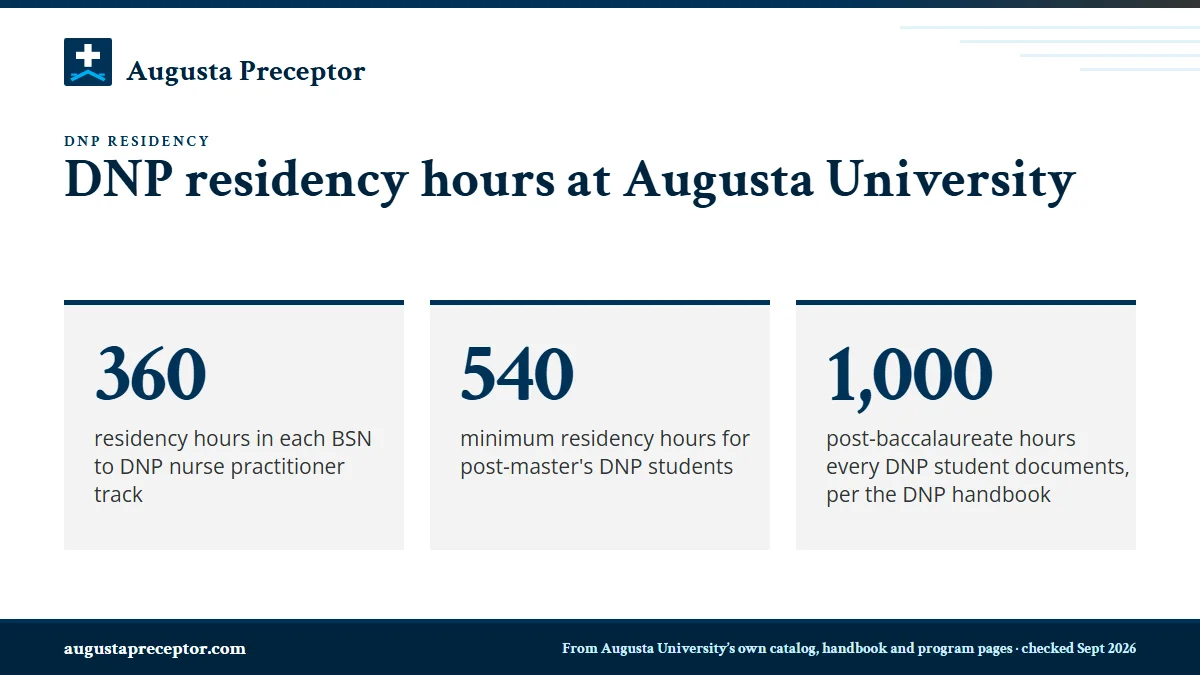
Every Augusta University DNP student earns residency hours through the DNP Project courses: 360 in the BSN to DNP nurse practitioner tracks, and at least 540 for post-master's students. The DNP handbook calls them practice hours, counts them toward a 1,000-hour post-baccalaureate minimum, and accepts indirect care work as well as patient care.
Find a setting for your residency
Share your track and project topic. We look for a practice setting and partner that fit.
Residency hours, course by course
Six project courses carry the DNP Project from question to dissemination, and five of them include residency hours. The handbook says the project courses run in sequence, with no exceptions. BSN to DNP students take the variable-credit courses at six residency credits in total; post-master's students take at least nine, mainly by enrolling in NURS 9062 for more credits. At 60 hours per credit, that is 360 hours against 540. For every program's totals in one table, see clinical hours by program.
| Course | Title | Semester | BSN to DNP | Post-master's |
|---|---|---|---|---|
NURS 7150 | Evidence-Based Practice: Principles and Process | Fall | 60 | 60 |
NURS 8550 | Evidence-Based Practice: Translation and Application | Spring | 60 | 60 |
NURS 9050 | Strategies for Effective Practice Change, Proposal | Summer | 0 | 0 |
NURS 9060 | Practice Inquiry and Change Design | Not listed; taken with NURS 9050 | 60 | 60 |
NURS 9061 | Practice Inquiry and Change Implementation | Fall | 120 | 120 |
NURS 9062 | Practice Inquiry and Change Dissemination | Spring | 60 | 240 |
| Total | 360 | 540 |
The 1,000-hour rule and how your total is built
Citing the AACN Essentials, the DNP handbook requires every DNP student to document at least 1,000 supervised post-baccalaureate hours. BSN to DNP nurse practitioner students reach most of that through the 840 clinical hours in their practice courses, and the 360 residency hours take them to the 1,200 the catalog prints.
Post-master's students arrive with verified hours from their master's program and make up the rest in residency. The handbook accepts two kinds of proof. Your prior program director can complete the Verification of Post-BSN Clinical and Practice Hours form, returned to the program manager before you register, or the body that certified you can send verification of current advanced practice certification to NursingCAS. Certification earns only 500 hours of credit. Either way, the Concentration Coordinator runs a gap analysis, and you complete at least 540 residency hours at Augusta University however many you bring.
Nurse Executive students work toward the same 1,000. Their program page gives the gap analysis to the Nurse Executive Concentration Coordinator, the catalog lets hours be added to any semester, and the part-time plans note that more residency hours may be needed. The post-master's DNP guide covers those tracks.
What counts as residency: the handbook's examples
Residency hours are not meant to be only direct patient care. The handbook asks for indirect care work in health care or related settings that builds toward the DNP Essentials and your program objectives, and its Appendix A gives examples. In our paraphrase, they include:
- Meetings about your DNP Project problem, and agency or community meetings that review a protocol, guideline or improvement project
- Planning sessions with an organization, and meetings with consultants or content experts on your project question
- Work with other doctoral students, including PhD students and other disciplines, and attending other students' DNP Project presentations
- Health department initiatives that involve students from other fields
- Using databases to evaluate outcomes of care, and collecting or analyzing data, including with a statistician
- Leadership work alongside a nurse leader, program director or manager, including mentoring from a dean, director or chief executive
- Site visits to learn about your topic, presentations or work groups on the project, and pre-approved workshops, webinars or conferences
- Helping write a grant proposal, reviewing journals with a mentor, revising policy at a practice site, or organizing community disaster preparedness
The handbook adds that these examples do not take the place of any direct clinical hours you need to master skills. When an activity looks borderline, ask your DNP Project faculty before you log it.
Logs and documentation
Residency hours go into the approved College of Nursing tracking system, the same paid platform NP students use for clinical hours. Each entry records the residency work you did, the hours it took, and the program objectives and DNP Essentials it met. The tracking system guide sets out what Augusta University publishes about the platform.
DNP Project faculty review your entries during the project courses. They can send a log back for more information, for clarification, or because the activity does not qualify as residency. Only logs marked accepted add to your cumulative residency total.
An hour you worked but that was never accepted does not count. Log each activity soon after it happens, tie it to a named objective, and fix returned logs quickly so a course does not end with hours still waiting for review.
Where the residency numbers conflict
Several published details disagree. Your plan of study and your faculty settle each one.
NURS 9062hours: the catalog description says students complete 60 residency hours, which matches the BSN to DNP plans. The post-master's plans schedule the same variable-credit course at five credits, or 240 hours, and it is those plans that add up to 540.- 500 or 540: a note in the handbook says the extra credits give post-master's students 'the required 500' of the 1,000 hours, while the same handbook sets the in-program minimum at 540 hours, or nine residency credits. The plans print 540.
- Course numbers: parts of the handbook still mention
NURS 9051andNURS 9052; its own course table and the catalog useNURS 9060,NURS 9061andNURS 9062. - Campus presence: the catalog describes one or two campus visits for the post-master's tracks, the program pages call them fully online, and the Graduate School requires a face-to-face orientation and defense.
Your project site and practice partner
The handbook describes a DNP project team of three: you, a faculty advisor, and a practice partner or sponsor from the site where the project takes place. It sets no educational requirements or credentials for that partner, who does not review or grade course assignments. Faculty assess your learning needs, write the practice objectives with you, orient any preceptor or mentor, and stay accountable for evaluating your learning.
Augusta University does not publish who secures a project site. Whether or not your program helps with that, a setting with a willing partner and a real practice problem makes residency hours far easier to earn and log. Our placement desk looks for a setting near you that fits your project question. For NP students we plan it alongside the preceptors for your practice courses, so residency work and clinical days do not compete for the same weeks. Send your project topic through the request form.
Questions Augusta University students ask
Do residency hours count toward the 840 clinical hours?
No. The plans keep them in separate columns: 840 clinical hours from the four practice courses and 360 residency hours from the project courses. The handbook even names them differently, calling residency time practice hours. Both count toward the 1,000-hour minimum and the catalog's 1,200, but neither can stand in for the other.
Can I earn Augusta University residency hours at my own workplace?
Augusta University does not publish a rule on residency hours at your employer. The handbook asks for activities tied to your DNP Project, the DNP Essentials and your program objectives, reviewed by project faculty, so the test is fit rather than location. Raise it with your faculty advisor before you log any hours there.
What if my master's program already had more than 1,000 clinical hours?
You still complete at least 540 residency hours at Augusta University. The handbook applies that minimum regardless of how many hours your master's program verifies. Verified hours cannot shorten the residency below nine residency credits, although enough of them can keep you from needing hours beyond the 540.
Do nurse anesthesia students complete DNP residency hours?
Yes. The fall 2026 nurse anesthesia curriculum lists 360 DNP residency hours in addition to 2,280 clinical hours and 315 lab hours. The handbook's residency rules, logging and faculty review apply to every DNP student, while the anesthesia plan sets when those hours fall across its nine semesters.
What if I fall short of residency hours when a project course ends?
Augusta University does not publish a make-up rule for residency hours. The catalog's Incomplete grade gives a student whose circumstances were beyond their control one more semester to finish, after which it becomes an F. Talk to your project faculty before the course ends, not after.
Related pages
Last checked 2026-09-27
We check these pages against Augusta University's own catalog, program plans, DNP handbook and program pages, and Georgia and South Carolina rules. Your course faculty and the College of Nursing have the final word.
Whatever your program arranges, we find the preceptor who fits.
Tell us your Augusta University track, where in Georgia or South Carolina you live and when your next clinical course starts. We find preceptors near you who fit the course and Augusta University's rules, and hand you everything your faculty and the site need, well before the semester.
- Adult, pediatric and older-adult preceptors for
NURS 8312toNURS 8318, acute care forNURS 8332toNURS 8338 - Pediatric primary care for the PNP courses and psychiatric preceptors for
NURS 8342toNURS 8348 - Across Georgia and South Carolina, from the CSRA to Savannah, Atlanta and Columbia
Start your placement plan
Program, city and start date is all we need to begin.