The 840 direct clinical hours in every Augusta University NP track
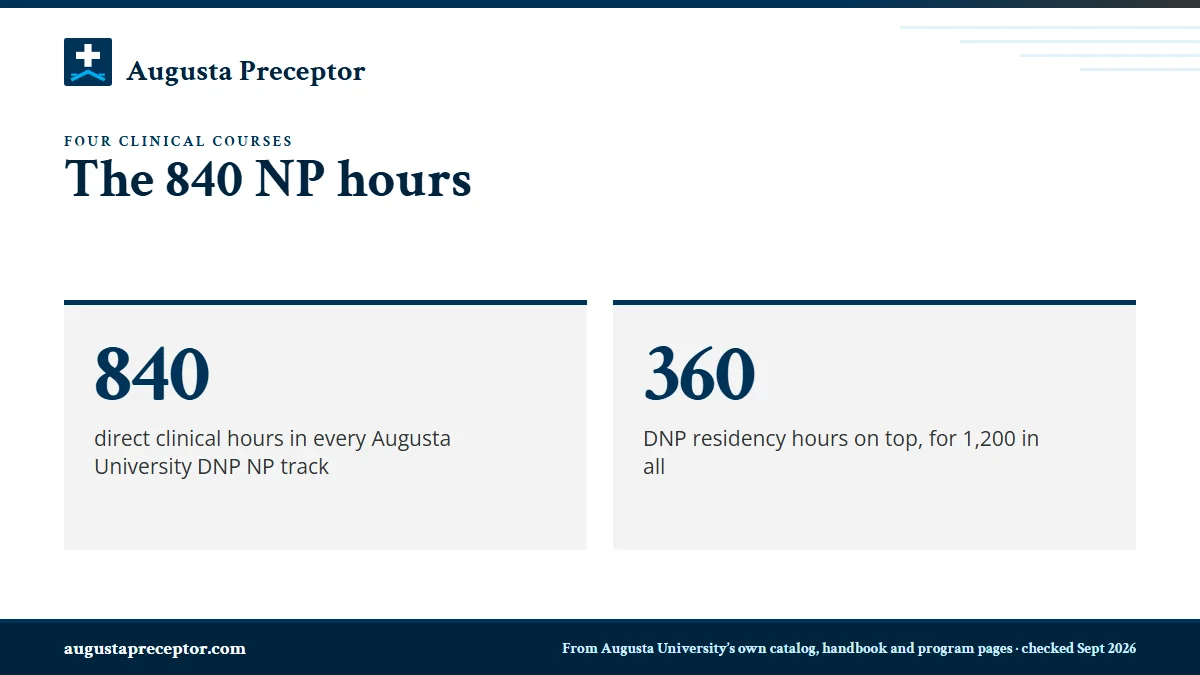
Each Augusta University DNP nurse practitioner concentration spreads 840 direct clinical hours over four courses: two of 180 hours, then two of 240. Add the 360 DNP residency hours and you reach the catalog's 1,200. The two 240-hour courses at the end make up the heaviest run of precepted time in the program.
Match a preceptor to each of your four courses
Give us your track and start term. We line up preceptors in Georgia or South Carolina course by course.
Four courses per track, always in the same order
The fall 2026 plans of study give every concentration four clinical courses in a fixed sequence. Practice I opens with 180 clinical hours plus a 45-hour lab, Practice II adds another 180, Practice III carries 240, and each track closes with the shared NURS 9192 practicum at 240. The totals match across DNP-FNP, DNP-AGACNP, DNP-PNP and DNP-PMHNP. What changes from track to track is the patient population and the setting.
Course numbers follow a pattern that makes them easy to read. FNP practice courses sit in the 8310s, PNP in the 8320s, AGACNP in the 8330s and PMHNP in the 8340s, and most are paired with a didactic course numbered one lower, such as NURS 8314 alongside NURS 8315. Knowing the pair helps when you brief a preceptor, since the didactic course sets the content your clinic days put into practice.
The four courses side by side
Find your course number in a row, or read down a column to see your whole clinical run. The plans write credits as lecture-lab-clinical-credit, so Practice I at 0-1-3-4 means one lab credit worth 45 hours and three clinical credits worth 180 hours.
| Course | Clinical hours | DNP-FNP | DNP-AGACNP | DNP-PNP | DNP-PMHNP | Full-time term |
|---|---|---|---|---|---|---|
| Practice I | 180, plus 45 lab | NURS 8312 | NURS 8332 | NURS 8322 | NURS 8342 | Spring, year 2 |
| Practice II | 180 (AGACNP adds 45 lab) | NURS 8315 | NURS 8335 | NURS 8325 | NURS 8345 | Summer, year 2 |
| Practice III | 240 | NURS 8318 | NURS 8338 | NURS 8328 | NURS 8348 | Fall, year 3 |
| Final practicum | 240 | NURS 9192 | NURS 9192 | NURS 9192 | NURS 9192 | Spring, year 3 |
| Whole plan | 840 clinical, 360 residency | 135 lab | 180 lab | 135 lab | 135 lab | 3 years full time |
The catalog gives each track its own arc. FNP moves from adults in primary care to infants, children and adolescents, then to older adults and their families. AGACNP Practice II and III focus on adults and older adults with complex, urgent and rapidly changing needs. PMHNP Practice II and III add child or adolescent and adult therapy groups with supervision. The FNP, AGACNP, PNP and PMHNP course guides take each course in turn.
Which terms carry the hours, full time and part time
On the three-year full-time plans, clinical hours begin in the spring of year two and continue for four straight terms: spring, summer, fall, spring. Year one and the fall of year two are didactic, apart from two 45-hour labs in NURS 7470 Advanced Health Assessment (summer of year one) and NURS 7460 Diagnostic and Clinical Reasoning (fall of year two). That leaves more than a year to line up a Practice I preceptor before the first clinical term.
The four-year part-time plans print the same totals, 840 clinical and 360 residency hours in every track, on a longer schedule. Each concentration page on augusta.edu posts both versions. Open the part-time plan for your track to see which terms hold each clinical course, and settle any change with your advisor before a preceptor commits to dates.
What 240 hours in one term means each week
The plans assume a 15-week semester. Spread evenly, 240 hours is 16 hours a week and 180 hours is 12, by our arithmetic. Real clinic weeks tend to be fewer. The fall 2026 classes run August 18 to November 24, about 14 weeks, which lifts a 240-hour course to roughly 17 hours a week before any time lost to site onboarding or holidays.
| Weeks at the site | 180-hour course | 240-hour course |
|---|---|---|
| 15 (plan basis) | 12 | 16 |
| 14 | About 12.9 | About 17.1 |
| 12 | 15 | 20 |
| 10 | 18 | 24 |
In clinic terms, 16 hours a week is two eight-hour days, against one and a half days for a 180-hour course over 15 weeks.
The two 240-hour courses run back to back, fall then spring of year three. A preceptor who can keep you for both terms saves a second search at the point in the program when time is shortest.
The 45-hour labs sit outside the 840
The plans calculate lab hours at three contact hours per credit, so each lab credit is 45 hours. Practice I carries one lab credit in every track, and AGACNP Practice II carries a second, which is why DNP-AGACNP shows 180 lab hours against 135 in the other three. The remaining two labs belong to the health assessment and diagnostic reasoning courses that come before clinicals.
Lab hours are not part of the 840 and are not preceptor time. The catalog attaches a nursing skills lab fee to the NP practice courses. Augusta University does not publish where or when each practice course lab meets; what it says about the campus intensive is in the MEGAI guide. Practice I is the first term that combines a lab, a didactic course and 180 hours at a site, so leave room in the preceptor schedule for lab dates once your faculty post them.
Adding the 360 residency hours
The 840 clinical hours are one part of the catalog's 1,200. The other 360 are DNP residency hours, which the handbook calls practice hours, earned in the project courses from NURS 7150 to NURS 9062. They can include indirect care work tied to your DNP Project, and project faculty review those logs on their own track. Both kinds of hours go into the College of Nursing's paid tracking system. DNP residency hours explains the course-by-course split and the 1,000-hour rule behind it.
The two kinds of hours run on separate calendars. The handbook offers NURS 9061, with 120 residency hours, in a fall term and NURS 9062 in a spring term, so check your plan for terms where project work and a practice course share the same weeks, and build your clinic schedule around both.
A matched preceptor for each course
However your course arranges its clinical experiences, the four courses call for four different kinds of practice, and each site must be in Georgia or South Carolina so faculty can visit you, your preceptor and the site. Our placement desk plans your whole clinical run at once. We map each course to the patients it asks for, find preceptors near you who fit, check every match against Augusta University's published rules and the state's licensing rules, and have the site paperwork ready before each term opens. For Practice II we look for a preceptor with more clinic days to offer, because summer terms are shorter than the plans assume.
If a preceptor steps back partway through a course, we find a replacement quickly so the hours keep moving. Send your track and start term through the form below.
Questions Augusta University students ask
Why does Practice I carry four credits but only 180 clinical hours?
One of its four credits is lab. The plans write Practice I as 0-1-3-4: no lecture, one lab credit worth 45 hours, and three clinical credits worth 60 hours each. Practice III and NURS 9192 are written 0-0-4-4, four clinical credits with no lab, and four times 60 is where their 240 hours come from.
Do Augusta University NP practice courses have grade prerequisites?
In the catalog, only the PMHNP track sets them. NURS 8345 needs at least a B in NURS 8341 and a Satisfactory in NURS 8342, and NURS 8348 needs a Satisfactory in NURS 8345. The FNP, AGACNP and PNP practice courses list no prerequisites there, although each is taken alongside its didactic course.
Can I split a 240-hour course between two preceptors?
Augusta University does not publish a rule on dividing one course's hours across preceptors or sites. Ask your course faculty before arranging it, since faculty visit each site you use. If they approve a second preceptor, our placement desk can find one who fits the same course and population.
Do part-time NP students complete fewer clinical hours?
No. The four-year part-time plans print the same totals as the full-time plans: 840 clinical hours and 360 residency hours in each track, with 135 or 180 lab hours. Part-time study changes when the courses fall, not how many hours each course carries.
When should I start looking for a Practice I preceptor?
Augusta University does not publish placement deadlines. On the full-time plan, Practice I begins in the spring of year two, and health systems often need months to process a student: Wellstar's ACEMAPP page, for example, sets mid-November for spring advanced practice requests. Starting by the fall of year two leaves room for compliance and site paperwork.
Related pages
Last checked 2026-09-27
We check these pages against Augusta University's own catalog, program plans, DNP handbook and program pages, and Georgia and South Carolina rules. Your course faculty and the College of Nursing have the final word.
Whatever your program arranges, we find the preceptor who fits.
Tell us your Augusta University track, where in Georgia or South Carolina you live and when your next clinical course starts. We find preceptors near you who fit the course and Augusta University's rules, and hand you everything your faculty and the site need, well before the semester.
- Adult, pediatric and older-adult preceptors for
NURS 8312toNURS 8318, acute care forNURS 8332toNURS 8338 - Pediatric primary care for the PNP courses and psychiatric preceptors for
NURS 8342toNURS 8348 - Across Georgia and South Carolina, from the CSRA to Savannah, Atlanta and Columbia
Start your placement plan
Program, city and start date is all we need to begin.