Pediatric primary care preceptors for Augusta University's PNP Practice I to III
Every hour of Augusta University's DNP-PNP clinical sequence before the final practicum is pediatric primary care: NURS 8322, NURS 8325 and NURS 8328. Pediatric preceptors are among the hardest to secure in both states, so each search should start well ahead of its term. We find pediatric primary care preceptors near your home in Georgia or South Carolina, and that holds whether or not your program has a role in placement.
Start your pediatric preceptor search
Tell us your PNP course, term and county. Summer courses benefit most from an early start.
One population across three terms
The FNP track rotates through adults, children and older adults. The PNP track stays with children the whole way, and Augusta University describes it as a primary care concentration. The Fall 2026 plan sets the practice courses in the spring and summer of year two and the fall of year three, each paired with a course in the same term, and none of the three lists a prerequisite in the catalog.
| Course | Clinical hours | Lab hours | Credits and notation | Full-time term | Paired with |
|---|---|---|---|---|---|
NURS 8322 PNP Practice I | 180 | 45 | 4 (0-1-3-4) | Spring, year 2 | NURS 8321 |
NURS 8325 PNP Practice II | 180 | none | 3 (0-0-3-3) | Summer, year 2 | NURS 8324 |
NURS 8328 PNP Practice III | 240 | none | 4 (0-0-4-4) | Fall, year 3 | NURS 8327 |
The catalog titles name the track rather than an age band or visit type, so read each course description and syllabus for its emphasis, and ask faculty what mix of well and sick visits they expect. Practice III hands off to NURS 9192 in the spring of year three, and the 840-hour breakdown shows how the track's hours add up with the residency.
Why pediatric preceptors are scarce
Our region research across Georgia and South Carolina flagged pediatrics as one of the thinnest specialties for NP students. When we checked, Children's Healthcare of Atlanta had no public page for NP students, and MUSC Health had none for students from outside MUSC, a system that includes the MUSC Shawn Jenkins Children's Hospital in Charleston.
The calendar adds pressure. PNP Practice II and FNP Practice II both fall in the summer of year two, so two Augusta University tracks look for pediatric preceptors in the same short term. By our reading, that makes summer the hardest pediatric term to fill, and it is the search we open first.
Setting matters as well. Much hospital-based pediatric care is inpatient and acute, while this track is primary care. In our view a children's hospital unit may not supply the office-based visits a primary care course is built around, so the strongest matches are usually outpatient.
Where pediatric primary care happens in both states
These are the places we search, roughly in order of how often they fit a PNP course:
- General pediatric practices, private or hospital-owned, the most direct fit for every PNP course.
- Community health centers with pediatric providers. HRSA lists 44 service sites across the 13 CSRA counties around Augusta, four of them school-based, and 100 in South Carolina's Pee Dee alone.
- Children's hospital outpatient clinics. In Augusta, Wellstar Children's Hospital of Georgia is part of Wellstar MCG Health and follows Wellstar's ACEMAPP process, and Wellstar's MCG Health Ambulatory entity lists pediatric primary care NP programs among those it accepts.
- School-based health centers, a good second setting for the fall course while school is in session.
- Rural and shortage-area practices, where one pediatric clinician may see a wide spread of ages and conditions.
A Georgia preceptor needs a Georgia or multistate license, and the Board of Nursing expects APRN clinical instruction from a nurse with Georgia APRN authorization. The CSRA guide covers the health systems and community health centers around Augusta.
Building the three PNP placements
The table gives our suggestions, which your course faculty should confirm. Augusta University does not publish setting rules for PNP courses.
| Course | What we look for | Why it fits |
|---|---|---|
NURS 8322, spring | A general pediatric office with a full, predictable schedule | A steady flow of visits gives a first clinical term its rhythm, and the course also carries 45 lab hours |
NURS 8325, summer | A practice that keeps full clinic days through the summer | The short summer term squeezes 180 hours into fewer weeks |
NURS 8328, fall | A second setting: a community health center, school-based site or a busier practice | At 240 hours it is the longest PNP course, and a new setting broadens what you see before the final practicum |
Augusta University does not publish whether one practice may host more than one PNP course. Continuity has real value in pediatrics, where you can follow the same children from visit to visit, so if you hope to stay with one practice, raise it with faculty early.
Summer's NURS 8325, in hours per week
The plan counts NURS 8325 as 180 hours on a 15-week semester, which works out to 12 hours a week. The Summer 2027 calendar instead offers a 10-week full term, May 17 to July 22, and an 11-week term, May 10 to Aug. 3. Our arithmetic: about 18 hours a week over 10 weeks, or about 16.4 over 11, before closures such as Memorial Day, Juneteenth and July 5. Part-time students should find where NURS 8325 lands in the four-year plan, which keeps the same totals.
For a pediatric preceptor, that means two or more full clinic days most weeks for the whole summer, so ask about vacation plans before you commit; one absent week is hard to recover. The summer terms guide covers the heavier weeks for every track.
How our placement desk runs a PNP search
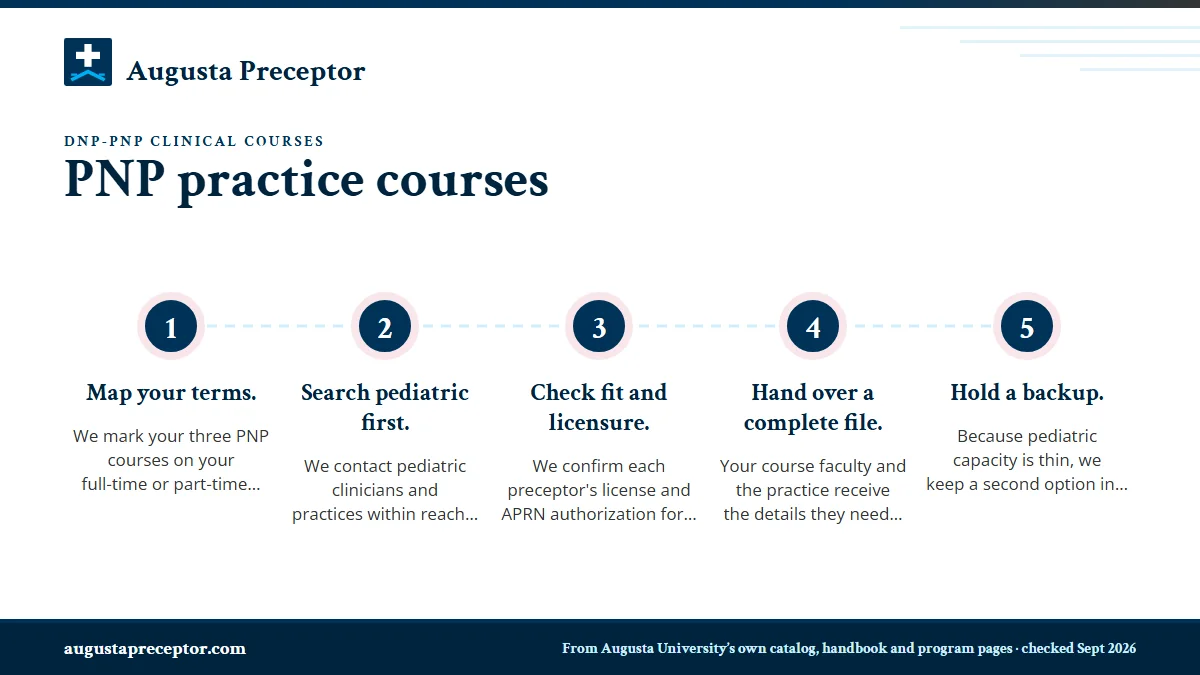
- Map your terms.We mark your three PNP courses on your full-time or part-time plan and set a start date for each search, earliest for summer.
- Search pediatric first.We contact pediatric clinicians and practices within reach of your home, including community health centers and practices outside the metro areas.
- Check fit and licensure.We confirm each preceptor's license and APRN authorization for Georgia or South Carolina and ask about pediatric volume and summer schedules.
- Hand over a complete file.Your course faculty and the practice receive the details they need early, so review and any faculty visit go smoothly.
- Hold a backup.Because pediatric capacity is thin, we keep a second option in view and step in quickly if a preceptor withdraws.
Tell us your course and term through the placement form.
Questions Augusta University students ask
Is Augusta University's PNP track primary care or acute care?
Primary care. The catalog lists a separate Pediatric Nurse Practitioner - Acute Care concentration among programs submitted for future approval, so it is not an option today. For the primary care track, Augusta University names the Pediatric Nursing Certification Board and the American Nurses Credentialing Center as certification bodies.
Can a family nurse practitioner precept a PNP student?
Augusta University does not publish preceptor qualifications for its NP courses, so there is no public rule for or against a family nurse practitioner. What matters is that the preceptor sees enough children for the course and holds the right Georgia or South Carolina authorization. Ask your course faculty before you commit to a non-pediatric preceptor.
Is there a post-graduate PNP certificate?
Not at present. Augusta University's certificate pages list only AGACNP and PMHNP. The catalog still carries older PNP certificate practice courses, NURS 8355, NURS 8356 and NURS 8357, and the College's accreditation line still names a PNP certificate, a conflict between pages. For new applicants, the current certificate pages are the better guide.
Do PNP students go to MEGAI?
Yes. Augusta University names PNP students, together with FNP and AGACNP students, for its multi-day campus skills intensive, and casting is on the published skill list. Dates and length are not posted; see our MEGAI guide for planning around it.
Can PNP hours be done at a children's hospital?
Augusta University publishes no setting rule for PNP courses. Because the track is primary care, outpatient pediatric clinics usually fit better than inpatient units. A children's hospital's ambulatory clinics can work; in Augusta, Wellstar's children's hospital applications run through ACEMAPP on published deadlines well before each term, so start early.
Related pages
Last checked 2026-09-27
We check these pages against Augusta University's own catalog, program plans, DNP handbook and program pages, and Georgia and South Carolina rules. Your course faculty and the College of Nursing have the final word.
Whatever your program arranges, we find the preceptor who fits.
Tell us your Augusta University track, where in Georgia or South Carolina you live and when your next clinical course starts. We find preceptors near you who fit the course and Augusta University's rules, and hand you everything your faculty and the site need, well before the semester.
- Adult, pediatric and older-adult preceptors for
NURS 8312toNURS 8318, acute care forNURS 8332toNURS 8338 - Pediatric primary care for the PNP courses and psychiatric preceptors for
NURS 8342toNURS 8348 - Across Georgia and South Carolina, from the CSRA to Savannah, Atlanta and Columbia
Start your placement plan
Program, city and start date is all we need to begin.