Augusta University's DNP-PNP: pediatric primary care, semester by semester
Augusta University prepares pediatric nurse practitioners through a 78-credit DNP in pediatric primary care, full time over three years or part time over four, starting each fall. Four precepted courses add up to 840 hours of pediatric clinical practice, and 360 residency hours complete the 1,200 the catalog lists, with every clinical hour spent in Georgia or South Carolina.
Find your pediatric preceptor
Give us your county and your first pediatric term, and your placement advisor will plan all four PNP courses with you.
Primary care, and only primary care for now
The DNP-PNP prepares nurse practitioners for pediatric primary care, the office-based care of children from infancy through adolescence. Augusta University lists a DNP concentration in pediatric acute care among programs submitted for future approval, not as an open option, so today's pediatric track is primary care only.
There is no pediatric post-graduate certificate on the current lists either. The catalog still holds older PNP certificate practicum courses, NURS 8355 to NURS 8357, but the Graduate School and the certificates page name only acute care and psychiatric mental health certificates. The DNP Handbook says the NP concentrations admit post-master's students, so for a nurse practitioner hoping to add pediatrics, this DNP is the published door.
Delivery follows the DNP pattern: web-based, with more than half of the work online and the cohort based at the Augusta campus.
Admission and the stretch before clinicals
Applications go through NursingCAS, then Augusta University's own portal. The fall 2027 window opens in early August 2026 and closes on May 15, 2027, with a document deadline two weeks later. Your RN license has to be current and unrestricted, from Georgia or through the multistate compact, before you enroll, and a year of nursing experience before clinicals is recommended rather than required. Pediatric experience is not listed as a condition.
The months before the first practicum are mostly online coursework, opened by a face-to-face orientation. The first summer brings NURS 7470, Advanced Health Assessment, and the second fall brings NURS 7460, Diagnostic and Clinical Reasoning, each with 45 lab hours. The DNP Project courses, from NURS 7150 onward, run alongside the clinical work across the three years.
The pediatric clinical courses
Each PNP practice course pairs with a didactic course (NURS 8321, NURS 8324, NURS 8327), and the final practicum pairs with NURS 9191. The Fall 2026 PNP plan is recent: its approvals run from the DNP Committee in August 2025 to the College of Nursing Faculty Senate in April 2026.
| Course | Credits | Clinical hours | Term |
|---|---|---|---|
NURS 8322 PNP Practice I | 4 | 180 plus 45 lab | Spring, year 2 |
NURS 8325 PNP Practice II | 3 | 180 | Summer, year 2 |
NURS 8328 PNP Practice III | 4 | 240 | Fall, year 3 |
NURS 9192 final practicum | 4 | 240 | Spring, year 3 |
Course-level detail lives on the PNP practice courses page, and the capstone every NP track shares has its own final practicum guide. Clinical courses are graded Satisfactory or Unsatisfactory.
Planning pediatric hours week by week
The plans turn credits into hours at a 4:1 ratio over 15 weeks, so each clinical credit stands for 60 hours. On that basis, by our arithmetic, Practice I asks for about 12 clinical hours a week, and Practice III and NURS 9192 about 16 each. Coursework and residency hours sit on top.
Summer breaks the pattern. The plans treat summer as 15 weeks too, but the summer 2027 calendar has full terms of 10 and 11 weeks. If NURS 8325 runs in one of them, its 180 hours work out to roughly 16 to 18 a week by our count. The summer terms guide covers how to plan for it.
The summer course carries 180 pediatric hours in a term of 10 or 11 weeks. Before NURS 8325 begins, confirm that your preceptor can host you in every week of that term, vacations included, not only in the first half.
MEGAI, residency and the tracking system
PNP students are named, alongside FNP and AGACNP, for MEGAI, the multi-day campus intensive where faculty teach clinical skills in person, among them suturing, joint injections, ultrasound and casting. Augusta University has not published its dates or length; the MEGAI page tracks what is known.
The 360 residency hours come from the DNP Project courses rather than the pediatric practicums, and the DNP Handbook counts them as practice hours toward its 1,000-hour minimum for every DNP student. You record both kinds in the paid tracking platform the College of Nursing approves, a system Augusta University keeps unnamed in public. The residency hours guide explains the project side.
Pediatric sites in Georgia and South Carolina
The PNP track is open only to residents of Georgia or South Carolina, so that instructors can reach you, your preceptor and the practice for visits. Pediatric clinicals therefore stay within the two states. For clinical work in Georgia, the Board of Nursing expects a Georgia or multistate license from students and preceptors alike, and it limits APRN clinical instruction to nurses who hold Georgia APRN authorization.
In Augusta itself, Wellstar MCG Health serves as the university's academic health system, and the university's surgery department describes Wellstar Children's Hospital of Georgia as the state's only Level 1 pediatric trauma center, with 157 beds. For outpatient pediatrics, Wellstar's ACEMAPP entity for MCG Health Ambulatory lists CPNP-PC among the NP tracks it accepts, and Wellstar requires an active affiliation agreement with the school. Children's Healthcare of Atlanta publishes no NP student page that we could locate.
Outside the large systems, pediatric primary care practices decide for themselves whether to host a student, which is where a direct, well-prepared request counts most.
Certification and outcomes
PNP graduates sit for pediatric primary care certification; the catalog lists two boards, the American Nurses Credentialing Center and the Pediatric Nursing Certification Board. By Augusta University's own report, PNP graduates passed their boards at 100% in four of the past five years. Each board, and the Georgia and South Carolina APRN steps that follow, are set out on the certification exams page.
Two more published facts round out the picture. CCNE's most recent action on Augusta University's DNP program came on March 13, 2024, and accreditation now extends to December 31, 2034. The DNP department also says the program satisfies first-time licensure rules across the United States and its territories apart from Maryland, where certain concentrations could need a further look, which matters mainly if you expect to leave Georgia and South Carolina after graduation.
How we find pediatric preceptors
Pediatrics is one of the scarcer specialties for NP clinicals in Georgia and South Carolina, so we start early and look across more of your region. No published College of Nursing document explains how PNP clinicals are arranged. Whether or not it lends a hand, we bring you a pediatric preceptor who fits Augusta University's rules and the course in front of you.
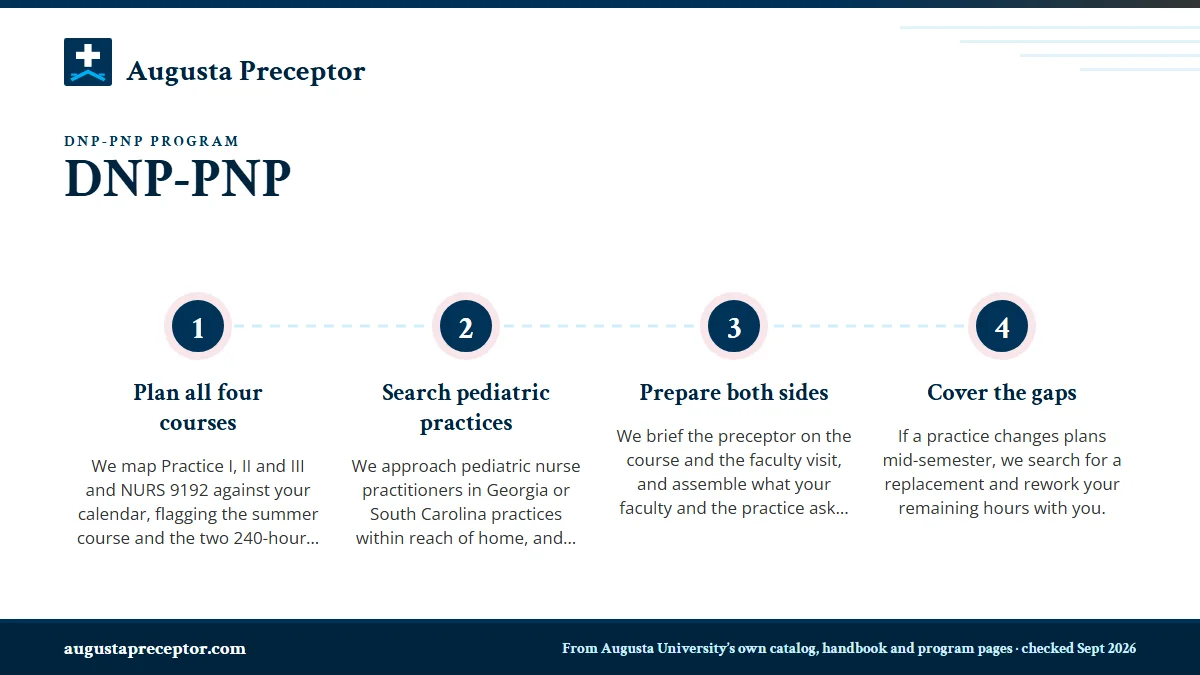
- Plan all four coursesWe map Practice I, II and III and
NURS 9192against your calendar, flagging the summer course and the two 240-hour semesters first. - Search pediatric practicesWe approach pediatric nurse practitioners in Georgia or South Carolina practices within reach of home, and confirm licensure and Georgia APRN authorization where it applies.
- Prepare both sidesWe brief the preceptor on the course and the faculty visit, and assemble what your faculty and the practice ask for before the term.
- Cover the gapsIf a practice changes plans mid-semester, we search for a replacement and rework your remaining hours with you.
Share your county and your first pediatric term on the request form.
Questions Augusta University students ask
Does Augusta University offer an acute care pediatric nurse practitioner program?
Not yet. The catalog places a DNP concentration in pediatric acute care among programs submitted for future approval. The DNP-PNP open today is the primary care track, and its four precepted courses are built for pediatric primary care. Check the College of Nursing's program pages for any change before you apply.
Could a family nurse practitioner be my PNP preceptor?
Preceptor qualifications for NP courses are not in Augusta University's public documents, so the answer rests with your course faculty. For Georgia sites, the Board of Nursing ties APRN clinical instruction to Georgia APRN authorization. A pediatric-focused preceptor fits the course most cleanly, and that is where our search begins; the preceptor requirements page covers what is published.
Is the Augusta University PNP program online?
Largely. More than half of the program is taught online, with the cohort based in Augusta. Campus visits are few: an in-person orientation at the start, MEGAI for hands-on skills and an in-person defense near the end, while your pediatric clinical hours take place at sites in Georgia or South Carolina that faculty visit.
Can I take the DNP-PNP part time?
Yes. The College of Nursing publishes a four-year part-time plan beside the three-year full-time plan. Both keep the same 78 credits, 840 clinical hours, 135 lab hours and 360 residency hours; the part-time version spreads them out, and the whole program must be finished within six consecutive years.
What should I do if my pediatric preceptor cancels?
Your course faculty should hear about it first, because they run the course and approve any new site. Policy CON23 already asks you to notify your clinical instructor and the site before any missed clinical day. If you work with us, we start looking for another pediatric preceptor and help you replan the hours still owed.
Related pages
Last checked 2026-09-27
We check these pages against Augusta University's own catalog, program plans, DNP handbook and program pages, and Georgia and South Carolina rules. Your course faculty and the College of Nursing have the final word.
Whatever your program arranges, we find the preceptor who fits.
Tell us your Augusta University track, where in Georgia or South Carolina you live and when your next clinical course starts. We find preceptors near you who fit the course and Augusta University's rules, and hand you everything your faculty and the site need, well before the semester.
- Adult, pediatric and older-adult preceptors for
NURS 8312toNURS 8318, acute care forNURS 8332toNURS 8338 - Pediatric primary care for the PNP courses and psychiatric preceptors for
NURS 8342toNURS 8348 - Across Georgia and South Carolina, from the CSRA to Savannah, Atlanta and Columbia
Start your placement plan
Program, city and start date is all we need to begin.