NURS 9192, the final practicum in every Augusta University NP track
NURS 9192 is the last clinical course for DNP-FNP, DNP-AGACNP, DNP-PNP and DNP-PMHNP students: 240 hours with a preceptor, graded Satisfactory or Unsatisfactory, and taken in the same term as the didactic NURS 9191. On the full-time plans it fills the spring of year three, the term you finish the program.
Set up your final practicum early
Tell us your track and your Practice III site. We find a NURS 9192 preceptor in Georgia or South Carolina who fits.
What the catalog says NURS 9192 is
The catalog titles the course Advanced Practice Nursing Program Practicum, for the DNP program. Its description frames it as the terminal clinical practicum that prepares you to graduate from an advanced practice program, and it expects you to take on the full scope of advanced practice nursing 'in conjunction with a preceptor'.
On the plans it is four credits, all clinical (0-0-4-4), which at 60 hours per credit comes to 240 hours. It is graded Satisfactory or Unsatisfactory, like the practice courses before it. Unlike them, it keeps one number across tracks: an FNP student and a PMHNP student enroll in the same course and share the same catalog description, each working within their own population.
Augusta University does not post the course objectives, evaluation tool or syllabus outside the course itself. Your faculty share those when the term opens, so this guide sticks to what the catalog and the plans print.
NURS 9191 and the rest of the final spring
The catalog lists NURS 9191 APRN Practice Synthesis as the corequisite, so the two courses run in the same term. The plans show it as a two-credit didactic course with no clinical hours. Augusta University's public pages do not describe its assignments, so expect those details inside the course.
Other milestones gather around the same months. The Graduate School requires accepted DNP students to attend a face-to-face defense, and the DNP handbook lists NURS 9062, the dissemination course with 60 residency hours for BSN to DNP students, as a spring offering. Check your plan for whether it shares a term with NURS 9192. If it does, your last spring holds 240 clinical hours, residency work and a defense at once, which is a strong reason to have the clinical side settled before January.
When it falls: the last term
On the fall 2026 full-time plans, NURS 9192 sits in the spring of year three, straight after the 240-hour Practice III in the fall. Part-time students take it on the four-year schedule in their own plan. The 840 NP hours shows how it closes out each track's clinical run.
The current calendar shows the shape of a spring term. Spring 2027 classes run January 13 to April 30, with a spring pause on March 11 and 12, spring break April 5 to 9, finals May 3 to 7 and grades due May 10. Applications for spring 2027 graduation were due October 5, 2026, early in the fall before, so check the calendar for your own year and file before the practicum begins.
By our arithmetic, 240 hours across a 15-week spring is 16 hours a week; if site onboarding takes the first two weeks, it is closer to 18.5. The College of Nursing's cost policy also places certification and licensure exam fees in the final semester, which makes this a full term on every front. The certification exams guide covers what comes next.
Which preceptors fit NURS 9192, track by track
Augusta University does not publish preceptor qualifications for its NP courses. In Georgia, the Board of Nursing states that clinical instruction for APRN programs must be conducted by a nurse holding Georgia APRN authorization; preceptor requirements covers what applies in each state. Within those limits, this is how our placement desk matches the final course to each track, working from the catalog focus of the courses that come before it.
| Track | What the earlier courses covered (catalog) | Preceptor we look for in NURS 9192 |
|---|---|---|
| DNP-FNP | Adults in primary care; infants, children and adolescents; older adults and families | A primary care practice that sees every age group, so the last term spans the full family scope |
| DNP-AGACNP | Adults and older adults with complex, urgent, emergent and rapidly changing needs | A hospital-based acute care team with high-acuity adult and older adult patients |
| DNP-PNP | Pediatric primary care | A pediatric primary care practice with well and sick visits from infancy through adolescence |
| DNP-PMHNP | Child or adolescent and adult therapy groups, with individual and peer supervision | A psychiatric practice with a broad caseload across ages, diagnoses and treatment types |
Some students want the last preceptor to match the job they plan to take; others want to fill a gap the earlier courses left. Both are sound reasons, and your course faculty decide the fit.
Certificate students: NURS 9193
Post-graduate certificate students take a separate course. The catalog's certificate version is NURS 9193, Advanced Practice Nursing Practicum for Post-Graduate Certificate, a three-credit terminal practicum completed with a preceptor. The AGACNP certificate schema lists it among the courses to take if you have not already completed it before the certificate starts.
The catalog does not state clock hours for NURS 9193, and the certificate schemas carry approvals from 2016. If your gap analysis includes it, ask the certificate program how many hours to plan for before you ask a preceptor for time. The AGACNP certificate guide covers the rest of that plan, including its three practice courses and 540 clinical hours. Keep the time limit in view as well: College of Nursing policy gives certificate students three consecutive years to finish, and the certificates are usually taken part time, under nine credits a term.
Planning the final practicum
Whether or not your program helps with placement, these steps keep the last term steady.
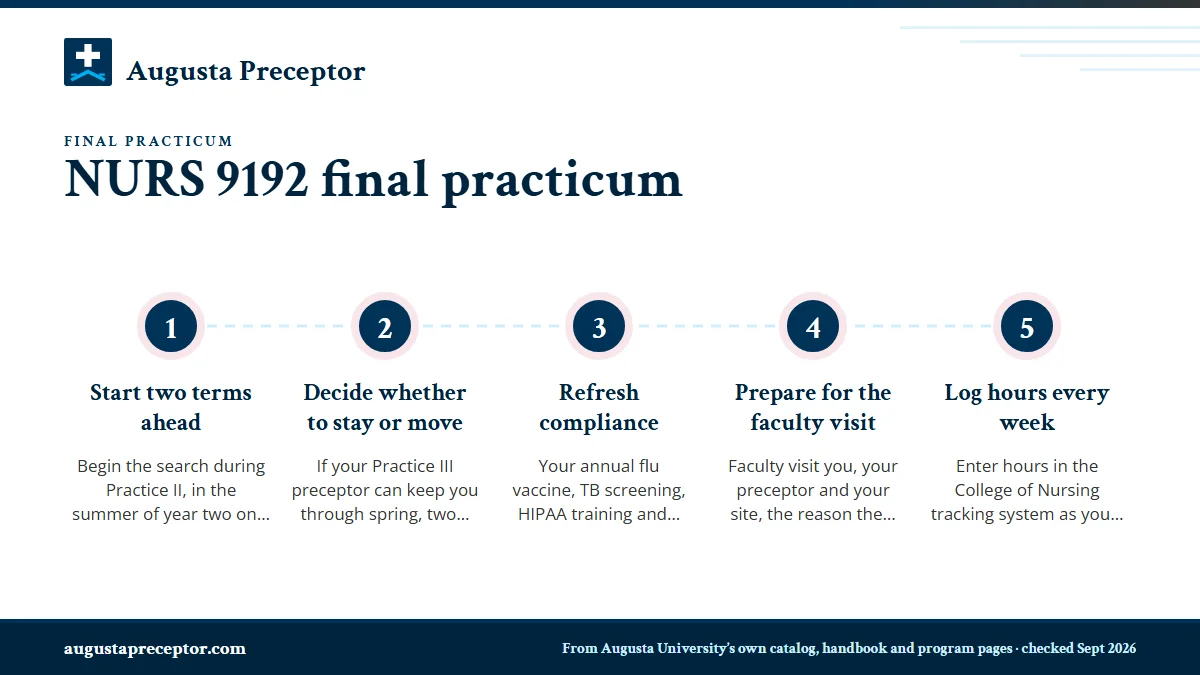
- Start two terms aheadBegin the search during Practice II, in the summer of year two on the full-time plan. That leaves the fall for site paperwork; Wellstar's ACEMAPP page, for one, closes spring advanced practice requests in mid-November.
- Decide whether to stay or moveIf your Practice III preceptor can keep you through spring, two 240-hour terms at one site saves a second onboarding. If you need a new population or setting, plan the move before fall ends.
- Refresh complianceYour annual flu vaccine, TB screening, HIPAA training and in-person AHA BLS must be current, and College of Nursing policy allows no grace period for lapsed certification. Some sites add their own checks at your expense.
- Prepare for the faculty visitFaculty visit you, your preceptor and your site, the reason the site must be in Georgia or South Carolina. Share the course objectives with your preceptor in week one. See faculty site visits.
- Log hours every weekEnter hours in the College of Nursing tracking system as you go, so a shortfall shows up in February rather than April.
- Close with the evaluationClinical courses end with a final evaluation tool that you may comment on and must sign. A single unsatisfactory rating on it fails the course.
How we set up NURS 9192
The final practicum is where a well matched preceptor counts most, and it arrives straight after the second 240-hour course, when you have the least time to search. Our placement desk starts from your track, the course you just finished and the setting you want to work in.
We find a preceptor in Georgia or South Carolina who fits, check the match against Augusta University's published rules and your state's licensing rules, and gather what your faculty and the site need before January. We also confirm that the preceptor's spring calendar offers enough clinic days for 16 or more hours a week, and that the site's onboarding can finish before classes start. If anything changes mid-term, we find a replacement and keep your hours on schedule. Start through the request form.
Questions Augusta University students ask
Can NURS 9192 be at the same site as Practice III?
Augusta University does not publish a rule for or against it. Staying saves onboarding time and lets a preceptor who already knows your work give you more independence; moving can fill a gap in your experience. Ask your course faculty which suits your track, then confirm the spring preceptor before the fall term ends.
Does NURS 9192 count toward the 1,200 hours?
Yes. Its 240 hours are the last part of the 840 direct clinical hours in every NP track. The other 360 hours in the catalog's 1,200 are DNP residency hours from the project courses, which you log separately and which the DNP handbook calls practice hours rather than clinical hours.
What happens if I receive an Unsatisfactory in NURS 9192?
College of Nursing policy CON01D dismisses a DNP student who earns a U in any DNP course, and grading policy CON27 treats one unsatisfactory rating on the final evaluation as a clinical failure. Because the stakes are high, talk to your course faculty early in the term if anything is going wrong at the site.
Can I start NURS 9192 hours before the spring term begins?
Augusta University's public documents are silent on hours before the term starts, so ask your course faculty before booking any early shifts. What you can do ahead of time is the groundwork: confirming the preceptor, completing the site's onboarding and bringing your compliance items up to date.
Do post-master's DNP students take NURS 9192?
Not in the Traditional or Nurse Executive tracks. Students there earn every Augusta University hour as residency in the DNP Project courses, with 540 as the floor, and take no patient care course. NURS 9192 belongs to the DNP nurse practitioner concentrations, and certificate students use NURS 9193 instead.
Related pages
Last checked 2026-09-27
We check these pages against Augusta University's own catalog, program plans, DNP handbook and program pages, and Georgia and South Carolina rules. Your course faculty and the College of Nursing have the final word.
Whatever your program arranges, we find the preceptor who fits.
Tell us your Augusta University track, where in Georgia or South Carolina you live and when your next clinical course starts. We find preceptors near you who fit the course and Augusta University's rules, and hand you everything your faculty and the site need, well before the semester.
- Adult, pediatric and older-adult preceptors for
NURS 8312toNURS 8318, acute care forNURS 8332toNURS 8338 - Pediatric primary care for the PNP courses and psychiatric preceptors for
NURS 8342toNURS 8348 - Across Georgia and South Carolina, from the CSRA to Savannah, Atlanta and Columbia
Start your placement plan
Program, city and start date is all we need to begin.