Augusta University's DNP-PMHNP and its psychiatric clinical sequence
Augusta University's Psychiatric Mental Health Nurse Practitioner concentration is an 80-credit DNP, the largest of its four NP plans, completed over three years of full-time study or four of part-time, beginning in the fall. Its 840 precepted hours run through a gated sequence that calls for youth groups, adult psychotherapy groups and supervision sessions, with 360 residency hours on top.
Plan your psychiatric rotations
Tell us your county and your first clinical term, and we will look for preceptors who can cover the group and supervision requirements too.
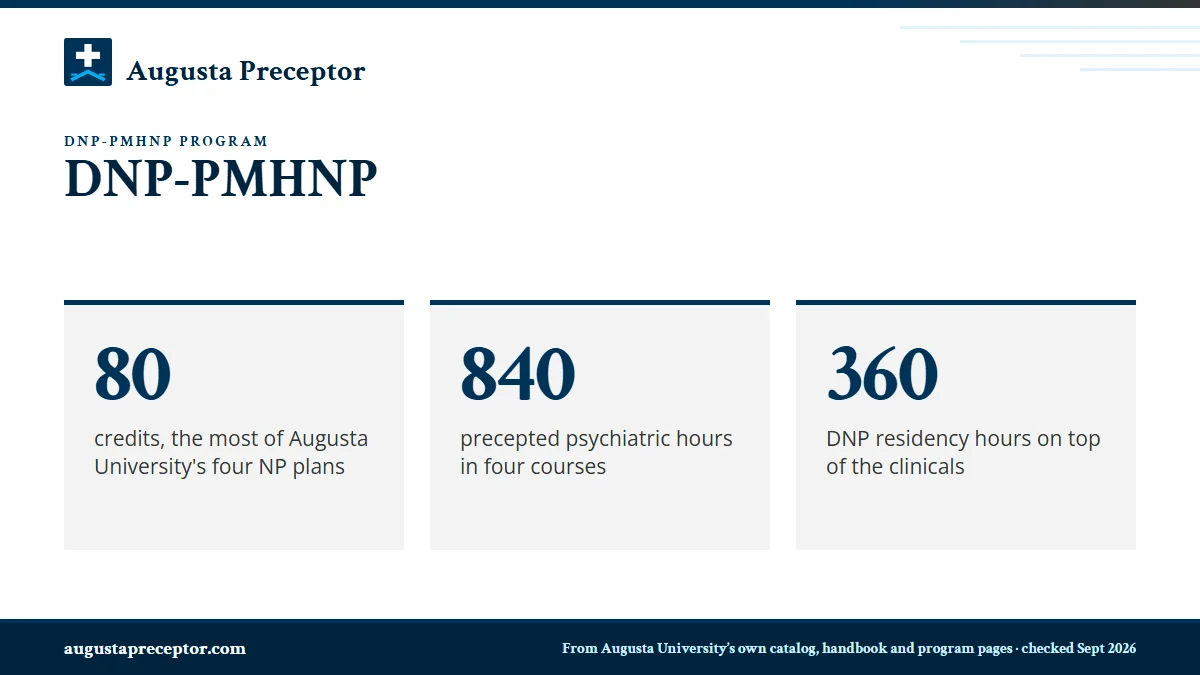
The PMHNP track by the numbers
Like the other NP concentrations, the PMHNP is a post-BSN DNP with more than half of it taught on the web and its cohort based at the Augusta campus. Augusta University has no master's-level psychiatric NP option, so this doctorate is the path for new psychiatric nurse practitioners.
| Measure | DNP-PMHNP |
|---|---|
| Credits | 80 |
| Full-time length | 3 years |
| Part-time length | 4 years |
| Start term | Fall |
| Direct clinical hours | 840 in four courses |
| Lab hours | 135 |
| DNP residency hours | 360 |
| Completion limit | 6 consecutive years |
The 80 credits compare with 78 for family and pediatrics and 77 for acute care, while the clinical hours are identical across all four. Augusta University's program page does not explain the gap; the plan of study lists every course and its credits.
Applying, and where campus time fits
Applicants file through NursingCAS and then finish in Augusta University's applicant portal once NursingCAS verifies them. For fall 2027, the cycle opens in early August 2026 and the application deadline is May 15, 2027. Your RN license, Georgia-issued or multistate and without encumbrances, must be current before you enroll, and one year of nursing practice before clinicals is advised but optional.
Campus time looks a little different for this track. Augusta University's description of MEGAI, its campus skills intensive, names FNP, AGACNP and PNP students and leaves PMHNP out, and the College of Nursing does not say whether PMHNP students attend a similar event. The Graduate School's face-to-face orientation and face-to-face defense apply to every accepted DNP concentration student, this one included.
A clinical sequence with gates
Among the four DNP tracks, only the PMHNP's catalog entries attach grade conditions between the practice courses. Entry to Practice II requires at least a B in NURS 8341 plus a Satisfactory in Practice I, with NURS 8344 as a corequisite; entry to Practice III requires a Satisfactory in Practice II. A setback in one semester therefore holds up the next.
| Course | Clinical hours | Term | Catalog requirement |
|---|---|---|---|
NURS 8342 PMHNP Practice I | 180 plus 45 lab | Spring, year 2 | Taken with NURS 8341 |
NURS 8345 PMHNP Practice II | 180 | Summer, year 2 | NURS 8341 B or better and NURS 8342 Satisfactory; with NURS 8344 |
NURS 8348 PMHNP Practice III | 240 | Fall, year 3 | NURS 8345 Satisfactory |
NURS 9192 final practicum | 240 | Spring, year 3 | Taken with NURS 9191 |
The PMHNP practice courses page looks at each course in depth, and the capstone the four tracks share has its own final practicum guide.
Groups and supervision: what the catalog requires
The catalog entries for Practice II and Practice III add requirements that go beyond seeing patients one at a time. Each of those courses expects you to join a minimum of one group serving children or teens and a minimum of one adult psychotherapy group, plus individual and peer supervision sessions run by faculty, preceptors or both.
That shapes the choice of site. A practice that sees only adults one-on-one may cover your hours but not the youth group, so the plan for NURS 8345 or NURS 8348 may need a second setting, such as a program that runs adolescent groups. Your course faculty decide what satisfies each requirement, so confirm the plan with them early.
Two catalog descriptions are slightly out of date: Practice I refers to skills from NURS 7348 and Practice III to NURS 7352, and neither course appears in the 2026-27 catalog. Treat your syllabus as the working version.
The group requirements sit in the summer and fall practicums, not the spring one. Before you commit to a Practice II or Practice III preceptor, ask whether the practice runs a youth group and an adult psychotherapy group you can join.
Residency hours, lab hours and the hour totals
The 840 clinical hours sit beside 360 residency hours earned in the project courses between NURS 7150 and NURS 9062, and the catalog adds them to a 1,200-hour total. The DNP Handbook's rule is broader: a 1,000-hour minimum of supervised practice after the bachelor's for any DNP student, with residency time counted as practice hours. The 840-hour page sorts out the three counts.
Lab time totals 135 hours: health assessment in the first summer, diagnostic reasoning in the second fall, and 45 hours inside Practice I. Logging happens in a College of Nursing platform that each student subscribes to at their own cost; Augusta University does not identify it publicly. The project side is explained in the residency hours guide.
Where psychiatric care is short in Georgia and South Carolina
Federal shortage data show how stretched psychiatric care is in both states. HRSA's quarterly summary, current to June 30, 2026, lists 92 mental health shortage designations in Georgia, where about 45% of need is met, against 89 in South Carolina, where the share is closer to 33%. HRSA estimates it would take 174 more practitioners in Georgia and 232 in South Carolina to remove those designations.
Many designated areas are rural, and in Georgia the community service boards anchor many of the low-income designations. For a PMHNP student, that suggests psychiatric preceptors are spread thin away from the cities, which is one more reason to start the search early and cast it widely.
The two-state rule and licensure
Residence in Georgia or South Carolina is a condition of the PMHNP track, which Augusta University links to faculty visits with each student, preceptor and site; their frequency is not published. The residence rule guide covers moving during the program.
Georgia's Board of Nursing extends its licensure rule to anyone teaching or working in the state, whether in person or electronically: students and preceptors both carry a Georgia or multistate license, while teaching APRN students clinically is reserved for nurses the state has authorized as APRNs. That electronic clause matters in psychiatric care, where some visits happen by video. Georgia requires its NPs to work under a physician-signed nurse protocol and South Carolina under a written practice agreement, and the two states share membership in the Nurse Licensure Compact.
How we build PMHNP placements
Psychiatric placements have more moving parts than most: the preceptor, the group requirements, supervision and the grade gates between courses. Augusta University has not published how PMHNP clinicals are arranged; whatever part the program plays, we bring a preceptor who fits the exact course and your corner of Georgia or South Carolina.
What we do for PMHNP students
- Find psychiatric nurse practitioners within reach of home, checked for licensure and, in Georgia, APRN authorization.
- Screen Practice II and III sites for youth groups, adult psychotherapy groups and room for supervision sessions.
- Plan the summer course's 180 hours against a 10- or 11-week term, by our arithmetic about 16 to 18 hours a week.
- Assemble what your faculty and the site request before each term, and prepare the preceptor for the faculty visit.
- Remain on call through the term, and look for a new preceptor if yours has to step back.
Tell us your county and your first clinical term on the request form.
Questions Augusta University students ask
Can PMHNP clinical hours at Augusta University be done by telehealth?
Augusta University does not publish a telehealth rule for PMHNP clinicals, so check with your course faculty before planning virtual hours. If your preceptor practices in Georgia, the Board of Nursing's licensure rule covers teaching done electronically as well as in person. Keep in mind that the residence rule itself rests on faculty visiting your clinical site.
What happens if I do not pass PMHNP Practice I?
Practice II requires a Satisfactory in NURS 8342, so an Unsatisfactory stops the sequence. Under CON01D, a U in any DNP course brings dismissal, and CON27 makes a failed clinical a failed course. Choosing a preceptor who fits the course from the start is the practical safeguard.
Is there a PMHNP post-graduate certificate at Augusta University?
Yes. Certified nurse practitioners with a master's or doctorate can add psychiatric mental health through a 22-credit post-graduate certificate that starts in spring, with 540 clinical hours and up to 750 by gap analysis. The PMHNP certificate guide has the details.
Which certification exam do Augusta University PMHNP graduates take?
Two boards appear in the catalog for PMHNP graduates: the American Academy of Nurse Practitioners and the American Nurses Credentialing Center. Augusta University states that its PMHNP graduates have passed at a 100% rate for the last five years. The certification exams page lays out each board and the state steps that follow.
Do Augusta University PMHNP students need a separate preceptor for each course?
Not necessarily; Augusta University does not publish a rule either way. One psychiatric preceptor could suit more than one course if the practice covers the youth and adult group work in Practice II and III, but a second setting may be needed for part of it. Your course faculty approve each arrangement.
Related pages
Last checked 2026-09-27
We check these pages against Augusta University's own catalog, program plans, DNP handbook and program pages, and Georgia and South Carolina rules. Your course faculty and the College of Nursing have the final word.
Whatever your program arranges, we find the preceptor who fits.
Tell us your Augusta University track, where in Georgia or South Carolina you live and when your next clinical course starts. We find preceptors near you who fit the course and Augusta University's rules, and hand you everything your faculty and the site need, well before the semester.
- Adult, pediatric and older-adult preceptors for
NURS 8312toNURS 8318, acute care forNURS 8332toNURS 8338 - Pediatric primary care for the PNP courses and psychiatric preceptors for
NURS 8342toNURS 8348 - Across Georgia and South Carolina, from the CSRA to Savannah, Atlanta and Columbia
Start your placement plan
Program, city and start date is all we need to begin.