The PMHNP post-graduate certificate at Augusta University, practicum by practicum
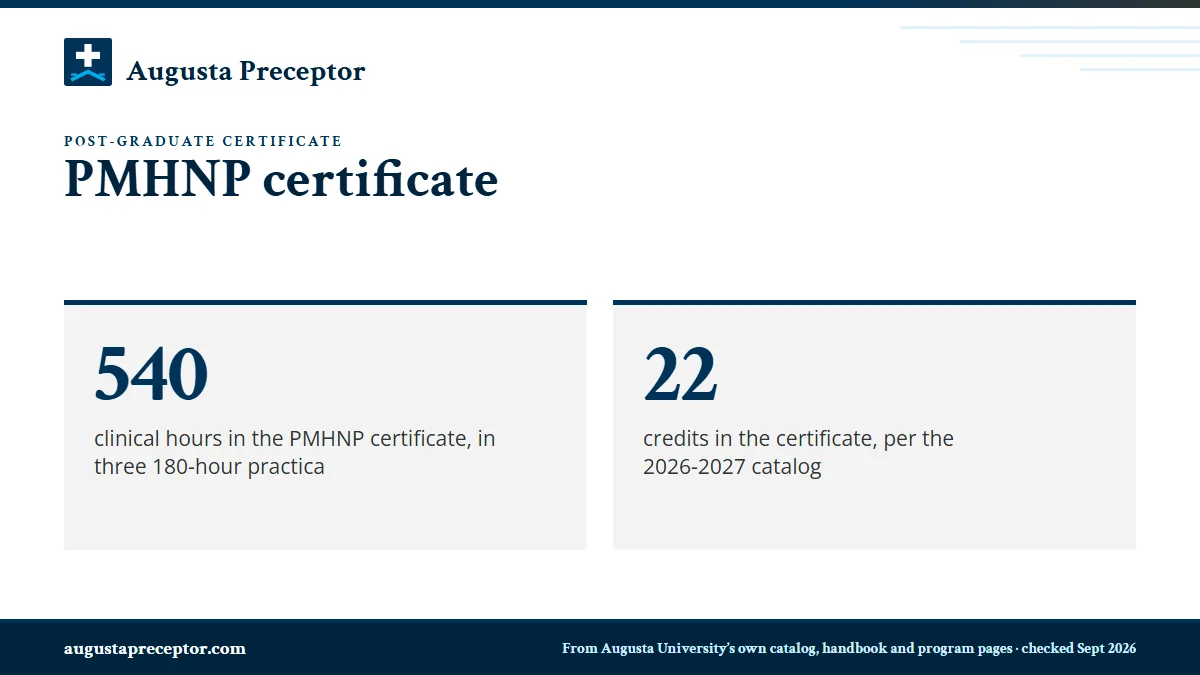
Augusta University's post-graduate PMHNP certificate is a 22-credit, one-year program in psychiatric mental health that opens each spring. It holds 540 clinical hours in three practica of 180 hours each, and an individual gap analysis can raise that to 750. Every one of those hours happens in Georgia or South Carolina alongside a psychiatric preceptor, so the match you make for each term shapes the whole year.
Plan your PMHNP certificate practica
Share your start term, your county and the practicum you are planning for. Your placement advisor comes back with psychiatric preceptor options.
The certificate at a glance
Most of what shapes a PMHNP certificate year sits in three Augusta University sources: the catalog, the College of Nursing's certificates page and a one-page curriculum schema. Read together, they give this outline.
- 22 credits in the 2026-2027 catalog, over a program length of one year.
- A spring start; applications for Spring 2027 closed on September 15, 2026.
- Usually part time, under nine credit hours a semester, since the specialty courses build in order.
- 540 clinical hours at minimum, with up to 750 required by an individual gap analysis.
- Three consecutive years to finish from first enrollment, under College of Nursing policy CON01C.
- CCNE accreditation through the post-graduate APRN certificate program, with a term running to December 31, 2034.
One catalog quirk is worth a question: NURS 7465 appears twice for this certificate, once as a prerequisite and once as a course inside the program. Ask the certificates program which applies to you before you register.
Three psychiatric practica of 180 hours each
Unlike the acute care certificate, the PMHNP schema gives its practice courses no lab hours. All 540 hours are clinical, split evenly across spring, summer and fall. The schema is titled as an accelerated certificate and shows approval dates from 2016, so confirm your current plan of study with your advisor.
| Course | Term | Clinical hours | Credits | What unlocks it |
|---|---|---|---|---|
NURS 8350 PMHNP Practice I | Spring, year 1 | 180 | 3 | Taken with NURS 8341 |
NURS 8351 PMHNP Practice II | Summer, year 1 | 180 | 3 | NURS 8341 at B or better and NURS 8350 satisfactory; taken with NURS 8344 |
NURS 8352 PMHNP Practice III | Fall, year 2 | 180 | 3 | NURS 8351 at B or better |
| Total | Three terms | 540 | 9 | Up to 750 by gap analysis |
The summer practicum is the tight one. Summer 2027 full-term sessions last 10 or 11 weeks, while the plans compute clinical hours on 15; by our arithmetic, 180 hours works out to about 16 to 18 a week in summer, compared with 12 in spring or fall. The gap analysis can add as many as 210 clinical hours overall (our subtraction), and the catalog does not say which term absorbs them. The clinical hours planner compares every program's totals.
What psychiatric clinical time asks of a preceptor
Augusta University's catalog spells out the DNP-PMHNP practice courses in some detail: students join at least one group for children or adolescents and at least one psychotherapy group for adults, and take part in individual and peer group supervision led by faculty or preceptors. The certificate course descriptions in our research do not repeat those lines, so ask your course faculty how the same expectations apply to NURS 8350 through NURS 8352. The PMHNP practice courses guide covers the DNP sequence.
A preceptor whose practice combines medication management with therapy, across several age groups, makes those expectations easier to meet. Augusta University does not publish preceptor qualifications for the certificate. Georgia's Board of Nursing states that clinical instruction in APRN programs must be given by a nurse holding Georgia APRN authorization, and that anyone precepting in the state needs a Georgia or multistate license.
The Graduate School's certificate page sets clinical experiences at ambulatory practices in Georgia or South Carolina, and the DNP overview page includes the certificates in its residence rule so that instructors can visit you, your preceptor and your site. The Georgia and South Carolina rule guide explains the requirement and what a move would mean.
Mental health shortages across both states
Federal shortage data frame any psychiatric search here. HRSA's quarterly summary, current to June 30, 2026, counts 92 mental health shortage designations in Georgia, meeting 45.33 percent of need, and 89 in South Carolina, meeting 32.84 percent. Every Upstate South Carolina county is a whole-county mental health shortage area, and so are all 17 Heart of Georgia Altamaha counties and all 18 counties of the south Georgia region.
For a PMHNP student that cuts two ways. Rural counties have fewer psychiatric clinicians to learn from, and the practices that do exist carry heavy demand. Georgia's community service boards anchor many of the state's low-income mental health designations, per HRSA's data. Our Upstate South Carolina guide shows how this plays out in one region, and the other region guides do the same for the rest of both states.
FNP and PNP certificates are not on the current list
The Graduate School's certificate page and the College of Nursing's certificates page each name two options: adult-gerontology acute care and psychiatric mental health. Some other Augusta University pages still mention family and pediatric certificates. The catalog keeps practice courses titled for an FNP certificate (NURS 8313, NURS 8353, NURS 8354) and a PNP certificate (NURS 8355, NURS 8356, NURS 8357), the CCNE line on the College's About page names both, and the Student Health immunization page lists them as well.
Take the two current program pages as the answer: FNP and PNP certificates are not currently listed. For family or pediatric preparation at Augusta University today, the published routes are the DNP concentrations, including the DNP-FNP. A nurse practitioner already certified in family or pediatric care who wants a second population can weigh the two certificates that are listed, this one and acute care.
Our placement desk and the PMHNP certificate
Whatever role your program plays in lining up clinical sites, a psychiatric preceptor who is close to home, ready for your hours and matched to your practicum makes each term steadier. We build that match around Augusta University's rules and your three practica.
What you get from us
- A search in your part of Georgia or South Carolina for psychiatric NPs and practices whose caseload spans the ages and formats your course calls for, including group work where it applies.
- A check of each preceptor against the residence requirement, the state's license rules and Georgia APRN authorization.
- A plan for the short summer practicum and for any hours your gap analysis adds.
- Preceptor and site details organized for your course faculty and ready for the site visit.
- A replacement search, started at once, if a preceptor has to step away mid-term.
Begin with the placement request form and name the practicum you are planning for.
Questions Augusta University students ask
Who can apply to Augusta University's PMHNP certificate?
Augusta University's pages word the entry point differently. The certificates page refers to applicants with a doctorate, while the DNP overview page accepts a master's or a doctorate, and the catalog titles the program a post-master's certificate. If your graduate nursing education ended at the master's level, ask the College of Nursing which reading applies before you send an application.
Is MEGAI part of the PMHNP certificate?
Augusta University describes MEGAI, its multi-day campus intensive for clinical skills, as an event for FNP, AGACNP and PNP DNP students. Neither the PMHNP track nor the post-graduate certificates appear in that description. Ask the certificates program whether any on-campus time is part of your plan of study.
Can I complete PMHNP certificate hours at the practice where I work?
Augusta University does not publish a rule on clinical hours at your own employer, for the certificate or the DNP tracks. Ask your course faculty before counting on it. The guide to clinicals where you work lists the questions worth putting to them and what is published on the topic.
How are PMHNP certificate clinical hours recorded?
The DNP Handbook says nurse practitioner students log clinical hours in an approved College of Nursing tracking system that students pay to access, and Augusta University does not name that system publicly. Confirm with your course faculty that the same system applies to your certificate practica, and log hours as you go rather than at term's end.
What happens if I struggle in a PMHNP certificate practicum?
Clinical grades are pass or fail, and one unsatisfactory rating on the final clinical evaluation fails the clinical. For certificate students, policy CON01C adds that a C in a clinical course means probation and a repeat. Because each practicum unlocks the next, a repeat can push the rest of your sequence back a term.
Related pages
Last checked 2026-09-27
We check these pages against Augusta University's own catalog, program plans, DNP handbook and program pages, and Georgia and South Carolina rules. Your course faculty and the College of Nursing have the final word.
Whatever your program arranges, we find the preceptor who fits.
Tell us your Augusta University track, where in Georgia or South Carolina you live and when your next clinical course starts. We find preceptors near you who fit the course and Augusta University's rules, and hand you everything your faculty and the site need, well before the semester.
- Adult, pediatric and older-adult preceptors for
NURS 8312toNURS 8318, acute care forNURS 8332toNURS 8338 - Pediatric primary care for the PNP courses and psychiatric preceptors for
NURS 8342toNURS 8348 - Across Georgia and South Carolina, from the CSRA to Savannah, Atlanta and Columbia
Start your placement plan
Program, city and start date is all we need to begin.