Augusta University clinical hours, program by program
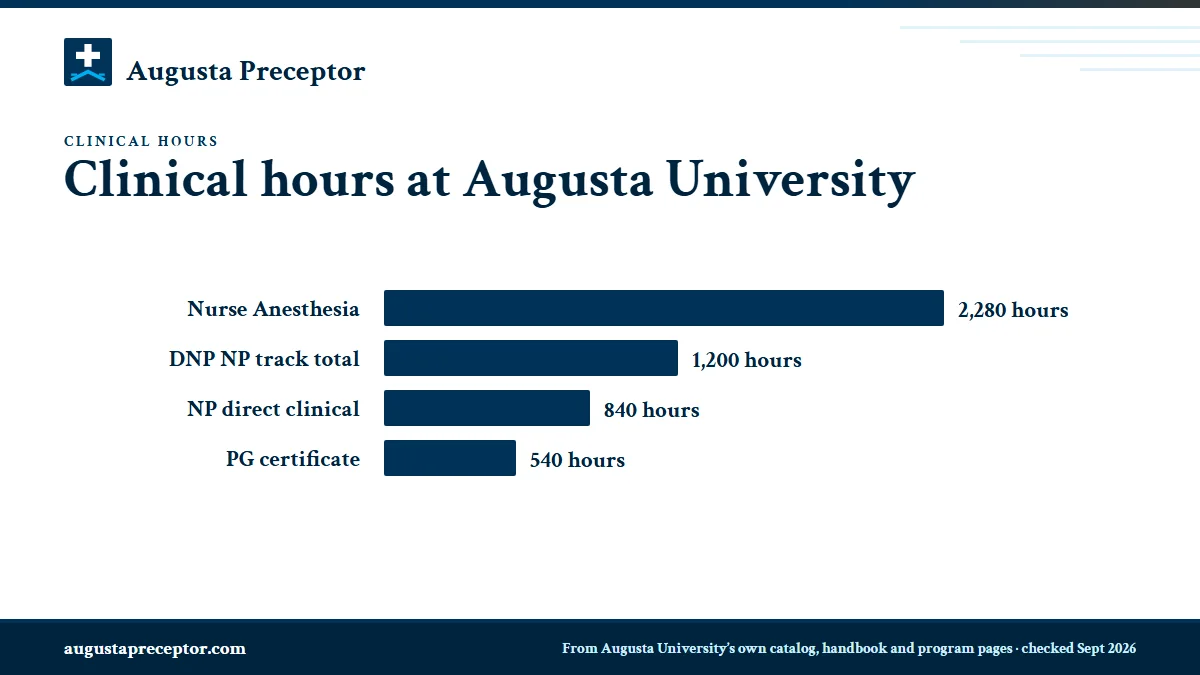
Every Augusta University DNP nurse practitioner track totals 1,200 hours: 840 direct clinical hours spread over four clinical courses, plus 360 DNP residency hours earned in the project courses. Certificates, the post-master's DNP, nurse anesthesia, the Clinical Nurse Leader program and the BSN each count hours their own way, and a few published figures disagree. This guide puts them side by side.
Plan your hours with a matched preceptor
Tell us your track and next clinical course. We find a preceptor in Georgia or South Carolina who fits it.
Pick your Augusta University program
Your clinical courses and hours, who can precept you, where, and when to start looking. From the 2026-27 Augusta University catalog, DNP handbook and program pages.
- Who precepts
- Primary care NPs and physicians: adults, then children and adolescents, then older adults
- Where
- Primary care practices in Georgia or South Carolina
- Start looking
- Well before each semester; faculty visit you, your preceptor and your site
- Who precepts
- Acute care NPs and physicians caring for adults and older adults
- Where
- Hospital units, hospitalist and critical care teams in Georgia or South Carolina
- Start looking
- Well before each semester; faculty visit you, your preceptor and your site
- Who precepts
- Pediatric primary care NPs and pediatricians
- Where
- Pediatric and family practices in Georgia or South Carolina
- Start looking
- Well before each semester; faculty visit you, your preceptor and your site
- Who precepts
- Psychiatric NPs and psychiatrists, with child and adult group work
- Where
- Outpatient psychiatry and behavioral health settings in Georgia or South Carolina
- Start looking
- Well before each semester; faculty visit you, your preceptor and your site
Hours by program at a glance
Augusta University prints its hour totals in two places: the 2026-27 catalog and the plans of study posted for students who begin in fall 2026. The table lines them up. Direct clinical hours are time with patients at a clinical site. Residency hours, which the DNP handbook calls practice hours, come through the DNP Project courses. Lab hours are skills sessions that the plans list in a column of their own.
| Program | Direct clinical | DNP residency | Lab | Total as printed |
|---|---|---|---|---|
| DNP-FNP, DNP-PNP, DNP-PMHNP | 840 | 360 | 135 | 1,200 clinical hours |
| DNP-AGACNP | 840 | 360 | 180 | 1,200 clinical hours |
| Post-graduate AGACNP certificate | 540 | None | 90 | 630 clinical and lab; 540 minimum, up to 750 |
| Post-graduate PMHNP certificate | 540 | None | None | 540; up to 750 |
| Post-master's DNP (Traditional, Nurse Executive) | None | 540 minimum | None | 540, toward a 1,000-hour DNP total |
| DNP Nurse Anesthesia | 2,280 | 360 | 315 | 2,280 clinical practice hours |
| MSN Clinical Nurse Leader | About 840 (our split) | None | About 225 (our split) | 1,065 clinical |
| BSN (Augusta and Athens) | About 675 (our split) | None | About 90 (our split) | 765 lab, simulation and clinical |
| RN to BSN (online) | 45 in NURS 4498; NURS 4598 not stated | None | None | Not stated |
The CNL and BSN splits are our own arithmetic, worked from the credit ratios printed on those schemas. Augusta University publishes only the combined figures for those two programs.
Nurse practitioner tracks: 840 clinical plus 360 residency
All four DNP concentrations follow one pattern. Practice I and Practice II carry 180 hours each, then Practice III and NURS 9192 carry 240 each. The plans convert credits to clock hours at four contact hours per clinical credit across a 15-week semester, so a clinical credit is worth 60 hours and a lab credit 45. Full-time students log these hours from the spring of year two through the spring of year three; the four-year part-time plans print the same totals.
The planner on this page lists each track's four courses with their hours, the kind of preceptor each one calls for, and a link to its course guide. For terms and weekly loads, read the 840 NP hours; for the shared last course, read the NURS 9192 guide.
The 360 residency hours sit in five of the six project courses, from NURS 7150 to NURS 9062, and they are logged as practice hours, not clinical hours. DNP residency hours breaks them down course by course.
Post-graduate certificates: 540 hours, sometimes more
Augusta University currently lists two post-graduate certificates, AGACNP and PMHNP, and each requires at least 540 clinical hours. The catalog adds that an individualized gap analysis, required under the National Taskforce Standards, can raise the number to as many as 750.
The AGACNP schema totals 630 because it counts 90 lab hours with the 540 clinical: NURS 8333 has 120 clinical and 45 lab hours, NURS 8370 has 180 and 45, and NURS 8371 has 240. The PMHNP certificate runs three 180-hour courses, NURS 8350, NURS 8351 and NURS 8352. Both certificates start in spring, and the certificate page puts clinical experiences at ambulatory practices in Georgia or South Carolina.
The AGACNP schema also lists NURS 9193, a final practicum with a preceptor, for students who have not completed it before; the catalog gives no clock hours for it. Both schemas show approvals from 2016, so confirm your hour plan with the certificate program. The AGACNP certificate and PMHNP certificate guides go further.
Post-master's DNP, nurse anesthesia, CNL and BSN
Post-master's DNP students in the Traditional and Nurse Executive tracks take no patient care courses at Augusta University. Their hours are residency hours: at least 540 during the program, whatever their master's hours were, with the rest of the 1,000-hour DNP total credited from verified prior hours through a gap analysis.
DNP Nurse Anesthesia carries 2,280 clinical hours in four practica: NURS 7837 with 480, then NURS 8363, NURS 9195 and NURS 9196 with 600 each. Add 315 lab and 360 residency hours. These practica run at the program's clinical sites, more than 40 of them in Georgia, Alabama, Florida and Tennessee, with certified registered nurse anesthetists and anesthesiologists.
The prelicensure programs are faculty-led. The MSN Clinical Nurse Leader program totals 1,065 hours and ends with the 420-hour NURS 7801 immersion, where students work with nurse preceptors. The BSN schema totals 765 lab, simulation and clinical hours, closing with NURS 4806 at 180 clinical hours by our arithmetic. The online RN to BSN, first admitting in fall 2027, lists 45 clinical hours in NURS 4498.
Where the published numbers disagree
Augusta University's documents were written at different times, and several hour figures do not line up. Confirm any that affect you with your faculty.
- 1,200 or 1,000: the catalog prints 1,200 clinical hours for each NP track (840 plus 360), while the DNP handbook sets a 1,000-hour post-baccalaureate minimum for every DNP student. The NP plans are built to 1,200, which clears that floor.
- Nurse anesthesia: the catalog and the fall 2026 curriculum give 2,280 clinical hours and 113 credits; the program page says at least 2,000 clinical hours and 112 credits.
- Certificates: the catalog's 540-hour minimum sits beside an AGACNP schema total of 630, the difference being 90 lab hours.
NURS 9062: the catalog description gives 60 residency hours, yet post-master's plans schedule the course at five credits, or 240 hours.- Summer: the DNP and certificate plans figure every semester at 15 weeks, but the summer 2027 terms run 10 or 11. See summer clinical terms.
- CNL notation: the schema's footnote orders its hour columns one way, but its semester totals only add up when read the other way.
How hours are logged and counted
NP students record clinical hours, and every DNP student records residency hours, in an approved College of Nursing clinical tracking system that each student subscribes to and pays for. Augusta University does not name the system publicly; the tracking system guide sets out what is known.
For residency hours, the DNP handbook says project faculty review log entries and can return them for more detail, for clarification, or because an activity does not qualify. Only logs marked accepted count toward your total. Augusta University does not publish how practice course hour entries are approved, a weekly hour cap, or a make-up rule for missed hours beyond its attendance policy; your course faculty set those details.
Hours alone do not pass a clinical course. Under College of Nursing grading policy, a single unsatisfactory mark on the final summative evaluation means failing the clinical, so ask early what your faculty and preceptor will assess, not only how many hours you owe.
Planning your hours with a preceptor who fits
Whether or not your program helps with placement, the surest way to protect your hours is a willing preceptor close to home, confirmed well before the term. Our placement desk finds preceptors across Georgia and South Carolina matched to the exact course: adults in primary care for NURS 8312, urgent and emergent adult care for NURS 8335, child and adult groups for NURS 8345. We confirm each one meets Augusta University's published requirements and the state's licensing law, prepare what your faculty and the site need, and help you keep a weekly pace that finishes the hours on time.
If a preceptor drops partway through a term, we find a replacement so your hour count keeps moving. Tell us your track, your next clinical course and your county through the request form.
Questions Augusta University students ask
Do lab hours count toward the 1,200 hours in Augusta University NP tracks?
No. The fall 2026 plans print lab hours in a separate column: 135 for DNP-FNP, DNP-PNP and DNP-PMHNP, and 180 for DNP-AGACNP. The catalog's 1,200 is the 840 direct clinical hours plus the 360 DNP residency hours, so a lab session inside a practice course does not reduce the time you owe at your clinical site.
Can hours from my master's program count toward the DNP at Augusta University?
Yes, for post-master's students. Hours can be verified by your former program director on Augusta University's verification form, or through current NP certification, which the handbook credits at only 500 hours. A gap analysis by the Concentration Coordinator then sets your remaining hours, and the in-program residency never drops below 540.
Is there a weekly limit on clinical hours for Augusta University students?
Augusta University does not publish one. The schedule rule it does publish is College of Nursing policy CON20, which bars students from working in the eight hours before any clinical. Our planning assumes a steady weekly pace across the term; your course faculty can tell you whether a heavier week is acceptable for your course.
Do DNP residency hours need a preceptor?
Not in the sense a practice course does. Your DNP Project involves a site partner or sponsor alongside you and your faculty advisor, and the handbook requires no particular credential from that person, who plays no part in grading. Your faculty set the residency objectives with you and provide orientation to any mentor involved.
Will every Augusta University certificate student need 750 hours?
No. The catalog sets 540 clinical hours as the certificate minimum and allows up to 750 when an individualized gap analysis calls for more. Because the analysis is individual, two students in the same certificate can owe different totals. Ask the certificate program for your number before you plan preceptor time around it.
Related pages
Last checked 2026-09-27
We check these pages against Augusta University's own catalog, program plans, DNP handbook and program pages, and Georgia and South Carolina rules. Your course faculty and the College of Nursing have the final word.
Whatever your program arranges, we find the preceptor who fits.
Tell us your Augusta University track, where in Georgia or South Carolina you live and when your next clinical course starts. We find preceptors near you who fit the course and Augusta University's rules, and hand you everything your faculty and the site need, well before the semester.
- Adult, pediatric and older-adult preceptors for
NURS 8312toNURS 8318, acute care forNURS 8332toNURS 8338 - Pediatric primary care for the PNP courses and psychiatric preceptors for
NURS 8342toNURS 8348 - Across Georgia and South Carolina, from the CSRA to Savannah, Atlanta and Columbia
Start your placement plan
Program, city and start date is all we need to begin.