Precepting an Augusta University nurse practitioner student
An Augusta University NP student joins your practice for one clinical course at a time: 180 or 240 hours in a term, a patient population the course names, and faculty who visit you and the site. Here is what each course asks of a preceptor in Georgia or South Carolina, how the student is graded, and how our placement desk keeps your side of the paperwork short.
Offer to precept a student
Pick the preceptor option in the program list and tell us your specialty, county and the terms that suit your practice.
Four clinical courses, each with its own patients
Augusta University prepares nurse practitioners at the doctoral level only, in four DNP tracks, and offers post-graduate AGACNP and PMHNP certificates to NPs adding a population. Each course describes the patients the student should see, so your own caseload is what makes the match.
| Track | Courses in order (clinical hours) | Patients the preceptor sees |
|---|---|---|
| DNP-FNP | NURS 8312 (180), NURS 8315 (180), NURS 8318 (240), NURS 9192 (240) | Adults in primary care, then children and adolescents, then older adults and families |
| DNP-AGACNP | NURS 8332 (180), NURS 8335 (180), NURS 8338 (240), NURS 9192 (240) | Adults and older adults with complex, urgent and rapidly changing needs |
| DNP-PNP | NURS 8322 (180), NURS 8325 (180), NURS 8328 (240), NURS 9192 (240) | Pediatric primary care |
| DNP-PMHNP | NURS 8342 (180), NURS 8345 (180), NURS 8348 (240), NURS 9192 (240) | Psychiatric care, with child, adolescent and adult groups later on |
| Certificates (spring start) | AGACNP NURS 8333, NURS 8370, NURS 8371; PMHNP NURS 8350 to NURS 8352 | Acute care or psychiatric care, at least 540 hours in all |
NURS 9192 closes every DNP track, and its catalog entry expects the student to work across the full scope of advanced practice alongside a preceptor. The final practicum guide goes further.
Hours per term, and why summer weeks run longer
In the full-time plans that began in Fall 2026, Practice I falls in the spring of year two, Practice II in the summer, Practice III in the fall of year three and NURS 9192 in the final spring. Part-time students spread the same totals over four years. The plans count one clinical credit as 60 clock hours over 15 weeks.
By our own arithmetic, that is about 12 hours a week in a 180-hour course and 16 in a 240-hour course. The 2027 summer terms run only 10 or 11 weeks, so a 180-hour summer course needs roughly 16 to 18 hours a week with you. We agree the weekly pattern with you and the student before the term, and the summer terms guide has the dates.
Faculty visits: what is published and what is not
Augusta University's DNP pages explain why its NP students must reside in Georgia or South Carolina: faculty come out to see each student along with the preceptor and the practice. Expect a College of Nursing faculty member to come to know your practice during the course.
The number of visits, their timing and whether they happen in person or by video are not published; course faculty set them. The DNP Handbook's residency section adds that faculty write learning objectives with the student, orient preceptors and mentors, and own the evaluation of learning. Faculty site visits covers preparation.
How the student is graded: Satisfactory or Unsatisfactory
Each NP practice course and NURS 9192 is graded Satisfactory/Unsatisfactory. College of Nursing policy passes a student only with a pass rating on every clinical objective, recorded on the course's own evaluation tool, which the student may comment on and must sign.
One unsatisfactory rating on the final summative evaluation fails the clinical, and a failed clinical fails the course whatever the classroom grade. Who completes the tool, preceptor or faculty, is not stated publicly, so course faculty explain your part. Candid feedback at midterm helps most, since policy allows remediation through extra lab or clinical time. See grades and time limits.
License points for Georgia and South Carolina preceptors
Georgia's Board of Nursing requires anyone precepting in the state to be licensed by Georgia or to hold a multistate license issued by another compact state, and it allows only a nurse authorized as an APRN in Georgia to provide clinical instruction in APRN programs. Georgia NPs work under a written protocol signed with the physician who delegates medical acts to them, and those protocol rules are silent on students.
South Carolina NPs work under a practice agreement developed with a physician, and the Nurse Practice Act exempts students in approved nurse education programs for their student role. We found no South Carolina rule written specifically about who may precept an NP student. Each state is part of the Nurse Licensure Compact.
Augusta University does not publish its own preceptor qualifications. Preceptor requirements sets out each layer, and the Georgia practice guide explains protocol agreements.
What the student brings, and how we keep your paperwork short
The student arrives with the clearances College of Nursing policy requires: immunizations and TB testing, BLS earned in person through the American Heart Association, criminal background and drug screening, HIPAA training, and liability and health insurance. Your organization reviews the background results itself and may add its own onboarding, such as ACEMAPP at many Georgia systems.
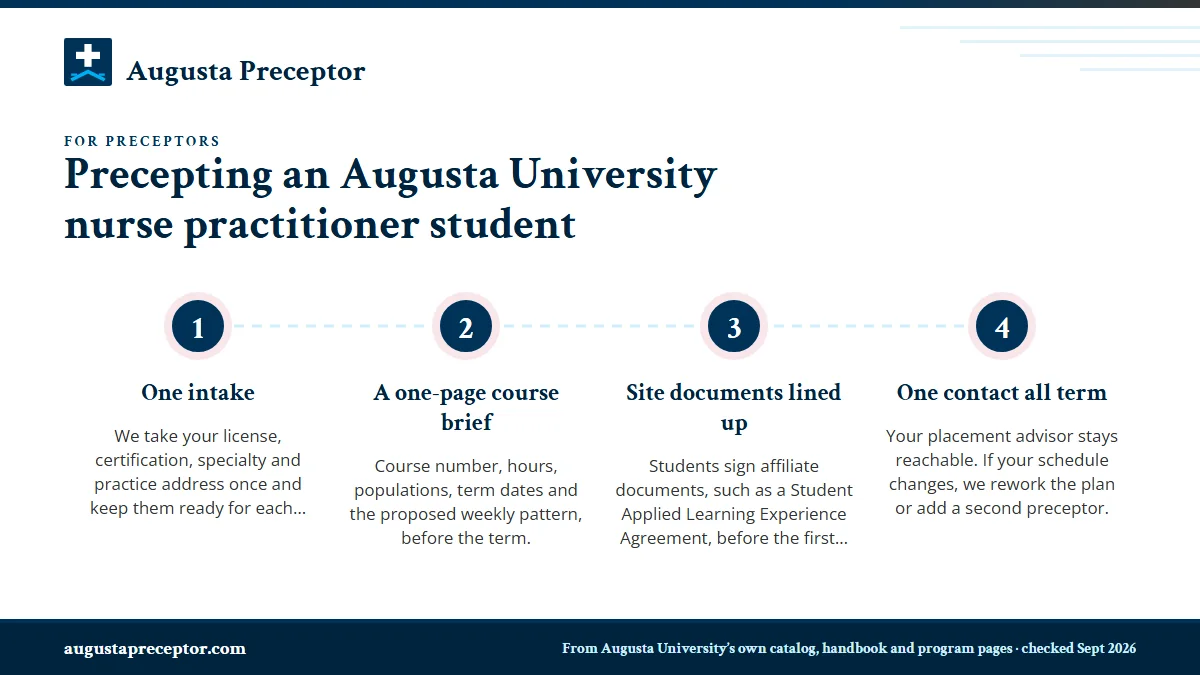
- One intakeWe take your license, certification, specialty and practice address once and keep them ready for each course you accept.
- A one-page course briefCourse number, hours, populations, term dates and the proposed weekly pattern, before the term.
- Site documents lined upStudents sign affiliate documents, such as a Student Applied Learning Experience Agreement, before the first shift; we coordinate them with your office manager.
- One contact all termYour placement advisor stays reachable. If your schedule changes, we rework the plan or add a second preceptor.
Preceptor forms, such as any agreement or evaluation, are not public. Course faculty supply them; we make sure they reach you early and go back complete.
What to expect from the student day to day
College of Nursing policy keeps students off work for eight hours ahead of any clinical shift, so they arrive rested. A student who must miss a day tells the clinical instructor and the site's designated contact beforehand, and may have to make up a full day; a student who turns up a quarter hour or more after the start time may be asked to leave. Hours go into the College's approved tracking system, which the student pays for.
If your practice sees the patients one of these courses names, tell us your specialty, county and preferred terms. We match you with an Augusta University student whose course fits, and you decide whether to go ahead.
Questions Augusta University students ask
Could a physician serve as preceptor for an Augusta University NP student?
Augusta University does not publish a preceptor credential list, so course faculty decide. Georgia's Board of Nursing ties APRN clinical instruction to Georgia APRN authorization, which points to NPs for work in Georgia. Some health systems accept physicians under their own student rules. We confirm the answer with course faculty as part of the placement.
Can a registered nurse precept an Augusta University student?
Not for the NP courses in Georgia, which limits APRN clinical teaching to nurses holding Georgia APRN authorization. RN preceptors appear in the MSN Clinical Nurse Leader immersion, NURS 7801, where Georgia's prelicensure rule has faculty and the site's responsible nurse choose the preceptor together, two students at most. See the CNL guide.
What if I have to stop precepting partway through a term?
Tell the student, the course faculty and your placement advisor as early as you can. We look for a replacement preceptor with the same population nearby, prepare the new paperwork and plan the remaining hours with the student, while course faculty confirm how the change is recorded. Behind on clinical hours covers the student's side.
Does a psychiatric preceptor need to run therapy groups?
Catalog descriptions of NURS 8345 and NURS 8348 have PMHNP students take part, at minimum, in a group for children or teens and a psychotherapy group for adults, with supervision sessions led by faculty or preceptors. If your practice runs no groups, tell us: we can pair it with a second site that does, subject to course faculty approval. See the PMHNP course guide.
Related pages
Last checked 2026-09-27
We check these pages against Augusta University's own catalog, program plans, DNP handbook and program pages, and Georgia and South Carolina rules. Your course faculty and the College of Nursing have the final word.
Whatever your program arranges, we find the preceptor who fits.
Tell us your Augusta University track, where in Georgia or South Carolina you live and when your next clinical course starts. We find preceptors near you who fit the course and Augusta University's rules, and hand you everything your faculty and the site need, well before the semester.
- Adult, pediatric and older-adult preceptors for
NURS 8312toNURS 8318, acute care forNURS 8332toNURS 8338 - Pediatric primary care for the PNP courses and psychiatric preceptors for
NURS 8342toNURS 8348 - Across Georgia and South Carolina, from the CSRA to Savannah, Atlanta and Columbia
Start your placement plan
Program, city and start date is all we need to begin.