Georgia NP practice: protocol agreements and what they mean for your preceptor
In Georgia a nurse practitioner performs medical acts under a written nurse protocol agreement with a delegating physician, and AANP rates the state restricted. For an Augusta University NP student, that means your Georgia preceptor works inside a list of delegated acts, has a named physician for immediate consultation, and can order Schedule II drugs only under a narrow emergency exception.
Find a Georgia preceptor who fits your course
Share your track, your county and the course you need hours for.
The nurse protocol agreement, in plain terms
A Georgia NP's authority for medical acts comes from a nurse protocol agreement. The Georgia Composite Medical Board's Chapter 360-32 defines it as a written document that an APRN and a physician both agree to and sign, through which the physician delegates certain medical acts under Code Section 43-34-25.
The Board of Nursing's own chapter, 410-11, tells an APRN using a protocol to follow one that is dated and signed by the APRN, the delegating physician and any other designated physicians. The agreement spells out which acts are delegated and must provide for immediate consultation with the delegating physician, or with a designated physician when the delegating physician is away.
Changes are formal too. Chapter 360-32 says amendments go to the Composite Medical Board for review within 30 days of being signed. For a student, the takeaway is that your preceptor's scope on any given day is written down, signed and on file.
Prescribing under a Georgia protocol
Prescriptive authority travels through the same agreement. Chapter 360-32 leaves Schedule II drugs out of the controlled substances a physician can delegate, with one carve-out: a qualifying APRN may be authorized to order hydrocodone, oxycodone and their compounds in emergency situations under O.C.G.A. 43-34-25(d.1).
AANP's 2026 practice environment map places Georgia in its restricted group, describing a state where physician delegation or supervision is required and NP prescribing of Schedule II drugs is limited. South Carolina sits in the same group for different reasons; the South Carolina practice guide sets the two side by side.
Our reading for clinic days, not a rule: Schedule II orders outside the emergency carve-out come from a physician at the practice, so students in settings that lean on those drugs see the handoff most often.
Physician limits that shape a practice
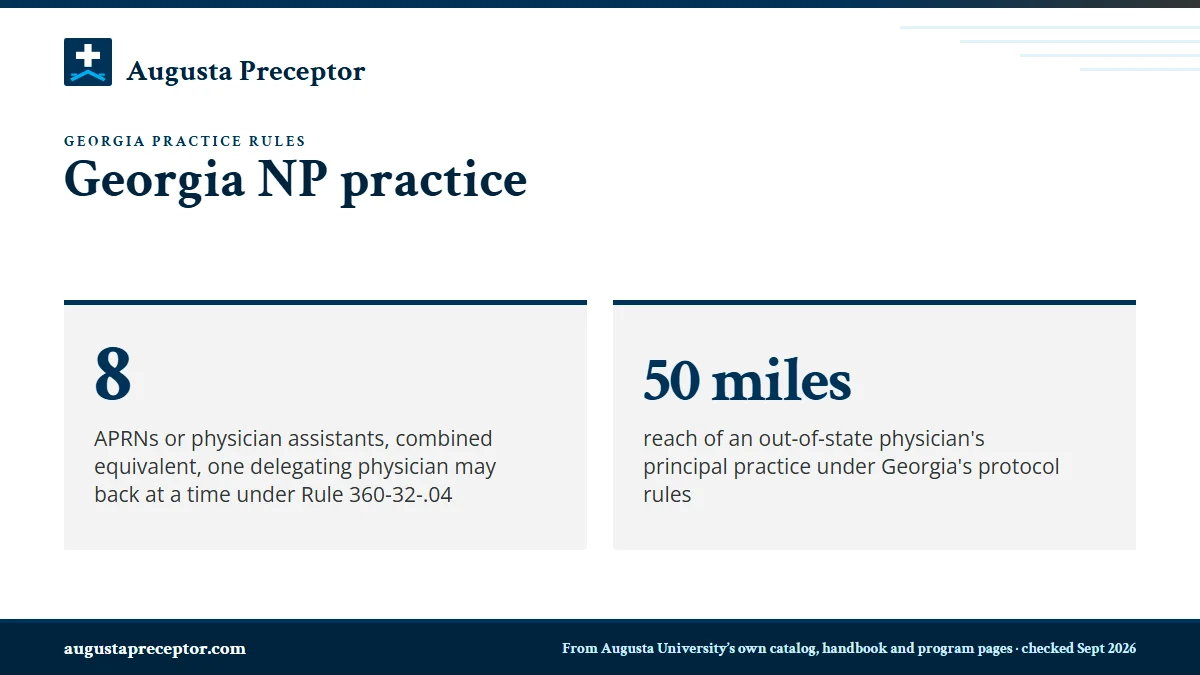
Two details in Chapter 360-32 affect the practices that host students. At accredited locations meeting O.C.G.A. 43-34-25(g.1), one delegating physician may hold protocols with no more than the combined equivalent of eight APRNs or physician assistants at any one time. That ceiling tells you how many NPs a single physician may be backing at a busy practice.
The chapter's definition of a physician also reaches one whose principal place of practice is outside Georgia, as long as it lies within 50 miles of where the protocol is used. Along the Savannah River that matters: a practice in Augusta, Martinez or Evans may have a delegating physician whose main office is in South Carolina.
Neither detail changes your clinical hours, but both explain why two Georgia practices that look alike can run their physician relationships very differently.
What Georgia's rules say about students, and what they leave open
Chapters 360-32 and 410-11 contain no rule on APRN students or precepting. Whether a preceptor's protocol agreement has to mention a student is not addressed in either, and Augusta University does not publish qualifications for NP preceptors.
The state rule that does reach your preceptor sits on the Board of Nursing's education page, which reserves clinical teaching in APRN programs for nurses the state has authorized as APRNs. The Georgia Board of Nursing guide covers that line and the license rules around it.
Hospitals add their own terms. According to Northside Hospital's page for advanced practice students, rotations run peer to peer, NP with NP, though a physician may precept any discipline; every rotation needs a sponsoring physician on active staff who signs an Exhibit A agreement; and each sponsoring physician or preceptor takes one student per rotation.
Read literally, the Board's sentence points to an APRN-authorized nurse as your clinical teacher, while Northside accepts physician preceptors. Augusta University does not publish its position, so confirm with your course faculty before counting hours with a physician.
How a Georgia practice runs day to day with a student
Applied to an ordinary clinic day, the rules look like this. You see patients alongside your NP preceptor, and what the preceptor orders, from labs to prescriptions, falls inside the acts the protocol delegates. When a case goes past them, the preceptor reaches the delegating or designated physician, which the agreement must allow without delay.
That structure is part of what you learn. Watching an NP decide what the protocol covers, when to consult and how to record the consult is the practice pattern you step into if you stay in Georgia after graduation.
Worth noticing in your first week
- Which acts the protocol delegates and which go to the physician
- Whether the delegating physician works on site or is reached another way
- How consultations and Schedule II requests are documented
- How the practice wants you to take part in orders your preceptor signs
What we check before proposing a Georgia preceptor
Whatever route your course takes to line up clinical sites, a Georgia preceptor we put forward has already been checked against the points below. Your instructors will be visiting that practice, so the file we hand over is finished well before the term starts.
- Georgia APRN authorization and an active Georgia or multistate RN license
- A current protocol agreement, and whether the site wants the delegating physician to sign anything for a student
- A patient mix that fits the course, such as adults in primary care for
NURS 8312or acute care forNURS 8332 - Room in the preceptor's schedule for a 180-hour or 240-hour course
- A location within reach of the faculty visits Augusta University describes; see faculty site visits
Then the paperwork your instructors and the practice expect is pulled together, and we remain on call through the term. Read how we search for a preceptor or start a request.
Questions Augusta University students ask
Is Georgia a full practice state for nurse practitioners?
No. AANP's 2026 map rates Georgia restricted: an NP needs physician delegation, through a nurse protocol agreement, to perform medical acts, and Schedule II prescribing is limited. Georgia has also not enacted the APRN Compact. Nothing about this changes your Augusta University coursework, but it shapes how every Georgia practice you train in is organized.
Can Georgia NPs prescribe controlled substances?
Through the protocol, yes, within limits. Chapter 360-32 defines the controlled substances a physician can delegate so that Schedule II drugs are left out, except that a qualifying APRN may be authorized to order hydrocodone, oxycodone and their compounds in emergencies under O.C.G.A. 43-34-25(d.1). Everything flows from the signed agreement.
Will I write prescriptions during my Georgia clinicals?
Georgia's protocol rules do not mention students, and student prescribing is not covered in Augusta University's public policies. Any prescription that leaves the practice does so under your preceptor's delegated authority, so the preceptor decides how you take part. Ask your course faculty what your clinical evaluation expects you to show.
Does the delegating physician have to be in the building?
The protocol rules quoted here require the agreement to provide for immediate consultation with the delegating physician or a designated physician. How a practice meets that, with the physician down the hall or reachable another way, varies. Ask in your first week so you know who your preceptor turns to.
Do Georgia's protocol rules apply if my clinicals are in South Carolina?
No. A South Carolina NP works under a practice agreement governed by South Carolina law, with its own prescribing limits. Augusta University NP students may live in either state, so read the South Carolina practice guide if your preceptor is across the river.
Related pages
Last checked 2026-09-27
We check these pages against Augusta University's own catalog, program plans, DNP handbook and program pages, and Georgia and South Carolina rules. Your course faculty and the College of Nursing have the final word.
Whatever your program arranges, we find the preceptor who fits.
Tell us your Augusta University track, where in Georgia or South Carolina you live and when your next clinical course starts. We find preceptors near you who fit the course and Augusta University's rules, and hand you everything your faculty and the site need, well before the semester.
- Adult, pediatric and older-adult preceptors for
NURS 8312toNURS 8318, acute care forNURS 8332toNURS 8338 - Pediatric primary care for the PNP courses and psychiatric preceptors for
NURS 8342toNURS 8348 - Across Georgia and South Carolina, from the CSRA to Savannah, Atlanta and Columbia
Start your placement plan
Program, city and start date is all we need to begin.