South Carolina NP practice: agreements, the student exemption and your preceptor
Every South Carolina nurse practitioner practices under a signed agreement with a physician partner, and AANP rates the state restricted. The Nurse Practice Act makes room for students in approved nursing programs, and an archived copy of the Board's FAQ calls post-licensure programs non-jurisdictional. For an Augusta University student in South Carolina, what matters most is your preceptor's agreement and your own RN license.
Find a South Carolina preceptor for your course
Tell us your track, your county and the course you need hours for.
The practice agreement behind every South Carolina NP
Section 40-33-34(C) of South Carolina's Nurse Practice Act requires each licensed NP, certified nurse-midwife or clinical nurse specialist to show evidence of a practice agreement. Section 40-33-20 describes that agreement as a written document the NP develops with a physician, or with medical staff, who commits to working alongside and supporting the NP.
The agreement is where the medical side of the NP's work is set out, and the definition names prescribing as part of it. So when you train with a South Carolina NP, the boundaries of what your preceptor orders and prescribes trace back to a signed document with a physician partner.
Georgia reaches a similar result by another path, delegated acts under a nurse protocol, and both states land in AANP's restricted group. The Georgia practice guide covers the Georgia side of the river.
Prescribing limits you will see in clinic
Section 40-33-34 caps Schedule II supplies written by an NP. A Schedule II nonnarcotic prescription may cover no more than 30 days. A Schedule II narcotic may cover no more than five days, and a follow-on prescription needs the physician's written agreement; hospice, palliative and long-term care patients are the exception, with a 30-day limit.
AANP's 2026 map explains its restricted rating for South Carolina the same way: NPs need a physician practice agreement to carry out delegated acts, and they work within controlled-substance supply limits.
Our reading, not a rule: the five-day narcotic cap and its physician sign-off show up most in urgent care, surgery follow-up and pain management, and you will see preceptors plan return visits around it. In any practice that prescribes Schedule II drugs regularly, ask early how refills and physician agreement are recorded.
The student exemption in 40-33-30(D)(4)
South Carolina's act lists activities it may not be read to prohibit, and one of them covers students practicing nursing while enrolled in a nurse education program the state treats as approved. That clause is what lets a student carry out clinical work that would otherwise call for a license the student does not yet hold.
The statute is silent on whether a post-licensure program based in another state, an Augusta University DNP track for instance, qualifies as approved here. South Carolina law as checked in September 2026 also has no provision on students working under a preceptor's practice agreement. Those are open questions, not settled answers, and your course faculty are the right people to confirm how the College of Nursing handles them.
Your RN license still matters. At entry, Augusta University requires an RN license from Georgia or a multistate license, and South Carolina put the Nurse Licensure Compact into effect alongside Georgia in January 2018. The RN license guide covers which license works where.
The Board of Nursing's view of post-licensure programs
The South Carolina Board of Nursing's education FAQ was read from an archived copy dated February 14, 2026, because the live Board site could not be reached. In that copy the Board calls post-licensure programs non-jurisdictional, keeps no list of them, and says it regulates neither those programs nor how a nursing course is formatted or delivered.
Regulation 91-6, the Board's approval rule for programs based outside South Carolina, covers only clinicals that train students toward a first nursing license. It requires Board approval before those clinicals begin and a written clinical affiliation agreement, among other conditions, but it does not address APRN programs. It therefore reaches prelicensure cohorts, not DNP nurse practitioner students.
The same goes for Regulation 91-11's preceptor terms, written for South Carolina's approved programs: an RN employed by the clinical agency, at least two years of clinical experience, no more than two students, and presence in the agency whenever the student is there. They do not bind Augusta University's NP tracks, though a site may adopt similar expectations.
What it means for South Carolina preceptors
For an NP in North Augusta, Aiken, Columbia or Greenville weighing an Augusta University student, the state adds no separate precepting credential: no South Carolina rule specific to NP preceptor licensure was found. The preceptor keeps practicing under their own license and practice agreement, and the practice's own policies shape what a student does from day to day.
Augusta University adds its own layer. Because instructors travel to see each NP student along with the preceptor and the practice, the program limits residence to Georgia and South Carolina, and a South Carolina preceptor should expect a faculty visit; the site visits guide explains how to prepare. Augusta University does not publish NP preceptor qualifications, so course faculty confirm them.
Health systems add a third. Prisma Health's graduate nursing page, seen in an archived copy from August 2025, names as acceptable NP preceptors Prisma NPs who have held an APRN license for at least two years with supervisor approval, or physicians, with PAs used for pediatrics only; the same page limits eligibility to Prisma team members with at least a year of employment and Clemson or University of South Carolina graduate nursing students, and says new school agreements are considered only for a specific workforce need.
AnMed's NP placement page, in an archived copy, considers only AnMed employees and students of Anderson University and Clemson University. Preceptors can read more on our page for preceptors.
How we match South Carolina students and preceptors
Whatever part your program plays in arranging clinicals, our South Carolina search begins with the preceptor's practice agreement and ends with a site your faculty can reach.
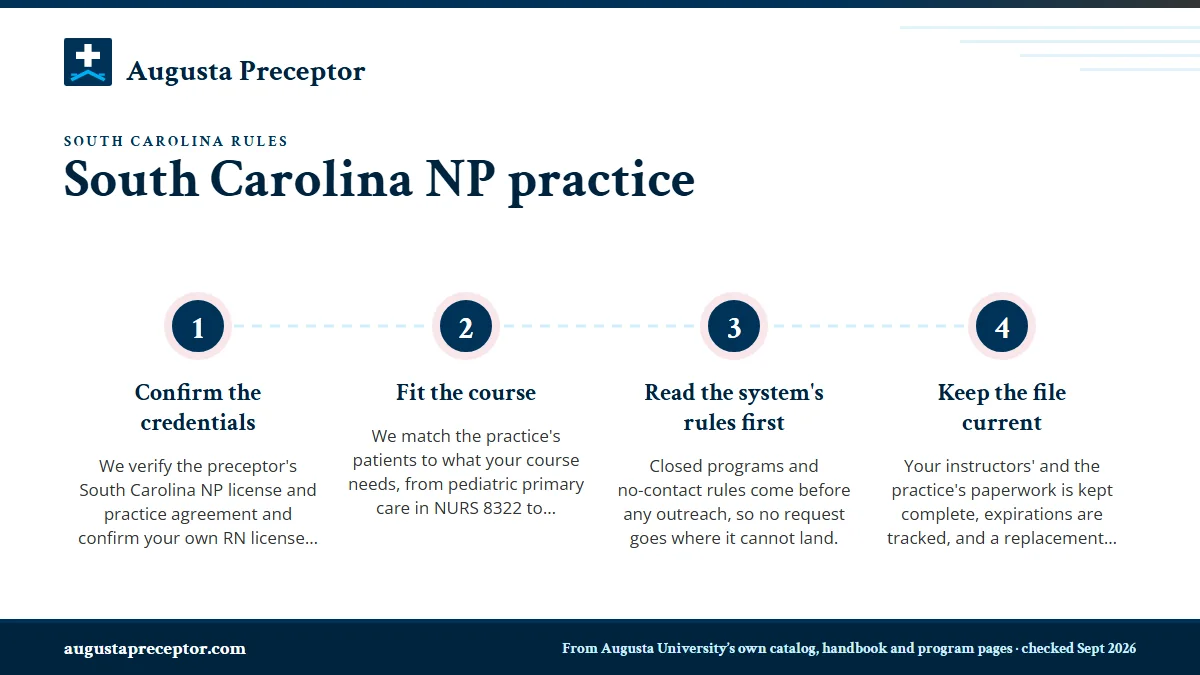
- Confirm the credentialsWe verify the preceptor's South Carolina NP license and practice agreement and confirm your own RN license reaches South Carolina.
- Fit the courseWe match the practice's patients to what your course needs, from pediatric primary care in
NURS 8322to psychiatric care inNURS 8342. - Read the system's rules firstClosed programs and no-contact rules come before any outreach, so no request goes where it cannot land.
- Keep the file currentYour instructors' and the practice's paperwork is kept complete, expirations are tracked, and a replacement search starts at once if a preceptor withdraws.
For local detail, start with the Midlands guide, which covers Aiken and North Augusta, or the Upstate guide, then send your request.
Questions Augusta University students ask
Is South Carolina a full practice state for NPs?
No. AANP's 2026 map rates South Carolina restricted: delegated acts require a physician practice agreement, and controlled-substance supplies are capped. Georgia carries the same rating. Neither state has enacted the APRN Compact, so an NP's advanced practice status stays tied to the state that granted it.
Does a South Carolina preceptor face a rule like Georgia's APRN instruction rule?
Georgia's Board limits APRN clinical teaching to nurses holding the state's own APRN authorization. No matching South Carolina rule for NP preceptors was found, and the archived Board FAQ treats post-licensure programs as outside its jurisdiction. Your preceptor still needs a current South Carolina NP license and practice agreement, and your faculty confirm the rest.
Does Augusta University need South Carolina Board approval before my clinicals there?
No approval step for NP clinicals was found. Regulation 91-6 is aimed at out-of-state programs whose students are working toward a first license, and the archived Board FAQ places post-licensure programs outside its oversight. Health systems are a separate matter: the ones that publish student rules want a school affiliation agreement in place first, as the clinical agreements guide explains.
Can a physician precept me in South Carolina?
South Carolina law as checked sets no preceptor-credential rule for NP students, and Augusta University does not publish its preceptor qualifications. Some systems accept physicians; Prisma Health, per an archived copy of its page, counts them among approved NP preceptors. Confirm with your course faculty before you begin logging hours with a physician.
Can a Georgia resident do clinical hours in South Carolina?
Augusta University's pages set a Georgia or South Carolina residence rule for NP students and describe clinical experiences in those two states, without publishing a rule that ties your hours to your home state. Your RN license has to cover South Carolina, and your faculty must be able to reach the site; bring it up with your course faculty early.
Related pages
Last checked 2026-09-27
We check these pages against Augusta University's own catalog, program plans, DNP handbook and program pages, and Georgia and South Carolina rules. Your course faculty and the College of Nursing have the final word.
Whatever your program arranges, we find the preceptor who fits.
Tell us your Augusta University track, where in Georgia or South Carolina you live and when your next clinical course starts. We find preceptors near you who fit the course and Augusta University's rules, and hand you everything your faculty and the site need, well before the semester.
- Adult, pediatric and older-adult preceptors for
NURS 8312toNURS 8318, acute care forNURS 8332toNURS 8338 - Pediatric primary care for the PNP courses and psychiatric preceptors for
NURS 8342toNURS 8348 - Across Georgia and South Carolina, from the CSRA to Savannah, Atlanta and Columbia
Start your placement plan
Program, city and start date is all we need to begin.