RN license requirements for Augusta University clinicals
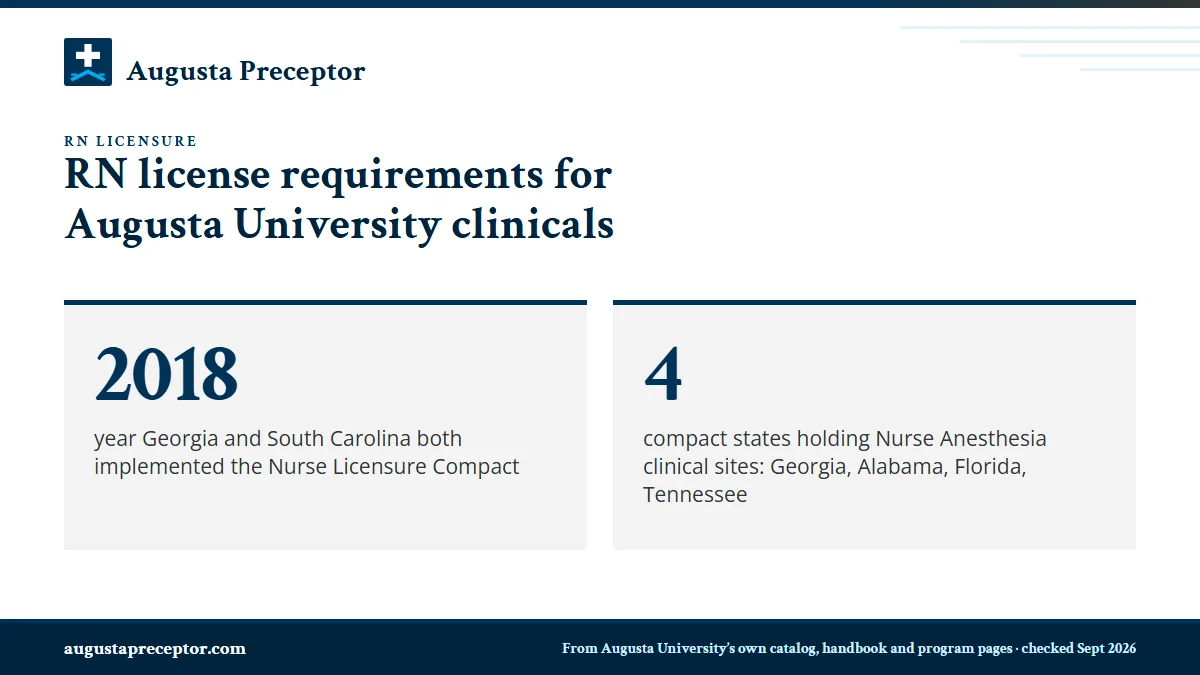
Augusta University's DNP admissions page asks for an unencumbered Georgia or multistate RN license before you enroll, and the license you rely on during clinicals must be recognized wherever the site sits. Georgia and South Carolina both began honoring the Nurse Licensure Compact on January 19, 2018, so a multistate license issued by either one is good for clinical work in the other. A license limited to one state is not, and nurse practitioner authorization after graduation is still handled by each state separately.
Get your placement plan
Tell us your Augusta University program and where you live. A placement advisor replies with preceptor and site options in your community that fit your Augusta University course.
What Augusta University requires
Four published statements set the license rules for Augusta University nursing students who are already RNs. Each comes from a different page, so it helps to see them together.
- DNP admissions (Graduate School): proof of a current, unencumbered Georgia RN license or a multistate RN license before enrollment.
- Compliance policy (CON16): graduate students need an unrestricted RN license before matriculation unless their admission contract says otherwise, and a multistate compact license may be needed to complete a graduate clinical rotation or meet an agency's requirements.
- Post-graduate certificate admissions: enrolled students must get an extra RN license for each state in which their clinical experiences happen.
- RN to BSN (catalog): a valid, unrestricted Georgia RN license.
BSN and MSN Clinical Nurse Leader students are prelicensure, so none of this applies to them until they are licensed. Nurse Anesthesia students train at program clinical sites in Georgia, Alabama, Florida and Tennessee; all four are compact states in NCSBN's data (Alabama since 2020, the rest since 2018), so a multistate license reaches every one of them.
Georgia's rule for students training in Georgia
Georgia's Board of Nursing does not regulate APRN programs, but its nursing education page sets a license condition for students anyway. A Georgia resident doing clinical hours in Georgia for a post-licensure program must hold either a Georgia license or a multistate license issued by some other compact member.
The same condition reaches the people teaching you: faculty and preceptors working in Georgia, in person or electronically, need a Georgia or multistate license, and clinical teaching in APRN programs is reserved for nurses Georgia has authorized as APRNs. The preceptor requirements guide covers that side, and the Board rules guide covers the rest of the Board's reach.
For most Augusta University NP students who live and train in Georgia, a Georgia license meets the rule. The license type only becomes a question when some clinical time crosses into South Carolina.
Multistate versus single-state licenses
Under the Nurse Licensure Compact, the state you declare as your primary residence issues your multistate license, and that license carries practice privileges into every other member state. A single-state license is limited to its issuing state. Because Augusta University's NP and certificate students must live in Georgia or South Carolina, the combinations are few.
- Georgia resident with a Georgia multistate license: covered for clinicals in both states.
- South Carolina resident with a South Carolina multistate license: covered in both, and Georgia's rule treats a multistate license issued by a fellow compact member as enough.
- Single-state license from either state: covered only in that state; clinical time across the line needs a multistate license or a second license.
Check the type printed on your license record with your state Board before you plan a site across the Savannah River. Because the multistate license follows your declared home state, moving across the border mid-program means checking in with the Board of your new state; the Georgia and South Carolina rule covers how a move affects the residence requirement.
South Carolina's position
South Carolina's statute shields students in approved nurse education programs but leaves open whether a post-licensure program from another state qualifies, and an archived Board FAQ puts such programs beyond the Board's reach; the South Carolina practice guide walks through both points. The state's approval rule for out-of-state programs covers only initial-licensure programs, so it would matter for Augusta University BSN or MSN Clinical Nurse Leader clinicals in South Carolina, not for NP students.
The practical answer for an NP student is an active license valid in South Carolina, which a Georgia or South Carolina multistate license is. Sites may spell it out: Prisma Health's graduate nursing page, in an archived copy, asks for a valid RN license as the South Carolina Board of Nursing defines it. That page does not mention multistate licenses by name, so confirm with the site if you hold one from Georgia.
After graduation: APRN authorization is state by state
The RN compact stops at your registered nurse license and does not carry a nurse practitioner role with it. Georgia and South Carolina have not adopted the APRN Compact, and with only five states on board it has not taken effect anywhere, so each state decides advanced practice status for itself.
After you pass national certification in your population, the Georgia Board of Nursing grants APRN authorization, and a Georgia NP then needs a signed protocol with a physician who delegates medical acts. A South Carolina nurse practitioner is licensed by that state's Board and must show evidence of a practice agreement with a physician. If you may practice on both sides of the river, plan for both processes. The certification guide covers the exams and each state's steps.
Augusta University's DNP page reports that the program satisfies initial licensure requirements across the states and territories, Maryland excepted, where certain concentrations may need additional review.
License checklist before your first clinical
- Your license is active, unencumbered and unrestricted, with an expiration date beyond the end of the term.
- Its type is multistate if any clinical time may fall in the other state, or you hold a second license.
- Any license condition in your admission contract is met.
- Your preceptor's license and APRN standing fit the state where the site sits.
- The site's own license wording, such as Prisma's, is read and satisfied.
- A copy of your license verification is saved with your clinical records.
Whichever way your clinical sites come together, the placement desk checks licensure on both sides of every match: yours against the site's state, and your preceptor's against Georgia or South Carolina rules. You start each course with the license questions already answered. See the compliance guide for the rest of clearance, or request a match.
Questions Augusta University students ask
Do I need a South Carolina RN license for clinicals in South Carolina?
No, as long as your license is multistate and issued by Georgia or South Carolina, since both belong to the compact. A single-state Georgia license does not reach South Carolina, and Augusta University's certificate admissions page requires enrolled students to add a license for any state their clinicals reach.
Is a multistate license required for Augusta University's DNP?
Not for admission: the Graduate School accepts an unencumbered Georgia RN license or a multistate license. The College's compliance policy adds that a multistate license may become necessary to finish a graduate rotation or satisfy an agency, so it matters once any clinical time falls outside the state that issued a single-state license.
When did Georgia and South Carolina join the Nurse Licensure Compact?
NCSBN's implementation table shows both states implementing the compact on January 19, 2018. Neither has adopted the APRN Compact, a separate agreement that still lacks enough member states to take effect, so after you certify, nurse practitioner authorization is a fresh application in each state.
Can I keep my license from another state if I move to Georgia for the program?
Georgia's Board says a Georgia resident completing clinical hours in the state must be licensed by Georgia or carry a multistate license from some other compact member. Under the compact, a multistate license is issued by whichever member state is your declared home, so after moving, ask the Georgia Board when you must switch, and meet the Graduate School's license proof before enrollment.
Must my RN license be unrestricted for Augusta University?
Yes. The Graduate School asks for a current, unencumbered license before enrollment, and CON16 calls for an unrestricted RN license before matriculation unless your admission contract says otherwise. Should anything on your license change mid-program, speak with your advisor before your next clinical day.
Related pages
Last checked 2026-09-27
We check these pages against Augusta University's own catalog, program plans, DNP handbook and program pages, and Georgia and South Carolina rules. Your course faculty and the College of Nursing have the final word.
- Augusta University Graduate School: DNP admission requirements
- Augusta University College of Nursing: CON16 clinical compliance policy
- Augusta University Graduate School: post-graduate certificate admission requirements
- Georgia Secretary of State: Georgia Board of Nursing, nursing education
- NCSBN: Nurse Licensure Compact map
Whatever your program arranges, we find the preceptor who fits.
Tell us your Augusta University track, where in Georgia or South Carolina you live and when your next clinical course starts. We find preceptors near you who fit the course and Augusta University's rules, and hand you everything your faculty and the site need, well before the semester.
- Adult, pediatric and older-adult preceptors for
NURS 8312toNURS 8318, acute care forNURS 8332toNURS 8338 - Pediatric primary care for the PNP courses and psychiatric preceptors for
NURS 8342toNURS 8348 - Across Georgia and South Carolina, from the CSRA to Savannah, Atlanta and Columbia
Start your placement plan
Program, city and start date is all we need to begin.