Preceptor requirements for Augusta University NP clinicals
Augusta University posts no list of qualifications for the preceptors in its nurse practitioner clinical courses, so the firm rules come from the state where you train. In Georgia, a preceptor needs a Georgia or multistate nursing license, and Georgia's Board wants clinical teaching in APRN programs done by nurses it has authorized as APRNs. South Carolina's law says far less, and the rest (experience, specialty, paperwork) is a conversation to have with your course faculty.
Get your placement plan
Tell us your Augusta University program and where you live. A placement advisor replies with preceptor and site options in your community that fit your Augusta University course.
Three layers decide who can precept you
State law comes first: it fixes the license a preceptor must hold where the site sits. The clinical site comes second, since many health systems set their own teaching rules. Your course comes third, and Augusta University's faculty, who visit you, your preceptor and your clinical site, are the people who can tell you what the College of Nursing expects beyond the law.
Only the first two layers are written down in public. The DNP handbook, revised for fall 2026, says in its opening pages that it does not cover each program's clinical requirements, and no NP clinical handbook, preceptor handbook or clinical course syllabus is posted on Augusta University's website. Course detail reaches enrolled students through their courses, so confirm expectations there rather than relying on what worked at another school.
What Georgia requires of your preceptor
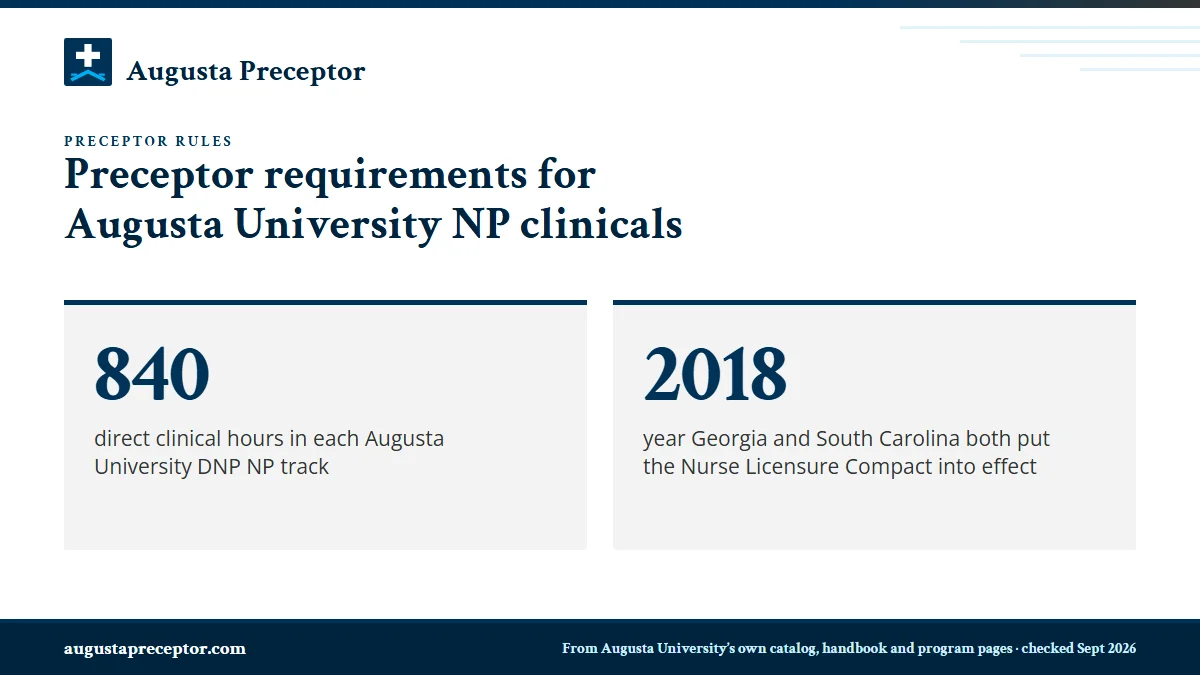
Georgia's Board of Nursing says on its nursing education page that it does not regulate post-licensure programs, and APRN programs fall in that group. It still attaches license conditions to teaching in the state. Anyone precepting or teaching in Georgia, on site or by electronic means, must hold a Georgia nursing license or a multistate license issued by another Nurse Licensure Compact state.
The same page adds a sentence written for nurse practitioner education: clinical instruction in APRN programs has to be given by a nurse with APRN authorization in Georgia. Read plainly, an NP preceptor at a Georgia site should be a Georgia-authorized APRN, not just an RN licensed somewhere in the compact.
The page does not say how that sentence applies when a physician or physician assistant runs your clinical days, and some Georgia systems accept them (Northside's student page lets a physician precept any discipline). If your strongest option is a physician, ask your course faculty how the College reads the Board's wording before you commit.
Georgia NPs practice through a protocol that a delegating physician signs, and the protocol rules never mention students (Georgia practice guide). Georgia's detailed preceptor rule, with its two-student cap, binds Board-approved prelicensure programs such as the faculty-led BSN and MSN Clinical Nurse Leader (Board rules guide).
What South Carolina requires
South Carolina's statute is thinner. The Nurse Practice Act carves out students in approved nurse education programs but never says whether a program based in another state and teaching licensed nurses qualifies. The Board's education FAQ, in an archived copy, places post-licensure programs outside its jurisdiction and keeps no list of them.
Our research turned up no South Carolina rule on which license an NP student's preceptor must hold. A South Carolina nurse practitioner must have a written practice agreement with a physician that sets out the medical side of care, prescribing included, and the statute is silent on students working under it. The South Carolina practice guide has the detail.
The state's own preceptor standards (an agency-employed RN, two years of clinical experience, at most two students, on site throughout) are written for programs the South Carolina Board approves, not Augusta University's NP tracks. Systems fill the gap themselves. According to an archived copy of Prisma Health's graduate nursing page, its approved NP preceptors are Prisma nurse practitioners with an APRN license held at least two years and a supervisor's approval, physicians, or physician assistants for pediatrics only.
What Augusta University does say about preceptors
Scattered across the catalog, the DNP handbook and the College's policies are a handful of statements that describe how preceptors fit into a course. None sets a qualification, but together they show the shape of the role.
- In the DNP residency, faculty assess each student's needs, write learning objectives with the student, orient the preceptor or mentor, and stay accountable for evaluating the student (DNP handbook).
NURS 9192, the final practicum shared by every NP track, expects you to practice across the full scope of advanced practice nursing alongside a preceptor (catalog).- The PMHNP courses
NURS 8345andNURS 8348include individual and peer group supervision led by faculty, preceptors or both (catalog). - Clinical performance goes on course-specific evaluation tools, every clinical objective needs a pass rating, and you sign the final tool; the policy does not say who fills it in (CON31).
- Nurse Anesthesia practicums run with certified registered nurse anesthetists, anesthesiologists or both; MSN Clinical Nurse Leader students work with nurse preceptors; and a DNP Project site partner needs no particular credential (catalog and handbook).
What Augusta University does not publish
Several items students search for are not on any public Augusta University page. Where one matters to your plans, the answer has to come from your course faculty or the College of Nursing, and it is worth having in writing. Guides that fill these gaps with another school's rules, or with a number that sounds official, are guessing.
- Minimum credentials, years of practice or a required specialty match for NP preceptors.
- A preceptor agreement, a preceptor CV or license form, or a site approval form.
- Preceptor orientation materials and preceptor evaluation forms.
- Deadlines for putting a preceptor or site forward in a given term.
- How many students one preceptor may take at a time in an NP course.
Rules the clinical site adds
Health systems often layer their own preceptor rules on top of the state's. Northside, according to its advanced practice student page, wants peer precepting (NP teaching NP), lets a physician precept any discipline, allows one student per preceptor per rotation, and requires an agreement signed by a sponsoring physician on its active staff. Wellstar accepts only its preceptor confirmation form dated May 2023, and Grady's NP packet includes a form the preceptor signs and dates to confirm willingness.
These belong to the site, not to Augusta University, and they stack on top of whatever your course expects. Most also depend on a school-level contract being in place first, which the clinical agreements guide explains.
Questions to settle with your course faculty
A short list of questions, asked before the term, prevents most preceptor surprises. Bring the candidate's credentials with you so the answers are specific.
- Which credentials the course accepts: nurse practitioners only, or also physicians and physician assistants.
- Whether the preceptor's certification must match your population: family, adult-gerontology acute care, pediatric primary care or psychiatric mental health.
- Whether the course sets a minimum number of years in practice.
- Which forms the preceptor signs, and the date each is due.
- Who completes the clinical evaluation tool, and when faculty plan to visit the site.
- For a South Carolina site, which license the College expects your preceptor to hold.
How we vet a preceptor before you rely on one
Whatever part your program plays in finding sites, our job is to bring you a preceptor who clears every rule on this page before you spend a week on paperwork. For a Georgia site, the placement desk confirms the preceptor's Georgia or multistate license and Georgia APRN authorization and the protocol behind the practice. For a South Carolina site, we confirm licensure and the practice agreement. In both states we match specialty and patient mix to your exact course, from NURS 8312 through NURS 9192.
Then we assemble what your faculty and the site will want: credentials, site details and an hours plan for the term, sent early. If a preceptor withdraws mid-course, we start the replacement search as soon as you tell us. See how it works, or send your course and county through the request form.
Questions Augusta University students ask
Can a physician be my preceptor in an Augusta University NP course?
Augusta University publishes no rule either way. Georgia's Board reserves clinical teaching in APRN programs for nurses it has authorized as APRNs, while some systems, such as Northside, let physicians precept NP students. Because those two points pull in different directions, ask your course faculty before you count on a physician, and keep their answer in writing.
Does a preceptor from South Carolina need a Georgia license?
Only for work at a Georgia site. Georgia's rule covers anyone precepting in the state, and a South Carolina multistate RN license meets its license condition because both states are in the compact. The APRN side differs: with no APRN compact in effect, the Board's wording points to Georgia APRN authorization for Georgia clinicals.
How many years of experience must my preceptor have?
Augusta University does not publish a minimum. Some systems set one for their own staff; an archived copy of Prisma Health's page asks for an APRN license held at least two years. South Carolina's two-year standard applies to programs its Board approves, not to Augusta University's NP tracks. Ask your course faculty whether your course sets a floor of its own.
Does my preceptor need certification in my NP specialty?
No public Augusta University page says so, yet a matching population is the safest choice because course objectives follow it. Ask your faculty about near matches before relying on one, for example a pediatric nurse practitioner for the FNP course on infants, children and adolescents (NURS 8315), or a psychiatrist for part of a PMHNP course.
What does my preceptor sign for Augusta University?
Augusta University does not post its preceptor documents. The DNP handbook says faculty orient preceptors and mentors in the residency, and sites keep their own paperwork, such as Wellstar's preceptor confirmation form. Your course materials will name the College's documents and dates; we prepare the preceptor's side ahead of time so nothing waits on a signature.
Related pages
Last checked 2026-09-27
We check these pages against Augusta University's own catalog, program plans, DNP handbook and program pages, and Georgia and South Carolina rules. Your course faculty and the College of Nursing have the final word.
- Georgia Secretary of State: Georgia Board of Nursing, nursing education
- Augusta University: DNP Handbook (revised Fall 2026)
- Augusta University catalog: NURS 9192 Advanced Practice Nursing Program Practicum
- Augusta University College of Nursing: CON31 clinical evaluation policy
- South Carolina Code, Title 40 Chapter 33 (Nurse Practice Act)
Whatever your program arranges, we find the preceptor who fits.
Tell us your Augusta University track, where in Georgia or South Carolina you live and when your next clinical course starts. We find preceptors near you who fit the course and Augusta University's rules, and hand you everything your faculty and the site need, well before the semester.
- Adult, pediatric and older-adult preceptors for
NURS 8312toNURS 8318, acute care forNURS 8332toNURS 8338 - Pediatric primary care for the PNP courses and psychiatric preceptors for
NURS 8342toNURS 8348 - Across Georgia and South Carolina, from the CSRA to Savannah, Atlanta and Columbia
Start your placement plan
Program, city and start date is all we need to begin.