Your own preceptor search or ours: a fair comparison
Both routes can end with a good preceptor. Searching yourself costs time and phone calls; working with us costs a service fee and buys a wider search, license checks, paperwork and a replacement plan. Which suits you depends on your contacts, your next course and how many weeks remain before it starts.
Want a second search running?
Send your track, course and ZIP code, plus any leads you already have.
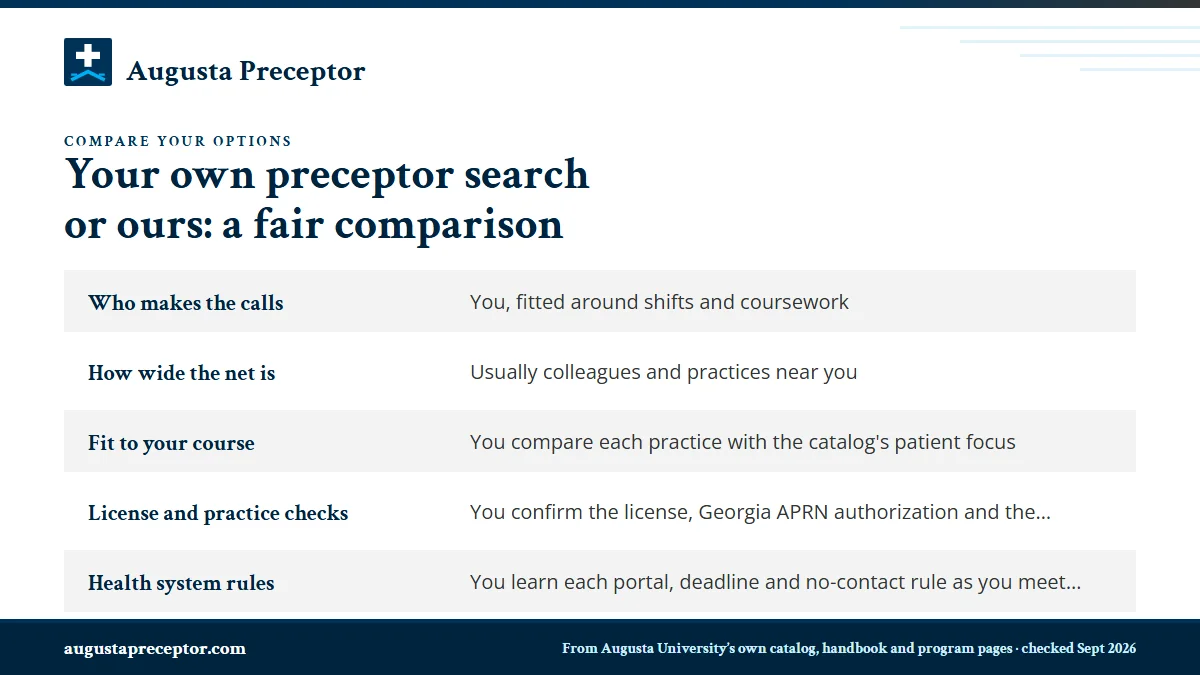
The two routes side by side
Whether or not your program has a hand in arranging clinicals, you can look on your own, through colleagues and practices you know, or hand the search to our placement desk. Here is how the two compare, point by point.
| Question | Searching on your own | Searching with our placement desk |
|---|---|---|
| Who makes the calls | You, fitted around shifts and coursework | Your placement advisor, with updates to you as leads develop |
| How wide the net is | Usually colleagues and practices near you | Independent practices, health centers and system clinics across your part of Georgia or South Carolina |
| Fit to your course | You compare each practice with the catalog's patient focus | Every lead is matched to your course number before you hear of it |
| License and practice checks | You confirm the license, Georgia APRN authorization and the protocol or practice agreement | Confirmed by us before a name reaches you |
| Health system rules | You learn each portal, deadline and no-contact rule as you meet it | Known in advance and built into the plan |
| Paperwork | You collect preceptor and site details for faculty | Assembled for you in the order faculty and the site request |
| If the preceptor leaves | You restart, often mid-term | We reopen the search for the same course |
| Cost | Your time, and hours you might otherwise work | A service fee, explained on our cost page |
| Who decides | You | You: every match waits for your yes |
When your own search is the right call
Some students already hold the answer: a nurse practitioner they have worked beside for years, a clinic that has hosted students before, a practice in a small town where the NP knows their family. If that person practices in Georgia or South Carolina and sees the patients your next course names, asking directly can be the quickest route of all.
A solo search also suits courses whose setting is common. Adult primary care for NURS 8312 exists in far more clinics than the child or adolescent group work that NURS 8345 requires, and a wide field forgives a late start better than a narrow one.
If you search alone, keep a written log of every practice you approach, the date and the answer. It saves repeat calls, shows faculty the effort you have made, and lets anyone who helps later pick up exactly where you stopped.
Where a search on your own runs into walls
Large health systems apply the same rules to every student, and several make a solo approach hard. Atrium Health and Atrium Health Floyd ask students not to call their physicians or advanced practice providers about an application. Emory runs one central request process and says it cannot honor placements arranged outside it. By an archived copy of its page, AnMed considers only its own employees and Anderson University and Clemson University students.
Other systems need a willing preceptor before anything else. Northside's page puts securing the sponsoring preceptor on the student or school, and Grady's NP packet needs the preceptor's signature, so a request there starts only after someone has said yes.
The quieter wall is time. Calls to busy practices can stall at the front desk, and a yes can take several conversations. Those weeks come out of your term, and a 240-hour course leaves little room to spare.
What our search adds
We work the whole map at once. Your placement advisor lists every practice type within your drive, ranks each by how well its patients fit your course, and approaches the strongest first, following each health system's stated route where one exists. A student near the state line sees options on both banks of the Savannah River, each checked against the license they hold.
Every lead is checked before you see it: license, Georgia APRN authorization where the clinical is in Georgia, the physician protocol or South Carolina practice agreement, room for a faculty visit and the site's onboarding lead time. Then we stay with you, preparing the paperwork, tracking compliance dates and searching again for the same course if a preceptor steps away. How it works lays out each stage.
What stays the same either way
The rules of your course hold whichever way the preceptor is found. Augusta University's faculty oversee the course and visit you, your preceptor and your site. Clinical agencies make their own decision on your background check and drug screen. The College of Nursing's compliance list, its paid tracking system and the Satisfactory/Unsatisfactory grade apply to every student.
Preceptors and sites also keep their own say. That is why an honest service, ours included, speaks in terms of effort, speed and a clear plan B rather than promised dates. The placement process guide sets out what Augusta University publishes about the steps.
Doing both at once
You can have the best of both: ask the people you know while our placement desk runs its own search. Send us your leads and we check them against the course and the licensing rules alongside our finds. If a contact says yes, you have saved time; if not, a search is already moving. Tell us which practices you have already approached, so each one hears a single, clear request.
If you are weighing services, choosing a placement service lists the questions worth asking, and the cost page explains what shapes our fee. If a course is already close, start with no preceptor yet.
Questions Augusta University students ask
Does Augusta University allow students to use a placement service?
Augusta University publishes no position on placement services either way. What counts is that the preceptor and site meet your course's requirements and satisfy your faculty, who oversee the course. If you are unsure, ask your course faculty, and share whatever they need to review the placement before your first clinical day.
Can I give you a lead I found myself?
Yes, and please do. Your placement advisor checks it the same way as our own finds: patient fit for the course, license and Georgia APRN authorization where relevant, the protocol or practice agreement, the site's own student rules and room for a faculty visit. If it passes, we help with the paperwork; if not, you learn why before investing more time.
Can a placement service get me past a health system's portal?
No service replaces a health system's own process. Where a system requires a school agreement, a portal request or a set deadline, that route applies to every student. What a good service adds is knowing those rules early and aiming the search at sites whose process fits your start date.
Which route is faster?
It depends on where you start. A warm contact whose practice fits the course can be the fastest path of all. Without one, an organized search across many practices usually beats cold calls made between shifts. Health system lead times apply either way: Northside wants compliance 30 days before a rotation, and Emory warns that a new school agreement can take several months.
Is placement help worth paying for if I only need one course?
Weigh the fee against the hours a solo search takes and the risk of a late start in a Satisfactory/Unsatisfactory course. You can also use us for the hardest course only, such as a pediatric or psychiatric term, and search alone for the rest. The fee depends on the course and timing rather than a flat rate.
Related pages
Last checked 2026-09-27
We check these pages against Augusta University's own catalog, program plans, DNP handbook and program pages, and Georgia and South Carolina rules. Your course faculty and the College of Nursing have the final word.
- Augusta University College of Nursing: Doctor of Nursing Practice programs
- Augusta University College of Nursing policy CON12
- Emory Healthcare: nursing students and faculty
- Grady Health System: nurse practitioner and post-graduate practicum
- Northside Hospital: advanced practice student rotations (ACEMAPP)
Whatever your program arranges, we find the preceptor who fits.
Tell us your Augusta University track, where in Georgia or South Carolina you live and when your next clinical course starts. We find preceptors near you who fit the course and Augusta University's rules, and hand you everything your faculty and the site need, well before the semester.
- Adult, pediatric and older-adult preceptors for
NURS 8312toNURS 8318, acute care forNURS 8332toNURS 8338 - Pediatric primary care for the PNP courses and psychiatric preceptors for
NURS 8342toNURS 8348 - Across Georgia and South Carolina, from the CSRA to Savannah, Atlanta and Columbia
Start your placement plan
Program, city and start date is all we need to begin.