NP certification exams and APRN licensure after Augusta University
Augusta University's catalog names the certification boards for each nurse practitioner track: ANCC for all four, joined by the American Academy of Nurse Practitioners for FNP and PMHNP, the American Association of Critical-Care Nurses for AGACNP, and the Pediatric Nursing Certification Board for PNP. After the exam comes the state step: APRN authorization from the Georgia Board of Nursing, or, next door, a South Carolina NP license backed by a practice agreement with a physician.
Plan your final practicum
Tell us your Augusta University track and when NURS 9192 starts. A placement advisor finds a preceptor who fits your population.
NURS 9192, the last practicum before boards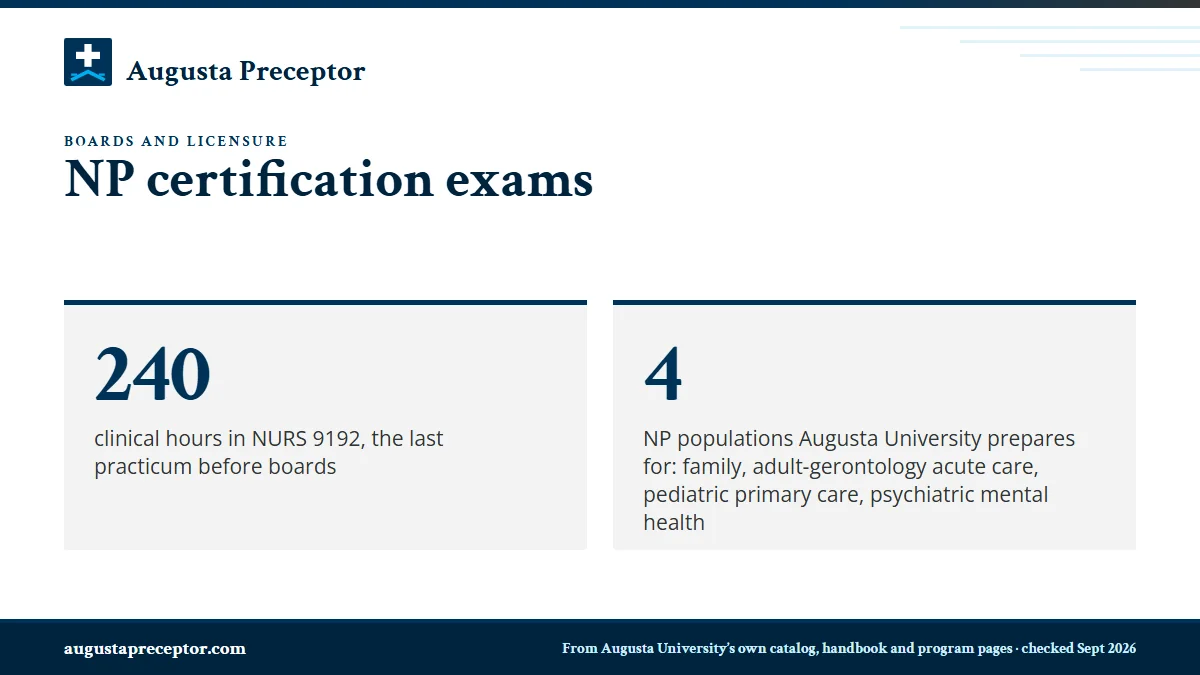
Which boards Augusta University names for each track
Each DNP concentration's catalog entry names the national certification boards for its graduates. The post-graduate AGACNP and PMHNP certificates prepare you for the same population as the matching DNP track.
| Track | Boards named in the 2026-27 catalog | Worth knowing |
|---|---|---|
| DNP-FNP | American Nurses Credentialing Center (ANCC); American Academy of Nurse Practitioners, whose exams run through its certification board, AANPCB | The FNP page publishes no pass rate |
| DNP-AGACNP | ANCC; American Association of Critical-Care Nurses (AACN) | Augusta University's web copy for the AGACNP certificate names the American Academy of Nurse Practitioners or ANCC instead |
| DNP-PNP (primary care) | ANCC; Pediatric Nursing Certification Board (PNCB) | The track is primary care; an acute care PNP concentration is only proposed |
| DNP-PMHNP | ANCC; the American Academy of Nurse Practitioners | PMHNP clinicals include child, adolescent and adult group work |
Two cautions apply. AACN in the AGACNP row means the critical-care nurses' association, not the American Association of Colleges of Nursing, whose Essentials shape DNP curricula. And boards open and retire exams over time, so check each board's current exam list and eligibility rules before you register; the catalog reflects the year it was written.
Clinical Nurse Leader graduates meet a similar split. The MSN page names the American Association of Colleges of Nursing's CNL exam in one place and ANCC in another, so confirm the current CNL certifier with the program.
Pass rates, as Augusta University reports them
The program pages carry short statements about board results. They are the university's own figures, with no cohort sizes or exam years attached.
| Track or certificate | Augusta University's statement |
|---|---|
| DNP-AGACNP | 100% board pass rate for the last 4 out of 5 years |
| DNP-PNP | 100% board pass rate for the last 4 out of 5 years |
| DNP-PMHNP | 100% board pass rate for the last 5 years |
| DNP-FNP | No figure published |
| AGACNP certificate | 100% board pass rate for the last 5 years |
| PMHNP certificate | 100% board pass rate for the last 5 years |
The DNP handbook speaks more generally of 100% pass rates for select advanced practice certificates. If a pass rate shapes your choice of board, ask the program which exam and which graduating classes a figure covers. Nurse Anesthesia results, where the catalog and the program page disagree, are set out in the accreditation guide.
How NURS 9192 leads into your boards
NURS 9192, Advanced Practice Nursing Program Practicum, is the last clinical course in every NP track: 240 hours, taken in the final spring of the full-time plan alongside NURS 9191, APRN Practice Synthesis, a two-credit didactic corequisite. The catalog frames it as the terminal practicum before graduation, where you work at the full breadth of advanced practice nursing beside a preceptor.
That makes the preceptor choice for NURS 9192 a board-preparation decision as well as a clinical one. In our view, the strongest final practicum mirrors the population your exam tests: an FNP student who has already covered adults, children and older adults in NURS 8312, NURS 8315 and NURS 8318 benefits from a family practice seeing all ages, and an AGACNP student from a setting with complex, rapidly changing adult patients. The final practicum guide goes deeper.
Budget for the exam too. Augusta University's published cost information puts board and licensure exam charges into your last semester, on top of everything else that term asks of you.
Passing a board exam does not by itself let you practice. In Georgia, working in the APRN role ahead of the Board of Nursing's authorization counts as practicing without authority, and in South Carolina a licensed NP must be able to produce a practice agreement signed with a physician or medical staff.
APRN authorization in Georgia
In Georgia, the Board of Nursing grants the APRN authorization that lets a nurse practitioner practice; Chapter 410-11 of its rules classes any APRN practice before the Board grants it as unauthorized. Check the Board's current application requirements on the Secretary of State's site before you apply.
Once authorized, Georgia NPs practice under a nurse protocol agreement: a written, dated document signed by the APRN and the delegating physician that spells out the delegated medical acts and provides for immediate consultation. The Composite Medical Board's rules require amendments to be filed within 30 days, generally hold a physician to no more than eight full-time-equivalent APRNs and PAs together, and limit Schedule II prescribing to narrow cases such as emergency hydrocodone or oxycodone orders. AANP rates Georgia's practice environment as restricted.
The same authorization matters to you before graduation. Georgia expects APRN students' clinical teaching to be done by a nurse the Board has authorized, which is why every Georgia preceptor we propose carries that authorization. The Georgia NP practice guide covers protocols in detail.
Nurse practitioner licensure in South Carolina
South Carolina licenses nurse practitioners through its Board of Nursing, and under section 40-33-34 each licensed NP must be able to show a practice agreement. The Nurse Practice Act defines that agreement as a written document developed by the NP with a physician or medical staff who agree to support the NP, setting out the medical aspects of care, prescribing included.
Prescribing carries firm limits: under section 40-33-34, Schedule II non-narcotics are capped at a 30-day supply and Schedule II narcotics at a five-day supply, with 30 days allowed in hospice, palliative and long-term care. AANP rates South Carolina restricted as well. The South Carolina NP practice guide explains how practice agreements shape precepting there.
Working in both states, or beyond
Georgia and South Carolina both joined the Nurse Licensure Compact, so a multistate RN license covers your nursing license in either state. The APRN Compact is a different matter: neither state has enacted it, and it is not yet in operation anywhere, so your NP credential is issued state by state. A graduate who plans to work on both sides of the state line around Augusta needs Georgia authorization and a South Carolina license separately.
For states farther away, the DNP program's licensure disclosure is broad: Maryland is the only state it flags, and only for some concentrations that may need extra review. The RN license guide covers the compact during your clinical years.
How we help you reach boards on schedule
A delayed final practicum delays graduation, and a delayed graduation pushes back the exam and the state steps after it. Regardless of how placement works in your program, we find you a NURS 9192 preceptor in Georgia or South Carolina early, matched to your population and your exam, with the Georgia APRN authorization or South Carolina license that the site's state requires.
We prepare the preceptor and site details your faculty review, keep your compliance items current through the final term, and stay on call for a replacement if a preceptor steps away in the last semester. Tell us your track and final-term dates on the request form.
Questions Augusta University students ask
Which certification exam should an Augusta University FNP graduate take?
The catalog names two options for FNP graduates: ANCC and the American Academy of Nurse Practitioners. Compare each board's current eligibility rules, exam format and renewal requirements, and ask your faculty which one past classes favored, since the FNP program page does not publish a pass rate for either.
Can I work as an NP in Georgia as soon as I pass my boards?
Not yet. You also need APRN authorization from the Georgia Board of Nursing, because the Board's rules count APRN practice before it acts on your application as unauthorized. Georgia NPs then practice under a signed nurse protocol agreement with a delegating physician, so plan both steps into the months after graduation.
Do I need separate NP credentials for Georgia and South Carolina?
Yes. A multistate RN license under the Nurse Licensure Compact works in both states, but the APRN Compact is not in effect in either, so Georgia APRN authorization and a South Carolina NP license are separate applications, each followed by that state's protocol or practice agreement.
When do Augusta University students pay for certification exams?
Augusta University's cost information lists board and licensure exam charges for your last semester, which on the full-time plans is also the NURS 9192 term. Fee amounts are set by the boards and states, so check each one's current schedule when you build your last-term budget.
Does NURS 9191 include board review?
The catalog lists NURS 9191 as APRN Practice Synthesis, a two-credit didactic course taken together with NURS 9192. The public materials we reviewed do not say whether it includes a formal board review, so ask your course faculty what it covers and plan any separate review course around it.
Related pages
Last checked 2026-09-27
We check these pages against Augusta University's own catalog, program plans, DNP handbook and program pages, and Georgia and South Carolina rules. Your course faculty and the College of Nursing have the final word.
Whatever your program arranges, we find the preceptor who fits.
Tell us your Augusta University track, where in Georgia or South Carolina you live and when your next clinical course starts. We find preceptors near you who fit the course and Augusta University's rules, and hand you everything your faculty and the site need, well before the semester.
- Adult, pediatric and older-adult preceptors for
NURS 8312toNURS 8318, acute care forNURS 8332toNURS 8338 - Pediatric primary care for the PNP courses and psychiatric preceptors for
NURS 8342toNURS 8348 - Across Georgia and South Carolina, from the CSRA to Savannah, Atlanta and Columbia
Start your placement plan
Program, city and start date is all we need to begin.