Augusta University's post-master's DNP: residency hours, the project site and the 1,000-hour count
Augusta University's post-master's DNP comes in two tracks, Traditional and Nurse Executive, each 37 credits with a fall start. Neither track has patient-care clinical courses. You complete DNP residency practice hours inside the project courses, at least 540 of them at Augusta University, and you carry out your DNP Project at a practice site with a partner there.
Plan your residency and project site
Tell us your track, your verified prior hours and your project idea. Your placement advisor replies with site and partner options.
Two tracks built on one 37-credit core
The Traditional track is for nurses who hold a master's in nursing and national certification as a nurse practitioner, nurse anesthetist, nurse-midwife or clinical nurse specialist. The catalog spreads it over five semesters, three full time and two part time. The Nurse Executive track admits applicants with a master's in nursing or another approved health-related field and runs 16 months of full-time study, with full-time, accelerated full-time and part-time plans published.
Both tracks carry 37 credits and begin in fall. The DNP Handbook describes them as asynchronous, with scheduled meetings each semester with your DNP project faculty advisor, and policy CON01D gives Traditional and Nurse Executive students five consecutive years from first enrollment to finish; the grades and time limits guide covers the rest of the progression rules.
Each student works from an individual Academic Plan of Study. The Concentration Coordinator builds it with you from your entry credentials, your full- or part-time status and your gap analysis; both of you sign it before enrollment, and it is reviewed every semester.
Residency hours instead of clinical courses
Post-master's students take no patient-care clinical courses. Their hours are DNP residency hours, which the handbook calls practice hours, earned inside the project course sequence: NURS 7150, NURS 8550, NURS 9060, NURS 9061 and NURS 9062, with NURS 9050 carrying none. The full-time plans total 540.
Two sources disagree on NURS 9062. Its catalog description says 60 residency hours, while the post-master's plans take it at five credits for 240 hours; the course is variable credit and the plans govern. The handbook also cites NURS 9051 and NURS 9052 in places, older numbers for the same project work. The DNP residency hours guide carries the course-by-course table.
Residency hours are not meant to be only direct patient care. The handbook expects indirect care work in health care settings or related environments: meetings on a practice problem, agency planning sessions, time with content experts, interprofessional work, site visits tied to the project topic, presentations and carrying out the project itself. Faculty set the learning objectives with you, orient any preceptor or mentor, and evaluate what you achieve.
How your 1,000 hours are counted
The handbook requires every DNP student to document at least 1,000 post-baccalaureate supervised hours. Post-master's students bring some from their master's program and earn the rest in the residency, and the Concentration Coordinator reconciles the two in a gap analysis. The Nurse Executive page states the same 1,000-hour expectation for that track.
Prior hours can be verified two ways. A program director at your master's school can complete Augusta University's Verification of Post-BSN Clinical and Practice Hours form, which goes to the program manager before course registration. Or your certifying body can send verification of current advanced practice certification to NursingCAS, in which case only 500 hours are credited.
| Verified prior hours | Still needed to reach 1,000 | Hours at Augusta University |
|---|---|---|
| 500, credited through NP certification | 500 | At least 540, the program minimum |
| 700, verified by your master's program | 300 | At least 540, the program minimum |
| 400, verified by your master's program | 600 | 600, above the 540 in the full-time plan |
However many hours you verify, the handbook sets a floor of nine residency credits, or 540 hours, at Augusta University. One passage speaks of post-master's students earning 500 of the 1,000 hours through the project courses, but 540 is the figure the plans print. Part-time plans warn that extra residency hours may be needed, and the Nurse Executive catalog entry says hours can be added to any semester.
The DNP Project team and your practice site
The handbook gives every DNP Project a three-part team: you, a doctorally prepared faculty member who advises you, and a practice partner or sponsor from the site where the project happens. It recommends team meetings every two weeks, and the faculty advisor makes sure both Augusta University's IRB approval and the site's own approvals are in place.
The site partner is someone employed at the site in a position to decide on project priority, feasibility, resources and what happens after you finish. No particular education or credential is required, and the partner does not grade your coursework. The partner's job is to help you gain the permissions, letters and sign-offs the site requires, keep the project aligned with site priorities and explain how the site works.
The partner also shows up at key moments. Your three-minute proposal presentation in NURS 9050 goes to project faculty and the site partner for approval, and at the end you give site leaders a one- to two-page executive summary and a short slide presentation. Augusta University does not publish who secures the project site, so ask your faculty advisor how your site should be chosen and approved.
Fully online, or one or two campus visits?
Augusta University describes the campus requirement three ways. The catalog approves the Traditional track as web-based with one to two visits to the Augusta campus, and the Nurse Executive track with one or two required visits. Both track web pages say the program is available 100 percent online and needs no on-campus presence. The Graduate School's admissions pages say accepted students must attend a face-to-face orientation and a face-to-face defense.
The handbook adds that the poster presentation day, about a month before the end of your graduation semester, may be held on campus or by video conference. Until the College of Nursing confirms your own plan, budget the time and travel for at least one trip to the Augusta campus.
The Student Health immunization page lists the Nurse Executive track among non-clinical programs, even though the track requires 1,000 post-baccalaureate hours and project work at a practice site. Check what your project site asks of visitors and students, since each site sets its own entry requirements.
How we help post-master's DNP students
Whether or not your program takes a hand in choosing your project site, the right site and the right partner keep a residency on schedule. Our placement desk works from the handbook's own description of the project team.
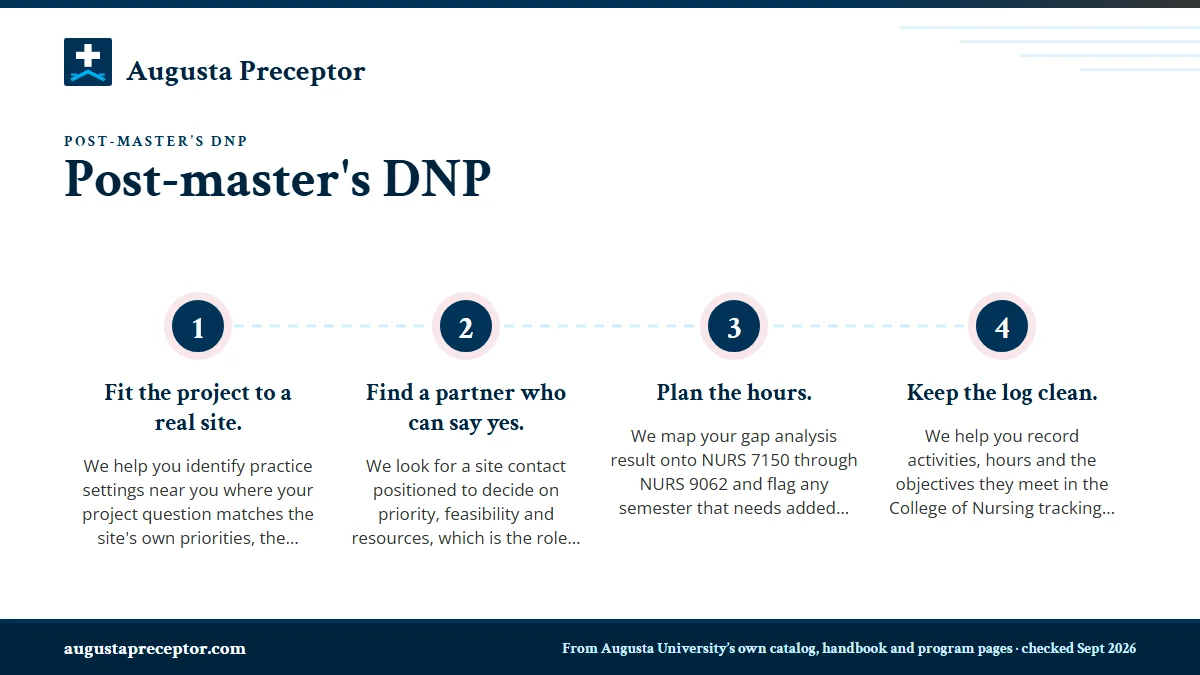
- Fit the project to a real site. We help you identify practice settings near you where your project question matches the site's own priorities, the handbook's test for a workable project.
- Find a partner who can say yes. We look for a site contact positioned to decide on priority, feasibility and resources, which is the role the handbook describes.
- Plan the hours. We map your gap analysis result onto
NURS 7150throughNURS 9062and flag any semester that needs added residency hours. - Keep the log clean. We help you record activities, hours and the objectives they meet in the College of Nursing tracking system, where only logs marked accepted count.
Share your project idea through the placement request form, and compare programs in the clinical hours planner.
Questions Augusta University students ask
Does the Georgia or South Carolina residence rule apply to the post-master's DNP?
The residence sentence on the DNP overview page names the four NP concentrations and the post-graduate certificates. It does not mention the Traditional or Nurse Executive tracks. Your project site still has to work for your faculty advisor and the project team, so settle location questions with the program before committing to a site.
Can a CRNA or nurse-midwife enroll in the Traditional track?
Yes, according to the track's web page, which opens it to nurses with a master's in nursing and national advanced practice certification as a nurse practitioner, nurse anesthetist, nurse-midwife or clinical nurse specialist. How many prior hours count depends on how you verify them, and verification through certification is credited 500 hours.
Do post-master's residency hours need a preceptor?
The handbook refers to a preceptor or mentor for residency practice experiences, whom faculty orient, and to the site partner for the DNP Project. It publishes no credentials for a residency mentor and says the site partner needs none. Ask your faculty advisor what records your mentor or partner should provide for your logs.
Can my employer be my DNP Project site?
Augusta University's handbook neither allows nor bars it in so many words. It describes the site partner as a person employed at the site with authority over project decisions. Ask your faculty advisor whether your workplace can serve as the site and how the team handles your dual role there. The guide to clinicals where you work covers related questions.
How long does Augusta University's post-master's DNP take?
The catalog shows the Traditional track over five semesters, three full time and two part time, and the Nurse Executive track over 16 months of full-time study, with accelerated and part-time plans also published. Policy CON01D sets an outer limit of five consecutive years from first enrollment for both tracks.
Related pages
Last checked 2026-09-27
We check these pages against Augusta University's own catalog, program plans, DNP handbook and program pages, and Georgia and South Carolina rules. Your course faculty and the College of Nursing have the final word.
Whatever your program arranges, we find the preceptor who fits.
Tell us your Augusta University track, where in Georgia or South Carolina you live and when your next clinical course starts. We find preceptors near you who fit the course and Augusta University's rules, and hand you everything your faculty and the site need, well before the semester.
- Adult, pediatric and older-adult preceptors for
NURS 8312toNURS 8318, acute care forNURS 8332toNURS 8338 - Pediatric primary care for the PNP courses and psychiatric preceptors for
NURS 8342toNURS 8348 - Across Georgia and South Carolina, from the CSRA to Savannah, Atlanta and Columbia
Start your placement plan
Program, city and start date is all we need to begin.