Augusta University's DNP Nurse Anesthesia Program: practica, clinical sites and hours
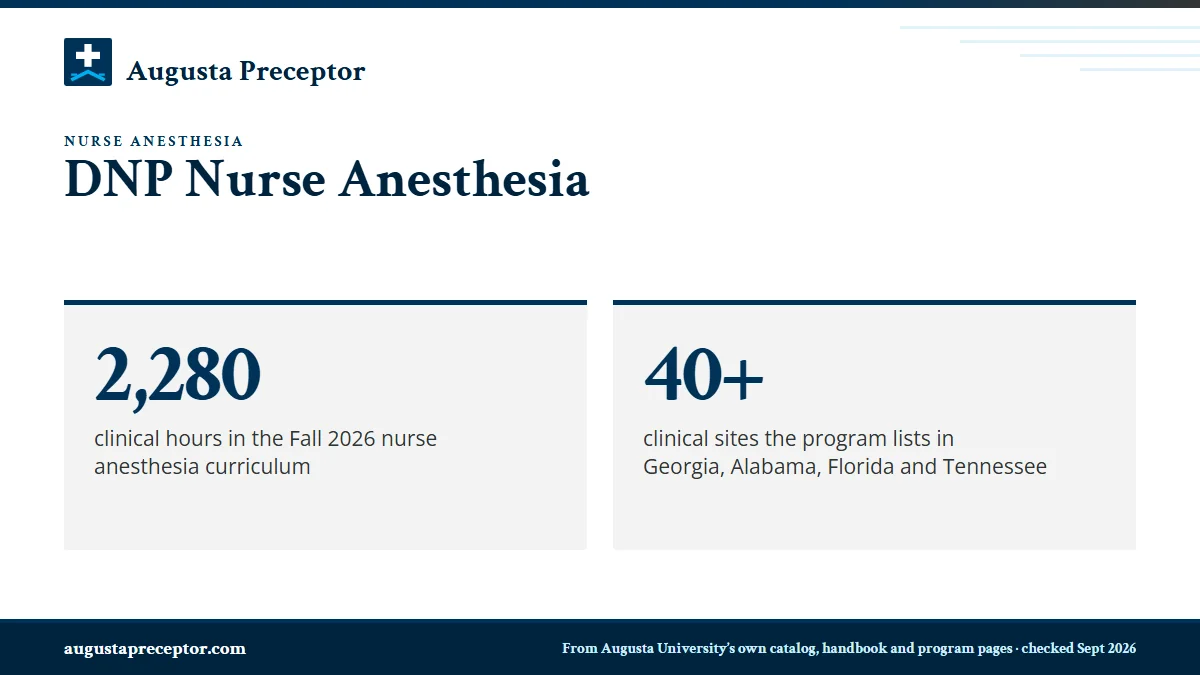
Augusta University's Nurse Anesthesia Program is a full-time, three-year DNP of nine semesters, and its clinical training runs through the program's own clinical sites, more than 40 of them across Georgia, Alabama, Florida and Tennessee. The Fall 2026 curriculum sets 2,280 clinical hours in four practica, taught alongside certified registered nurse anesthetists and anesthesiologists. For anesthesia students, the planning that pays off most is compliance, licensing and the DNP Project.
Plan your anesthesia program years
Tell us your cohort year and where you live. Your placement advisor replies with a planning outline for compliance, licensing and your DNP Project.
The program at a glance
The Nurse Anesthesia Program, known as NAP, replaced Augusta University's master's-level CRNA program in 2016. It runs full time for three years, nine semesters in all, mixing campus and online instruction, and it admits one cohort each fall; the program page describes cohorts of 60 students. Applications for Fall 2027 were open from August 7 to September 21, 2026.
Applicants need at least one year of full-time critical care nursing experience completed within the past three years, according to the program's FAQ. Like the nurse practitioner concentrations, NAP admits both post-baccalaureate and post-master's students.
The credit count depends on the source. The 2026-2027 catalog and the Fall 2026 curriculum both total 113 credits, while the program page says 112. Plan on the curriculum's 113 and check your own plan of study against it.
Four practica, 2,280 clinical hours
Clinical training comes in four practica across the last four semesters, each worth eight or ten credits. Unlike the pass or fail practica in the NP tracks, the catalog grades these with standard letter grades, and each later practicum requires a B or better in the one before it.
| Course | Term | Clinical hours | Credits |
|---|---|---|---|
NURS 7837 Nursing Anesthesia Clinical Practicum I | Summer, year 2 | 480 | 8 |
NURS 8363 Nursing Anesthesia Clinical Practicum II | Fall, year 3 | 600 | 10 |
NURS 9195 Nursing Anesthesia Specialty Practicum I | Spring, year 3 | 600 | 10 |
NURS 9196 Nursing Anesthesia Specialty Practicum II | Summer, year 3 | 600 | 10 |
| Total | Four terms | 2,280 | 38 |
The hour figures conflict too. The Fall 2026 curriculum and the catalog's program total both say 2,280 clinical hours, while the program page and one catalog sentence describe more than 800 anesthetics over at least 2,000 clinical hours. Read 2,000 as a floor and 2,280 as the current plan. On top of those come 315 lab hours, 360 DNP residency hours and three one-credit synthesis courses, NURS 9197, NURS 9198 and NURS 9199, in the final year.
The catalog still lists NURS 8364, a third clinical practicum, and NURS 9194, a rural anesthesia practicum, yet neither appears in the 2026-2027 requirements or the Fall 2026 curriculum. An older curriculum is also still linked from the program page, so work from the one for classes entering Fall 2026 and after. The clinical hours planner sets these totals beside Augusta University's other programs.
Clinical sites in four states, taught by anesthesia providers
The program lists over 40 clinical sites in Georgia, Alabama, Florida and Tennessee. The catalog says practicum experiences take place in collaboration with a certified registered nurse anesthetist, an anesthesiologist or both. That model differs from the NP concentrations: Augusta University's Georgia or South Carolina residence sentence names the NP tracks and certificates, not nurse anesthesia.
Four states make licensing a real planning item. College of Nursing policy CON16 says a multistate compact RN license may be needed for graduate clinical rotations or agency requirements, and all four of these states have implemented the Nurse Licensure Compact, according to NCSBN's implementation table. The RN license guide explains how the compact works. Under policy CON14, travel to clinical agencies and any overnight lodging are the student's cost.
State law also shapes what an anesthesia student may do before certification. Policy CON20 points anesthesia students to the Georgia Board of Nursing rule against practicing as an advanced practice nurse before Board authorization; until you are certified and authorized, you work only in the student role.
Compliance that travels with you
Rotating through many clinical sites multiplies compliance work, and Augusta University's policies spell out what that means for anesthesia students.
- Repeat criminal background checks and drug screens throughout the program, each at the student's expense, because DNP and NAP students move through several clinical agencies (CON12).
- In-person American Heart Association BLS, plus ACLS and PALS for anesthesia students, with no grace period for a lapsed certification (CON16).
- Additional liability insurance bought in the second year, and an anatomy lab fee (CON14).
- Clinical agency documents signed before each rotation, plus any added requirements a site sets, at the student's expense (CON16).
- Immunizations recorded on the College's clinical form, including annual influenza vaccine and TB testing.
The compliance requirements guide covers the deadlines and the places where Augusta University's sources disagree on them.
The DNP residency and project
Anesthesia students complete the same 360 DNP residency hours as the BSN to DNP nurse practitioner tracks, logged in the College of Nursing tracking system that students pay to access. The residency sits inside the project courses and leads to a DNP Project carried out at a practice site, with a faculty advisor and a partner from that site on your team. The handbook says its project team guidelines draw on COA principles as well as AACN's.
With 2,280 clinical hours already on the calendar, the residency is easy to push to the side. Settling on a project topic and a site early keeps the final year from stacking up, since NURS 9195 and NURS 9196 each carry 600 clinical hours. The DNP residency hours guide explains how residency hours are counted and logged.
Accreditation and reported outcomes
The Council on Accreditation of Nurse Anesthesia Educational Programs lists the program with a decision of continued accreditation, a last review on October 11, 2023 and its next review on October 11, 2033. The College of Nursing's About page still shows an older COA date, so rely on COA's own listing. CCNE accredits the DNP program as a whole.
Augusta University reports its outcomes in two versions. The program page says 86 percent of graduates passed the certification exam on the first attempt, against a national average of 83 percent, with a 100 percent overall pass rate and 100 percent employed within six months. The catalog reports a 100 percent overall pass rate and a first-time rate above 90 percent. The accreditation guide sets these beside the other programs.
Where our planning help fits
The program's clinical sites carry the anesthesia practica, so what we offer nurse anesthesia students is planning. It is the same close reading of Augusta University's rules we bring to nurse practitioner students, aimed at the parts of the program outside the operating room.
- A compliance calendar built around your four practica, so BLS, ACLS, PALS, screenings and site documents stay current between rotations.
- License and travel planning for rotations in Georgia, Alabama, Florida and Tennessee.
- Help framing your DNP Project and finding a practice site and partner for it, whatever role your program plays in that choice.
- Support keeping residency logs complete in the College of Nursing tracking system.
If that would help, tell us your cohort year through the placement request form.
Questions Augusta University students ask
Do Augusta University nurse anesthesia students have to live in Georgia or South Carolina?
The residence sentence on the DNP overview page names the four NP concentrations and the post-graduate certificates, not nurse anesthesia. The program's clinical sites span Georgia, Alabama, Florida and Tennessee. Ask the program where students are expected to live during the clinical years, especially for rotations far from the Augusta campus.
How many anesthetics do Augusta University anesthesia students give?
Augusta University says students administer, on average, more than 800 anesthetics over at least 2,000 clinical hours. It does not publish a breakdown by case type or by practicum. Ask the program for its current case log expectations early, so you can see how each practicum builds toward them.
Can I work during Augusta University's nurse anesthesia program?
Augusta University does not publish a work rule written only for anesthesia students. College of Nursing policy CON20 bars nursing students from working in the eight hours before any clinical. With 480 to 600 clinical hours a term in the final four semesters, plan your finances around that load before the practica begin.
Where are Augusta University's nurse anesthesia clinical sites?
The program page gives the number and the states, more than 40 sites across Georgia, Alabama, Florida and Tennessee, but not a list of names. Ask the program for the current site list and for how rotations are sequenced, and plan housing and licensing with those states in mind.
How does the nurse anesthesia DNP differ from Augusta University's NP tracks?
It has 2,280 clinical hours against 840 in each NP track, letter-graded practica instead of pass or fail, clinical sites in four states rather than a Georgia or South Carolina residence rule, and preceptors who are CRNAs or anesthesiologists. It also asks for a year of critical care experience before admission.
Related pages
Last checked 2026-09-27
We check these pages against Augusta University's own catalog, program plans, DNP handbook and program pages, and Georgia and South Carolina rules. Your course faculty and the College of Nursing have the final word.
Whatever your program arranges, we find the preceptor who fits.
Tell us your Augusta University track, where in Georgia or South Carolina you live and when your next clinical course starts. We find preceptors near you who fit the course and Augusta University's rules, and hand you everything your faculty and the site need, well before the semester.
- Adult, pediatric and older-adult preceptors for
NURS 8312toNURS 8318, acute care forNURS 8332toNURS 8338 - Pediatric primary care for the PNP courses and psychiatric preceptors for
NURS 8342toNURS 8348 - Across Georgia and South Carolina, from the CSRA to Savannah, Atlanta and Columbia
Start your placement plan
Program, city and start date is all we need to begin.