Doing Augusta University clinicals where you work
Augusta University does not publish a rule on whether nurse practitioner students may complete clinical hours at their own employer, on their own unit or with their own supervisor. The question belongs to your course faculty, and it is worth asking before you build a semester around your job. What is published is a firm rule about working right before clinical, and several Georgia and South Carolina systems openly favor their own staff.
Get your placement plan
Tell us your Augusta University program and where you live. A placement advisor replies with preceptor and site options in your community that fit your Augusta University course.
What Augusta University publishes, and what it leaves open
No public Augusta University page, policy or handbook addresses NP clinicals at a student's workplace. The College of Nursing's student policies, the DNP program pages and the fall 2026 DNP handbook say nothing about using your employer as a clinical site, training on your own unit, having a coworker or manager as your preceptor, or counting time during a paid shift.
What is published touches your job at the edges. The College's CON20 policy bars students from working in the eight hours before any clinical. The fees policy (CON14) makes travel to and from clinical agencies your cost. The residence rule on the DNP pages exists so that instructors can visit you, your preceptor and your clinical site, and nothing on those pages exempts a workplace site from those visits.
The eight-hour rule catches working nurses most often. Under CON20 you may not work in the eight hours before a clinical, so a night shift that ends at 7 a.m. rules out a clinical starting before 3 p.m. that day, even in the same building.
Why a workplace clinical appeals, and where it gets complicated
The pull is easy to understand. You know the building, the schedule and the people, the commute is already part of your week, and the organization may have screened you as an employee. For some students it looks like the only way to fit 180 or 240 clinical hours into a term alongside a full-time job.
The complications are about roles, not geography. Clinical hours are student time spent meeting a course's objectives, and faculty need to see that clearly on their visit and in your records. A preceptor who also writes your performance review, patients who know you as their nurse, and the habit of picking up RN tasks mid-shift can all blur that line. None of this is an Augusta University rule; it is why the conversation with faculty matters before anything is booked.
What to ask your course faculty
Frame the conversation around specifics. A general question gets a general answer; a named site, unit and preceptor gets one you can plan on.
- May my clinical site be my current employer, and does it matter whether it is my own facility or a different clinic in the same system?
- May I train on the unit where I work as an RN?
- May a colleague, my direct supervisor or my manager serve as my preceptor?
- Can clinical hours overlap with paid time, or must they be kept entirely separate from my job?
- If my employer runs its own student process, which steps and dates apply, and what does the College need from me?
- How does the CON20 eight-hour rule apply to my usual rotation of shifts?
Keep the answers in an email thread with your faculty so they are on record when the semester begins, and check again if your job or your unit changes mid-program.
Systems that favor their own employees
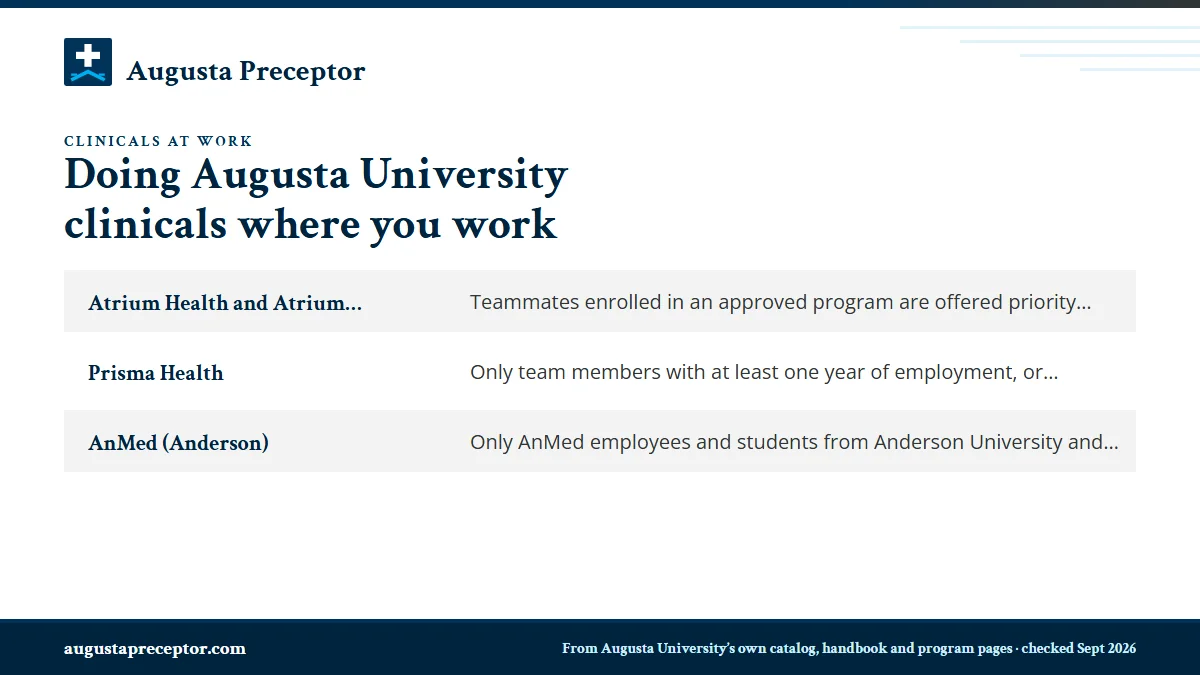
Three systems in our research put their own staff first. At these, being an employee can decide whether you are eligible at all, though it does not replace the school-level agreement each still expects.
| System | What its page says | Page status |
|---|---|---|
| Atrium Health and Atrium Health Floyd | Teammates enrolled in an approved program are offered priority placement | Floyd page read September 2026; central page archived February 2026 |
| Prisma Health | Only team members with at least one year of employment, or graduate nursing students from Clemson University or the University of South Carolina, are considered; the student must attend a Prisma-affiliated school | Archived copy, August 2025 |
| AnMed (Anderson) | Only AnMed employees and students from Anderson University and Clemson University are considered | Archived copy, April 2026 |
At Prisma, employment is only half the test. The same archived page reserves new school contracts for a specific workforce need, so a Prisma nurse whose school lacks a contract may still be turned away. The clinical agreements guide covers that side of the question.
Employees still go through student onboarding
Elsewhere, being on staff changes little about clearance. Wellstar's ACEMAPP pages say team members rotating as students must meet every student requirement, including a background check and drug screen through Advantage Students, and may not use employee access; since May 2025 its application asks whether you currently work for Wellstar. Piedmont has employee students apply for an employee designation in ACEMAPP. Northeast Georgia Health System requires ACEMAPP of employee students, with the background check and drug screen waived. Archbold employees complete the same student onboarding as anyone else.
Emory points its own staff who are returning to school to an internal page, and Northside reviews requests from employees involving their home unit case by case, according to its student page. The practical upshot: plan for full student clearance even at your own employer, since only some systems waive parts of it for staff. The compliance guide covers the College's side.
If faculty approve your workplace
Treat the approval as the start of a student arrangement, not an extension of your job. Agree on clinical days in advance with your preceptor and your manager, and keep them off the staffing grid so you are never pulled to cover a shift. Make sure the preceptor has the course objectives before day one, and that faculty have the site details they need to schedule a visit.
Keep your own dated record of every clinical shift, separate from your timesheet, and enter hours in the College's system as you go; the tracking system guide explains what Augusta University publishes about it. If the arrangement starts to slip, with shifts cancelled for staffing or tasks drifting back toward RN work, raise it with faculty early rather than at the final evaluation.
When your workplace is not the answer
Sometimes an employer simply cannot host you: the specialty does not match the course, the system limits student slots, or the roles are too tangled. Whether or not your program has a hand in placement, we find a preceptor near home who fits your Augusta University course and works around your job.
The placement desk plans clinical days that respect the eight-hour rule, matches the preceptor to the population your course covers, from adults in NURS 8312 to the final NURS 9192 practicum, and keeps a backup option in view in case a site changes course. Tell us your course and schedule, or read how we search.
Questions Augusta University students ask
Can I do my Augusta University NP clinical hours at my job?
Augusta University does not publish a rule for or against it. Ask your course faculty before you plan around your workplace, and ask specifically about your own unit, your own supervisor and paid time, since those details are the most likely to change the answer. Get the reply in writing.
Can my manager be my preceptor?
No Augusta University page addresses it. When the person judging your clinical performance also reviews your job performance, the two roles can blur, so expect faculty to look closely at that arrangement. That is a practical concern rather than a published rule; bring your manager's credentials and ask your course faculty directly.
Do paid work hours count as clinical hours?
Augusta University does not say. Its program plans convert each clinical credit into 60 clock hours, four a week over a 15-week term, and say nothing about paid time. Whether any clinical time may overlap with a paid shift is a question for your course faculty, best settled before the term starts.
Can I work a night shift before a clinical day?
Only if it ends at least eight hours before your clinical begins. The College of Nursing's CON20 policy prohibits working in the eight hours preceding any clinical, which rules out the common pattern of going straight from a night shift to a morning clinical, even at the same hospital.
Does working for Prisma Health help me get a Prisma clinical?
It can open the door. Prisma's graduate placement page, as archived in August 2025, considers team members once they have a year of service, yet it also insists on enrollment at a school Prisma is already affiliated with and holds new school contracts to cases of workforce need. Ask your course faculty how that applies to you before counting on it.
Related pages
Last checked 2026-09-27
We check these pages against Augusta University's own catalog, program plans, DNP handbook and program pages, and Georgia and South Carolina rules. Your course faculty and the College of Nursing have the final word.
Whatever your program arranges, we find the preceptor who fits.
Tell us your Augusta University track, where in Georgia or South Carolina you live and when your next clinical course starts. We find preceptors near you who fit the course and Augusta University's rules, and hand you everything your faculty and the site need, well before the semester.
- Adult, pediatric and older-adult preceptors for
NURS 8312toNURS 8318, acute care forNURS 8332toNURS 8338 - Pediatric primary care for the PNP courses and psychiatric preceptors for
NURS 8342toNURS 8348 - Across Georgia and South Carolina, from the CSRA to Savannah, Atlanta and Columbia
Start your placement plan
Program, city and start date is all we need to begin.