Who does what: College of Nursing roles around your clinical courses
Your course faculty run each clinical course, the DNP Project team guides the residency, and coordinators, advisors and program managers keep your plan of study moving. The College of Nursing directory also lists a Clinical Placement Coordinator and an APRN Clinical Coordinator, but their duties are not published, so this guide names each role by title and says what to ask it.
Add a placement advisor to your team
Tell us your track and next clinical course, and your placement advisor will search Georgia and South Carolina for a preceptor who fits it.
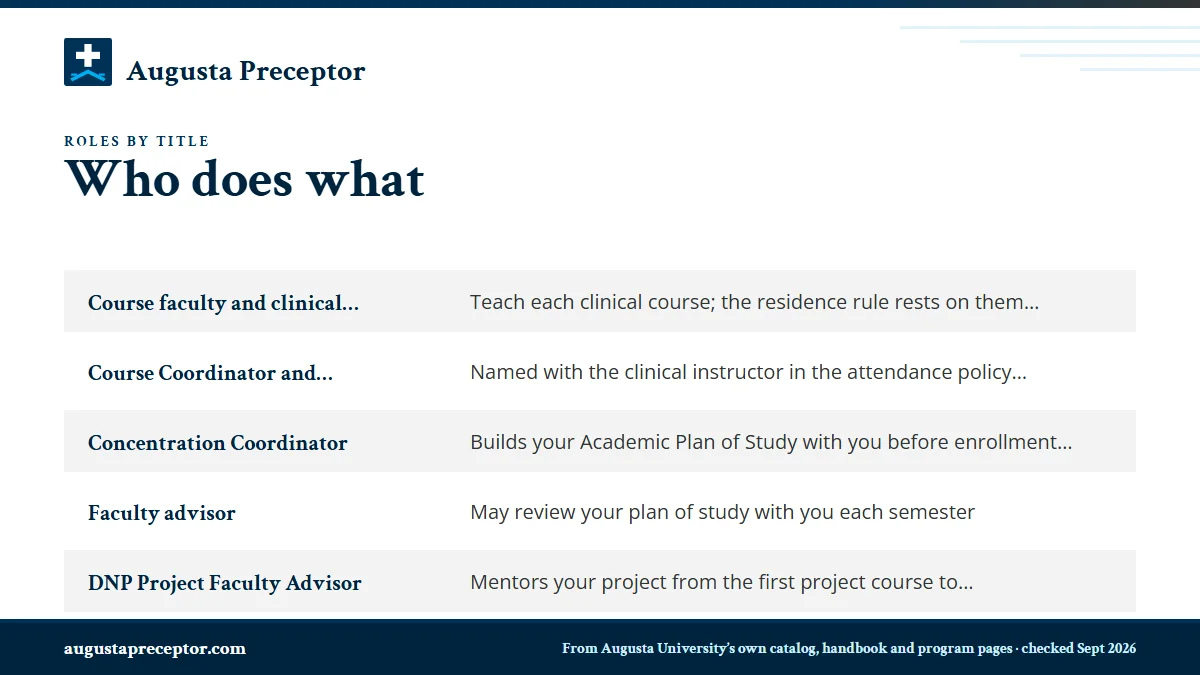
The roles at a glance
Titles below come from Augusta University's College of Nursing directory, the DNP handbook revised for fall 2026, College of Nursing policies and Graduate School pages. Names change often, so this guide uses titles only; the directory on augusta.edu shows who holds each role today.
| Role | What Augusta University publishes | What to ask |
|---|---|---|
| Course faculty and clinical instructors | Teach each clinical course; the residence rule rests on them visiting you, your preceptor and your site; absence notices go to them | Preceptor and site fit, the visit plan, the evaluation tool, weekly hours |
| Course Coordinator and Program Director | Named with the clinical instructor in the attendance policy, CON23 | Make-up days and course-level decisions |
| Concentration Coordinator | Builds your Academic Plan of Study with you before enrollment; runs the gap analysis for post-master's hours | Plan changes, part-time timing, credit for prior hours |
| Faculty advisor | May review your plan of study with you each semester | Progress, course order, workload |
| DNP Project Faculty Advisor | Mentors your project from the first project course to dissemination; faculty of record for the IRB; reviews residency logs | Project site, timeline, residency hours |
| DNP Project Site Partner or Sponsor | Works at the project site; handles permissions and site policy; does not grade | Letters, approvals, site rules |
| Program managers | Keep every version of your plan of study on file; provide the hours verification form; help schedule project meetings | Records, forms, scheduling |
| Clinical Placement Coordinator | Listed in the College of Nursing directory; duties not published | Ask course faculty whether this office has a role in your course |
| APRN Clinical Coordinator | A professor in the DNP Department, per the directory; duties not published | Same: ask course faculty first |
| Track Directors | One each for AGACNP, FNP, PNP, PMHNP, Post-Masters Traditional and Nurse Executive; duties not described | Track-level questions faculty route upward |
| The Graduate School | Awards the DNP; runs admissions, orientation and defense requirements, time limits and graduation | Admission documents, time limits, graduation steps |
| Student Health Services | Collects immunization records through its Medicat Connect portal | Immunization status and deadlines |
Course faculty: the first stop for anything clinical
For nearly every clinical question, start with the faculty member teaching your clinical course. Instructor visits to you, your preceptor and your site are the whole reason for the residence rule. Policy CON31 records your performance on the course's own evaluation tools, and CON23 has you notify your clinical instructor and the site's designated clinical contact before any absence. A missed day may need a full make-up day, and the same policy names the Course Coordinator and Program Director in its attendance chain.
Faculty are also the source for what the university leaves unpublished: preceptor qualifications, forms, approval steps and deadlines for NP courses. Put your questions in writing during the term before the course, keep the replies, and share the parts that affect your preceptor. The placement process guide lists every published step so your questions can start where the public record ends.
The DNP Project team and your residency hours
Every DNP student completes a DNP Project and residency hours through the project courses, from NURS 7150 and NURS 8550 on to NURS 9050, NURS 9060, NURS 9061 and finally NURS 9062. The handbook defines a project team of three: you, a faculty member serving as advisor, plus a practice partner or sponsor who works where the project takes place.
The DNP Project Faculty Advisor is a doctorally prepared College of Nursing faculty member with a Graduate School appointment. The handbook gives this person the mentoring role from proposal to dissemination, the faculty-of-record role for IRB applications, and review of your residency log entries; only entries marked accepted count. Bi-weekly team meetings are the expected rhythm, set up with help from your program manager.
The site partner holds a job at the site with enough standing to judge project priority and resources. No particular credential is required, and the partner grades nothing; the job is to help with permissions, letters and site policy. The residency hours guide covers the 360 and 540 hour totals.
Two coordinator titles with unpublished duties
The College of Nursing directory lists a Clinical Placement Coordinator, with no department or duties shown, and an APRN Clinical Coordinator, a professor in the Doctor of Nursing Practice Department. The augusta.edu pages checked in September 2026 describe neither role's work.
A title tells you an office exists, not what it handles for NP clinicals. Rather than building a plan around what either role might do, ask your course faculty whether and when to be in touch with either office for your course, and follow the route they give you.
The common mistake: reading a job title as a job description. Before you email any coordinator about a preceptor or a site, ask your course faculty who handles that step for your course, then act on their answer.
Plans of study, advisors and program managers
Your Academic Plan of Study is drafted before enrollment by the Concentration Coordinator together with you, and both of you sign it. Each semester the Concentration Coordinator or your faculty advisor reviews it with you and revises it if something changes, such as a move from full-time to part-time study. For post-master's students, the Concentration Coordinator also runs the gap analysis that credits earlier hours toward the 1,000-hour DNP requirement; a current NP certification counts for only 500.
Program managers keep the original plan and every revision in your electronic folder. They supply the Verification of Post-BSN Clinical and Practice Hours form that your earlier program director completes, and they help set dates for project meetings and presentations. The handbook lists separate program managers for the DNP tracks and for Nurse Anesthesia.
The Graduate School and campus offices
The DNP is awarded through the Augusta University Graduate School. It runs admissions after NursingCAS verification, requires both the orientation and the defense to be face-to-face, and sends background check and drug screen instructions through the applicant portal. Its Graduate Student Handbook sets a six-year limit for the DNP with NP concentrations and a 2.8 GPA floor, while College of Nursing policy CON01D asks for 3.0, so plan to the College's higher bar.
Student Health Services takes immunization records through its Medicat Connect portal. The College of Nursing's Student Affairs office receives background check and drug screen results, and a new criminal conviction must be reported within 30 days. For the portals, library and support services around all of this, see online student tools and library and academic support.
Where your placement advisor fits
Your placement advisor from our desk works alongside every role above. Whatever role your program plays in placement, we find a preceptor and site within Georgia or South Carolina matched to your course, then prepare the items your course faculty and the site request, so each person in the chain receives complete, early paperwork.
When faculty set a requirement, we build it into the search from that day forward, and we keep a running record of what each course and site has asked for, so nothing needs explaining twice between Practice I and NURS 9192. How it works walks through each stage, and the form below starts your request.
Questions Augusta University students ask
Who do I contact first if my preceptor cancels a shift?
Your clinical instructor and the site's designated clinical contact, before the shift starts, as policy CON23 requires when you will miss clinical time. If the preceptor is leaving the course altogether, tell your course faculty at once, because the course and its evaluation are theirs. If you work with us, your placement advisor starts a replacement search for a preceptor who fits the same course.
Who approves my preceptor for an Augusta University NP course?
Augusta University does not publish a preceptor approval step or say who signs off. In the handbook's residency section, preceptor and mentor orientation is listed among faculty duties, and course faculty oversee each clinical course. Ask your course faculty what they need to see about a preceptor, in what form, and by what date.
Is my faculty advisor the same person as my DNP Project Faculty Advisor?
The handbook uses both terms: a faculty advisor who may review your Academic Plan of Study each semester, and a DNP Project Faculty Advisor who mentors your project from the first project course through dissemination. It does not say whether one person holds both roles for a given student, so ask at orientation.
Who can tell me the MEGAI dates?
MEGAI dates and length are not published. MEGAI is the multi-day campus intensive for FNP, AGACNP and PNP students, so ask your course faculty or the DNP program office early enough to arrange time off and travel. The MEGAI guide covers what the intensive includes.
Related pages
Last checked 2026-09-27
We check these pages against Augusta University's own catalog, program plans, DNP handbook and program pages, and Georgia and South Carolina rules. Your course faculty and the College of Nursing have the final word.
Whatever your program arranges, we find the preceptor who fits.
Tell us your Augusta University track, where in Georgia or South Carolina you live and when your next clinical course starts. We find preceptors near you who fit the course and Augusta University's rules, and hand you everything your faculty and the site need, well before the semester.
- Adult, pediatric and older-adult preceptors for
NURS 8312toNURS 8318, acute care forNURS 8332toNURS 8338 - Pediatric primary care for the PNP courses and psychiatric preceptors for
NURS 8342toNURS 8348 - Across Georgia and South Carolina, from the CSRA to Savannah, Atlanta and Columbia
Start your placement plan
Program, city and start date is all we need to begin.